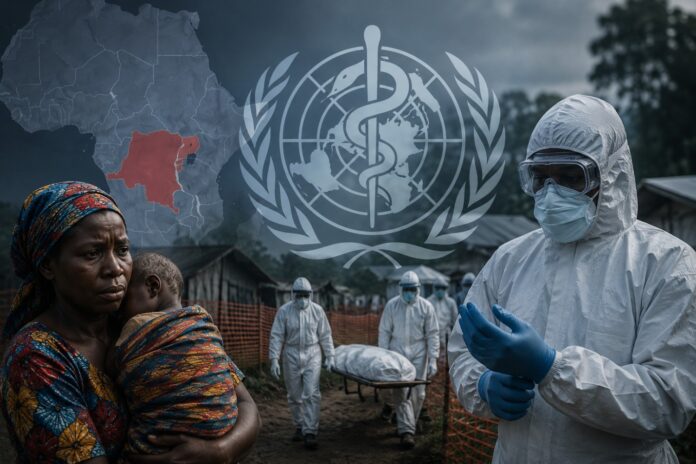
An Ebola outbreak in north-eastern Democratic Republic of Congo is entering a more dangerous and expansive phase than health authorities initially feared, after the virus reached a crowded displacement camp in Ituri province. This raised alarm among aid workers and international health officials who warn that containment is falling dangerously short of what is needed.
The United Nations refugee agency confirmed the first Ebola-related deaths at the Kpanga displacement camp, where cramped living conditions with hundreds of people sharing a single toilet have raised fears of rapid contagion. The deaths, according to an aid worker, occurred on May 31 and June 1, just days after the outbreak was formally declared on May 15.
Since the declaration of the outbreak, 676 confirmed Ebola cases have been recorded, including 136 deaths, across Ituri, North Kivu and South Kivu provinces, according to figures released by the World Health Organization (WHO). Only 32 patients have recovered, and a further 119 suspected cases remain under investigation. The WHO said the Ebola strain responsible is the rare Bundibugyo variety, for which no approved vaccines or treatments currently exist.
Olivier le Polain, the WHO’s head of epidemiology and analytics, delivered a stark warning on Friday, saying that new Ebola cases were being identified in previously unaffected health zones on an almost daily basis. “That reflects really the scale of this outbreak: a scale that is much bigger than what is being detected, and the high mobility of the population,” he said, noting the disease has now begun spreading locally in newly affected communities rather than simply being imported by travellers from known hotspots.
Le Polain acknowledged significant gaps in the response. Contact tracing, while improving, remains too limited to bring the epidemic under control, and isolation bed capacity is far below the level needed given the pace at which the virus is moving. “There are still many blind spots in some areas that are high risk,” he said. “The full scale of the outbreak is not yet clear and we’ll get more clarity as surveillance improves.” Without sufficient safe spaces to isolate patients, he warned, scaling up surveillance alone would not be enough to curb transmission.
For humanitarian workers on the ground, the arrival of Ebola in displacement camps represents one of the most feared scenarios. Caitlin Brady, country director for the Danish Refugee Council in Congo, described the profound anxiety spreading among aid organisations. “We are all really worried that Ebola in these camps will spread extremely quickly and that there will be panic and people will flee all over whether or not they’re contacts, whether or not they’re ill,” she told Reuters.
The wider context in eastern Congo has long complicated disease response efforts. Decades of armed conflict have left infrastructure severely degraded, and the government lacks full control over large swathes of territory where rebel groups compete for dominance over the region’s mineral wealth. Hundreds of thousands of civilians have been displaced by the violence, creating the very overcrowded camps that now risk becoming epicentres of Ebola transmission. Health workers attempting to trace contacts and set up isolation facilities have at times faced hostility and attacks, further undermining the response.
The spread of the disease has also alarmed neighbouring Uganda, which has confirmed 19 cases and two deaths linked to the outbreak. The African Union’s health agency recently reported that Uganda appears to have the situation under control, though international health officials have urged continued vigilance given the porous nature of the border and the high mobility of populations in the region.


As the Ebola crisis deepens in the DRC, the WHO and its partners face a race against time to mobilise resources, expand surveillance, and prevent a localised epidemic from becoming a far broader humanitarian catastrophe.