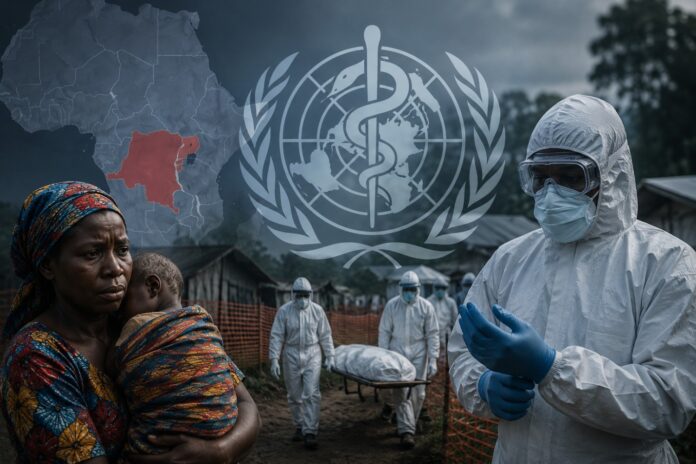
The Democratic Republic of Congo’s Ebola outbreak has crossed a grim new threshold, with confirmed infections rising above 4,000 for the first time since the epidemic was declared, according to government data released this week. Health officials say the milestone confirms what many on the ground have feared for months: that this Ebola outbreak is spreading faster than any recorded episode of the disease apart from the catastrophic West African epidemic of 2014 to 2016.
Congo’s public health institute said in its latest report that the total number of Ebola infections had reached 4,053, including 1,850 deaths. The figures place the current Ebola outbreak as the world’s second-largest since the virus was first identified, trailing only the West African crisis that killed more than 11,000 people across Guinea, Liberia and Sierra Leone, out of over 28,000 recorded cases.
Cases have now been confirmed in five provinces of the vast Central African nation: Ituri, North Kivu, South Kivu, Haut-Uele and Tshopo. The geographic spread illustrates how difficult it has become to contain the Ebola virus in a region already strained by armed conflict, mass displacement and a fragile health system. Aid workers say the combination of insecurity and porous borders between provinces has allowed the disease to move faster than response teams can track it.
The outbreak was officially declared on May 15, but mounting evidence suggests the Ebola virus had been circulating undetected for months beforehand. A study published in the journal Science last month concluded that the outbreak likely began in January, or possibly earlier, in the Ituri region. Researchers identified more than 500 suspected cases between mid-January and May 15, indicating that Ebola was silently spreading through communities long before authorities sounded the alarm.
Experts caution that the official case count of just over 4,000 may still understate the true scale of the crisis. Delayed detection, overwhelmed surveillance systems, ongoing military conflict in the east of the country, and a shortage of vaccines and treatments effective against the particular strain of the virus involved have all hampered the response. The outbreak involves the Bundibugyo species of the Ebola virus, for which existing vaccines developed for other strains offer only limited protection, complicating efforts to slow transmission.
Health authorities are also investigating whether the virus itself may be mutating in ways that could affect its transmissibility, according to officials cited in recent reporting. Such questions add urgency to an already stretched response, as international health agencies work alongside Congolese officials to scale up testing, contact tracing and community engagement in affected provinces. Burial teams in protective equipment have become a familiar sight in towns like Bunia, where safe burial practices are considered critical to breaking chains of transmission.
The scale of the crisis has drawn comparisons to the 2014-16 West African epidemic, which remains the deadliest Ebola outbreak on record and reshaped how the world responds to the disease. While the current outbreak has not yet approached that death toll, its speed has alarmed epidemiologists, some of whom describe it as the fastest-spreading Ebola outbreak ever documented. That pace, combined with the difficulty of operating in conflict-affected areas, has made this one of the most challenging Ebola responses in years.


For now, Congolese health officials say they remain focused on expanding vaccination campaigns, improving surveillance in remote areas, and securing additional international support to bring the outbreak under control. With case numbers still climbing and the true extent of transmission uncertain, health workers warn that the coming weeks will be critical in determining whether this Ebola outbreak can be brought to heel before it grows even larger.