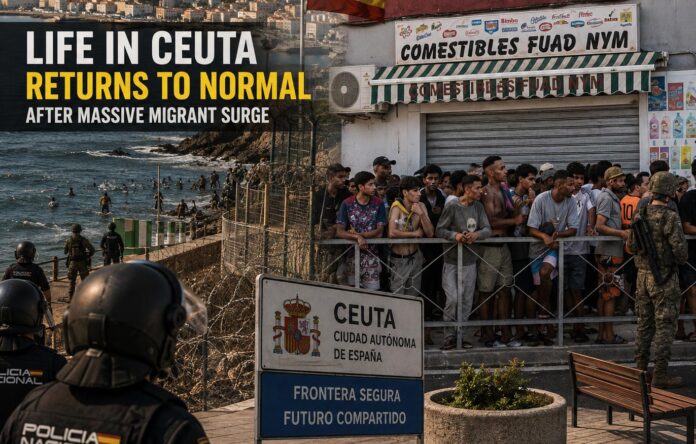
Life in Spain’s North African enclave of Ceuta is gradually returning to normal after the Ceuta migrant surge that saw tens of thousands of people cross from neighboring Morocco within just a few days. Spanish authorities say the emergency situation has largely been brought under control, although the event has reignited debate across Europe over border security, migration policy, and humanitarian responsibilities.
Officials estimate that around 60,000 migrants entered Ceuta during the unprecedented influx. However, by the weekend, Spanish authorities confirmed that nearly all of those who had crossed had already returned to Morocco or been sent back through coordinated border operations.
The sudden movement of people placed enormous pressure on local services and security forces while drawing attention from governments across the European Union.
Ceuta Migrant Surge Triggers Massive Security Response
Spanish police and military personnel remained heavily deployed across Ceuta as efforts continued to restore order along the border. Security forces monitored coastal routes where many migrants had entered by swimming around the border barrier extending into the Mediterranean Sea.
Authorities ensured that anyone attempting to remain inside the enclave without authorization was escorted back toward the Moroccan side of the border. New temporary security infrastructure was also installed near the main crossing point, including an inflatable barrier designed to strengthen border protection and discourage further mass crossings.
Spain’s Interior Ministry said the crisis has been largely contained, describing the situation as having returned close to normal after days of intensive operations.
The humanitarian cost of the Ceuta migrant surge remains significant. Spanish officials confirmed that at least 67 people lost their lives while attempting the dangerous journey across the water, highlighting the risks many migrants were willing to take in pursuit of a better future.
Many of those who reached Ceuta explained that poverty, unemployment, and limited opportunities in their home countries had pushed them to make the dangerous crossing. Several migrants from sub Saharan Africa expressed hope of eventually reaching mainland Europe to find work and support their families.
Others said personal reasons motivated their journey. One Moroccan man explained that he hoped to reunite with his seriously ill mother living in Spain after years of struggling with low wages and limited prospects at home.
European Leaders Respond to the Ceuta Migrant Surge
The Ceuta migrant surge quickly became a major political issue across Europe, prompting urgent discussions among European Union member states about strengthening the bloc’s external borders.
Several governments called for immediate coordination among interior ministers to develop a common strategy for managing similar migration emergencies in the future. European leaders stressed that protecting the Union’s external borders should remain a shared responsibility rather than the burden of individual member states.
Italy temporarily suspended visa free travel arrangements with Spain under the Schengen framework for one month as a precautionary measure following the sudden influx.
Spanish Prime Minister Pedro Sánchez criticized what he described as a lack of solidarity from some European partners, urging greater cooperation instead of unilateral measures. European Commission President Ursula von der Leyen also emphasized the importance of reviewing the crisis to strengthen Europe’s preparedness while noting that none of the migrants managed to reach mainland Spain or other European Union countries during the incident.
Meanwhile, Morocco has yet to provide a detailed public explanation for what triggered the sudden movement of thousands of people toward Ceuta.
Border officials on the Moroccan side have continued receiving returning migrants, transporting many back to their hometowns through organized bus and rail services. Authorities also reinforced security around the Fnideq border crossing and surrounding hills after disturbances involving groups of young men during the height of the crisis.
Ceuta and the nearby Spanish enclave of Melilla remain Europe’s only land borders with Africa, making them highly sensitive points for migration. Similar incidents have occurred in previous years, particularly during periods of diplomatic tension between Spain and Morocco. One of the most notable cases took place in 2021, when more than 10,000 migrants entered Ceuta within just 48 hours.
Although the immediate crisis appears to have eased, migration experts believe the underlying causes remain unresolved. Economic hardship, regional instability, and limited employment opportunities across parts of Africa continue to drive migration toward Europe. As a result, officials expect migration to remain one of the European Union’s most pressing policy challenges in the years ahead.
The Ceuta migrant surge may have subsided, but it has once again exposed the fragile balance between humanitarian responsibility, national security, and international cooperation.
While Spain has successfully restored order in Ceuta, the crisis serves as another reminder that long term solutions will require closer collaboration between European nations and neighboring countries to address both border management and the root causes of migration.