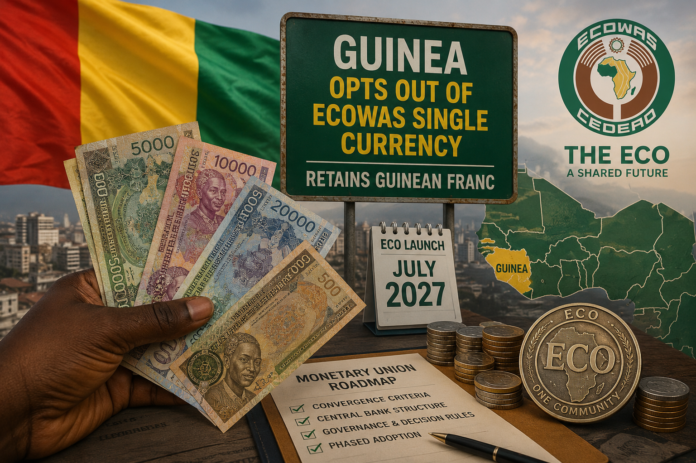
Guinea has announced it will not adopt the planned ECOWAS Eco currency, choosing instead to retain the Guinean franc as West Africa moves toward a monetary union in 2027.
Guinea has become the first member of the Economic Community of West African States to officially decline participation in the planned Eco currency, signaling a major development in the region’s long running effort to establish a single monetary system.
The announcement comes as ECOWAS continues preparations for the introduction of the Eco, a common currency expected to launch in July 2027. While regional leaders remain committed to the project, Guinea has confirmed it will continue using the Guinean franc, arguing that maintaining control over its national currency better serves its current economic priorities.
Why Guinea Rejected the ECOWAS Single Currency
The Guinea ECOWAS Single Currency decision reflects the country’s desire to preserve greater control over its monetary policy while continuing to strengthen its domestic economy.
In recent months, ECOWAS has acknowledged that not every member state is equally prepared for monetary integration. The regional bloc has therefore leaned toward a phased implementation strategy, allowing only countries that meet agreed economic benchmarks to join the first phase of the Eco.
These benchmarks include maintaining stable inflation, sustainable public debt levels, sound fiscal management, and broader macroeconomic stability.
Guinea, however, has decided that remaining outside the initial rollout is the best option for its economy.
Economic analysts believe one of the main reasons behind the move is concern that joining a monetary union before building stronger industrial and production capacity could reduce the country’s economic flexibility. Without sufficient domestic production, Guinea could face greater challenges competing within a shared currency system.
Another important factor is the country’s trade profile. Around 80 percent of Guinea’s exports are destined for Asian markets rather than neighboring West African countries. As a result, the economic benefits of adopting a regional currency may currently be less significant compared to countries whose trade is concentrated within ECOWAS.
Maintaining the Guinean franc also allows authorities to retain greater influence over exchange rate policy and other monetary tools that can help respond to changing economic conditions.
What Guinea’s Decision Means for the Eco Currency Project
Although Guinea’s decision marks the first official withdrawal from the planned monetary union, it does not necessarily threaten the broader ECOWAS vision.
Regional leaders have already indicated that the Eco will likely be introduced gradually rather than simultaneously across all member states. Countries that successfully satisfy the required convergence criteria will be able to adopt the currency first, while others can join once they are ready.
This phased approach is intended to improve the long term stability of the common currency and reduce the economic risks associated with launching a monetary union among countries with significantly different economic conditions.
ECOWAS officials are expected to meet again in December to address several outstanding issues before the planned 2027 launch. Among the key topics are the structure of the future regional central bank, governance and decision making arrangements, and determining which countries will participate in the first phase of the Eco.
Guinea’s decision highlights the practical challenges involved in creating a common currency across a diverse region. While the Eco remains a central objective for ECOWAS, member states continue to balance regional integration with their individual economic priorities.
As discussions continue, the success of the Eco project will depend not only on political commitment but also on each country’s readiness to meet the economic standards required for a sustainable monetary union.
Guinea’s decision to retain the Guinean franc marks an important moment in the evolution of the ECOWAS monetary union. While the regional bloc remains committed to launching the Eco in 2027, Guinea has chosen to prioritize monetary independence and economic flexibility.
As ECOWAS finalizes the framework for the new currency, the coming months will determine which member states are prepared to take the first step toward a shared financial future.