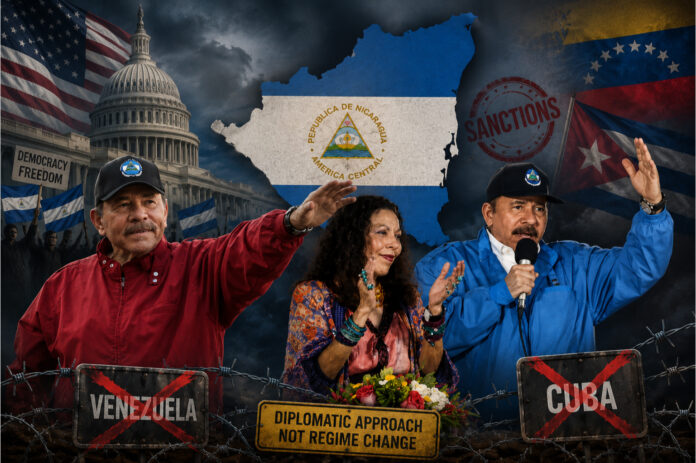
After taking aggressive action against Venezuela and increasing economic pressure on Cuba, many expected the Trump administration to turn its attention to Nicaragua. The Central American nation, led by co presidents Daniel Ortega and Rosario Murillo, has increasingly tightened its grip on power, including moves to eliminate future elections. Yet despite growing criticism from Washington, the United States has refrained from launching the kind of sweeping campaign seen against other governments in the region.
This cautious approach has sparked renewed interest in understanding the current US Policy on Nicaragua and why the White House appears to be pursuing a different strategy.
While Washington has openly challenged the governments of Venezuela and Cuba, its response toward Nicaragua has remained measured. Political analysts argue that the differences stem from both strategic and practical considerations.
Unlike Venezuela, Nicaragua does not possess the same level of oil wealth or geopolitical significance in global energy markets. At the same time, the Ortega Murillo administration has largely avoided direct confrontations with the United States, choosing instead to make limited concessions that reduce diplomatic tensions without weakening its control.
Shortly after the United States intensified actions against Venezuela, Nicaragua released dozens of political prisoners whose freedom had been requested by Washington. The government also restored visa requirements for Cuban citizens, a move widely interpreted as an effort to reduce migration toward the United States.
Although these decisions did not fundamentally change Nicaragua’s political system, they were viewed as calculated gestures aimed at easing international pressure.
Rather than pursuing direct intervention, the Trump administration has continued applying targeted sanctions against individuals linked to the Nicaraguan government.
Earlier this year, the United States imposed sanctions on two sons of President Daniel Ortega and Vice President Rosario Murillo. Secretary of State Marco Rubio has also strongly criticized Ortega’s announcement that future elections could be abolished, describing it as another setback for democracy.
Even so, Washington has stopped short of calling for regime change in Nicaragua, a position it has taken more openly toward Cuba.
Political experts believe this reflects a long term strategy focused on increasing pressure without creating instability that could trigger large migration flows or unpredictable political consequences.
Analysts say the current US Policy on Nicaragua recognizes that forcing rapid political change could produce unintended consequences.
Unlike countries experiencing severe economic crises or widespread public demonstrations, Nicaragua remains relatively stable despite international sanctions. The government has maintained control over state institutions, security forces and much of the country’s political landscape.
Without a unified domestic opposition capable of leading a transition, any external effort to remove the current leadership could create uncertainty rather than democratic reform.
For this reason, many observers believe Washington is attempting to gradually isolate the government while waiting for internal political or economic pressures to create opportunities for change.
Daniel Ortega and Rosario Murillo have ruled Nicaragua together since Murillo formally became co president in 2025. While Ortega has appeared less frequently in public due to his age, Murillo has taken on a much larger role in the day to day running of government.
Many analysts now view her as the country’s most influential political figure.
The couple has spent years consolidating authority by ensuring key institutions, including security agencies and government officials, remain loyal to their leadership. Their children have also assumed increasingly visible political responsibilities, leading to speculation that the family hopes to maintain power for years to come.
Although some observers have suggested that internal divisions could eventually emerge, there is currently little public evidence of significant fractures within the ruling establishment. One of the biggest obstacles to political change remains the fragmented state of Nicaragua’s opposition.
Opposition leaders continue advocating for democratic reforms from exile and within the country, but they have struggled to unite around a single strategy or leadership structure. Without broad coordination, experts believe it will be difficult to mount an effective political challenge against the government.
This fragmented landscape also reduces the likelihood that outside pressure alone could produce a peaceful transition.
Attention is now turning toward Nicaragua’s scheduled 2027 general elections, although Ortega has suggested elections may no longer be necessary under his government’s political model.
Some analysts believe Washington could increase diplomatic and economic pressure as that date approaches in hopes of encouraging electoral reforms. Others argue that unless major developments occur inside Nicaragua, the United States is likely to continue relying on sanctions and diplomatic isolation rather than direct intervention.
For now, the evidence suggests that the White House views gradual pressure as a more practical strategy than attempting immediate political change.
The current US Policy on Nicaragua reflects a more cautious and calculated approach than Washington has taken toward Venezuela and Cuba. While the United States continues to criticize Ortega and Murillo’s government and expand targeted sanctions, it has avoided actions that could destabilize the country or trigger wider regional consequences.
With the Ortega Murillo administration maintaining firm control and the opposition still divided, meaningful political change appears unlikely in the near future. As Nicaragua moves closer to the next scheduled election cycle, international attention will remain focused on whether increased diplomatic pressure can eventually create conditions for democratic reform.