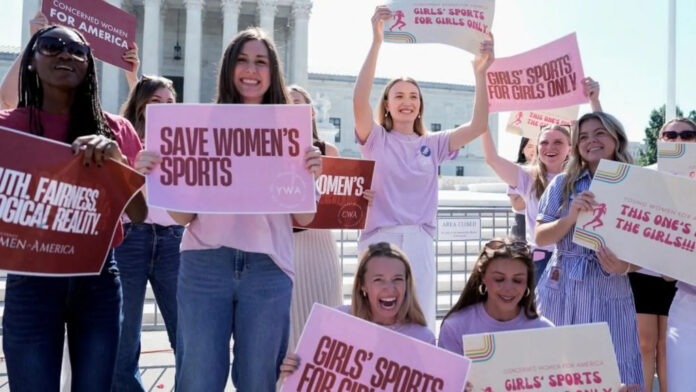
The US Supreme Court ruling on transgender athletes in women’s sports has become one of the most significant legal decisions in recent years, allowing states to prohibit transgender women from competing in female school and college sports.
The decision affects laws in Idaho and West Virginia and could influence policies across the country, as more than two dozen states have already adopted similar measures.
President Donald Trump welcomed the ruling, describing it as a major victory, while LGBTQ advocacy groups expressed disappointment and concern over its impact on transgender students.
US Supreme Court Ruling on Transgender Athletes in Women’s Sports Explained
The Supreme Court reviewed challenges brought by transgender students against laws in Idaho and West Virginia.
Both states enacted policies requiring student athletes to compete according to the sex listed on their birth records rather than their gender identity.
Those challenging the laws argued that the restrictions violated constitutional equal protection guarantees and conflicted with federal civil rights protections.
However, the court ultimately ruled that the state bans do not violate Title IX, the federal law that prohibits sex-based discrimination in educational institutions.
The ruling marks an important moment in the ongoing national conversation about fairness, inclusion, and women’s athletics.
Conservative and Liberal Justices Remained Divided
Although all nine justices agreed that Title IX does not prevent states from enforcing such bans, the court was sharply divided on constitutional issues.
The six conservative justices concluded that the state laws do not violate the Equal Protection Clause of the Fourteenth Amendment.
Meanwhile, the three liberal justices disagreed with that interpretation.
Justice Brett Kavanaugh, who authored the majority opinion, wrote that the Constitution and existing federal law do not require fundamental changes to women’s and girls’ sports programs across America.
Justice Sonia Sotomayor, in her partial dissent, argued that the ruling reflected a narrower understanding of equal protection rights in athletic participation.
Idaho Case Became a National Legal Battle
One of the cases considered by the court involved Lindsay Hecox, a transgender long-distance runner who challenged Idaho’s law shortly after it was introduced in 2020.
Lower courts had previously granted injunctions that temporarily blocked the law from taking effect.
Barbara Ehardt, the Idaho lawmaker who sponsored the legislation, maintained that the measure was designed to ensure fairness for female athletes and prevent biological males from competing against girls and women in school sports.
However, earlier appellate court decisions found that the state had not provided sufficient evidence to prove that the ban was necessary to protect equal opportunities for female competitors.
The Supreme Court’s latest ruling now settles that dispute at the national level.
West Virginia Officials Celebrate the Decision
The second case centered on Becky Pepper-Jackson, a 16-year-old transgender student from West Virginia who challenged her state’s law under constitutional equal protection arguments.
Following the ruling, West Virginia Attorney General JB McCuskey praised the decision, calling it a victory for fairness and common sense.
He stated that the judgment provides states with greater confidence to implement policies aimed at protecting opportunities and safety for female athletes.
The ruling is expected to strengthen similar laws that already exist in numerous states across the country.
LGBTQ Groups Criticize the Supreme Court Decision
Despite celebrations from supporters, advocacy organizations expressed disappointment over the outcome.
The Human Rights Campaign, one of the nation’s largest LGBTQ rights organizations, described the ruling as deeply troubling for transgender students.
The group’s president, Kelley Robinson, argued that the decision could leave many young athletes excluded from participating in sports simply because of their gender identity.
Critics of the bans maintain that transgender students deserve equal access to educational opportunities, including athletic participation, and question whether existing scientific evidence supports broad restrictions.
Trump and Republicans Made the Issue a Campaign Priority
The debate over transgender participation in women’s sports gained national attention during the 2024 presidential election campaign.
President Trump frequently discussed the issue and later signed an executive order seeking to prohibit transgender women from competing on female sports teams in schools and colleges.
Following that move, the NCAA, which governs college athletics in the United States, also introduced restrictions on transgender women participating in women’s competitions.
The Supreme Court ruling is widely viewed as reinforcing many of those policies at the state level.
Melania Trump Calls for Fairness and Respect
First Lady Melania Trump also responded to the decision, describing it as a victory for female athletes while emphasizing the importance of respecting LGBTQ communities.
In a social media statement, she said that supporting LGBTQ rights and protecting fairness in girls’ sports can exist together.
She added that both values are important and should be respected.
Her comments reflected broader efforts by some political leaders to balance support for equal rights with concerns about competitive fairness in athletics.
Scientific Debate Continues Over Competitive Advantages
Supporters of the state bans argue that biological differences provide transgender women with physical advantages in certain sports.
They point to research involving strength, endurance, and power as reasons for maintaining separate categories based on biological sex.
The International Olympic Committee recently reviewed scientific findings over an 18-month period and stated that male biology may provide performance advantages in sports that depend on strength and physical endurance.
However, opponents dispute the idea that there is a universal scientific consensus.
Many advocacy groups and researchers argue that athletic performance varies significantly between individuals and believe blanket restrictions unfairly target transgender athletes.
The debate is expected to continue despite the court’s ruling.
A Landmark Decision With Lasting Impact
The US Supreme Court ruling on transgender athletes in women’s sports represents one of the most influential legal decisions in the ongoing national discussion about sports, gender identity, and equal rights.
With more than two dozen states already enforcing similar laws, the judgment provides new legal clarity while also fueling continued debate among policymakers, educators, athletes, and advocacy groups.
As the conversation evolves, the balance between inclusion, fairness, and competitive integrity will likely remain a central issue in American public life.