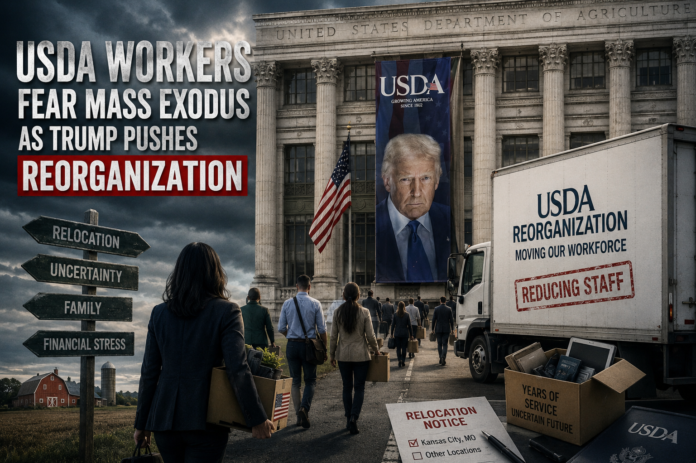
The Trump administration’s USDA reorganization is once again putting federal employees in a difficult position: uproot their lives and move hundreds of miles away, or leave jobs they may have spent decades building.
For workers such as agricultural economist Laura Dodson, the situation feels painfully familiar. After receiving a notice that her position would be relocated to Kansas City, Missouri, Dodson immediately remembered what happened during the first Trump administration.
In 2019, the Department of Agriculture moved large numbers of employees from the Economic Research Service and the National Institute of Food and Agriculture to Kansas City. The department argued that the relocation would reduce costs and bring employees closer to the people and industries they served.
Instead, many workers chose not to move. The result was a dramatic loss of experienced staff. The two agencies lost more than half of their employees, while research output declined and some grants took longer to process, according to a federal watchdog review.
Now, Dodson fears the same pattern could happen again.
A survey conducted by her union found that only about 6% of affected employees said they were willing to relocate, while another 25% remained undecided. Based on those figures, Dodson believes the department could lose as many as 80% of some affected teams.
She has received an exemption that gives her until January to make a decision, but she is already considering opportunities outside government.
The administration says the USDA reorganization is intended to make the department more efficient and better align its workforce with its core mission of supporting agriculture, forestry and rural communities.
The department has also argued that it has broad legal authority to reorganize its internal operations and that employees who are required to relocate can receive reimbursement for moving expenses.
However, unions and other organizations involved in a lawsuit challenging the plan see the situation differently.
They argue that relocating workers could function as a reduction in force without formally calling it one. Employees who cannot move because of family responsibilities, housing costs, medical needs or other personal circumstances may effectively be pushed out.
That concern is particularly strong among long serving employees who have established homes and families in their current communities.
One USDA employee facing a possible relocation said moving would be extremely difficult because their partner has a job locally and the family also cares for a seriously ill relative. Rising mortgage costs make purchasing another home elsewhere even less realistic.
Another employee said the uncertainty surrounding the next relocation notice has become a constant source of stress.
The uncertainty is also affecting workers who have not yet received official relocation orders. Some are already planning for the possibility that they may need to sell their homes, find new jobs or uproot their families.
The scale of the USDA reorganization is significant. An earlier workforce plan anticipated that the department’s overall headcount could fall by about 23% from its January 2025 level of roughly 103,000 employees. The plan also warned that many workers could reject geographic reassignment.
The USDA now says its strategy has changed and that the previous workforce projections no longer represent the department’s current approach. Officials say the latest plan includes hiring about 16,000 employees, although that number also includes existing employees moving into new positions or receiving promotions.
The department maintains that it does not intend to conduct a reduction in force and does not expect employee departures to reach the levels seen during previous relocations.
Still, unions involved in the legal challenge argue that the updated plans remain substantially similar to the earlier proposal.
Some USDA agencies are expected to consolidate regional offices into a smaller number of hubs. The Food and Nutrition Administration, for example, plans to reduce seven regional offices to five hubs, with locations including Denver, Dallas and three new cities.
For some agencies, previous projections suggested that nearly half of their employees could leave as a result of the changes.
The situation comes after the USDA has already lost a significant portion of its workforce. More than 28,000 employees have departed through resignations, retirements and various government incentive programs since Trump returned to office. After accounting for new hires, the department’s workforce is down by nearly 16,000 employees.
The debate over the USDA reorganization goes beyond government employees and office locations.
USDA workers provide services that directly affect farmers, rural businesses, low income families and state agencies across the country.
Employees in the department’s Rural Development programs, for example, help administer loans and grants for rural hospitals, broadband projects, electric cooperatives, water systems and small businesses.
Union officials say these programs depend heavily on employees who understand the complicated requirements and local circumstances involved in delivering federal assistance.
Losing experienced workers could therefore create a knowledge gap that cannot easily be filled by new hires.
The National WIC Association has also raised concerns about the potential impact on nutrition programs. The organization represents thousands of state and local agencies serving millions of pregnant women, new mothers and young children through the Women, Infants and Children program.
The association relies on communication with USDA officials over funding and policy issues. Its representatives fear that a reduction in experienced staff could make it harder for states to resolve funding problems quickly.
That could become particularly serious when state agencies face tight budgets and need rapid assistance to keep benefits flowing.
The USDA has disputed the claim that staffing reductions were responsible for previous funding delays, pointing instead to funding availability and normal fiscal procedures.
For many employees, however, the biggest issue is not simply where they will work. It is whether they can continue working for the department at all.
Some employees have children with medical or educational needs that require them to remain in their communities. Others have custody agreements that make moving across state lines difficult. Some are caring for aging parents or other relatives.
Even employees without those responsibilities face difficult choices.
One Forest Service supervisor who was not required to relocate said the wider turmoil inside the department had become so stressful that she was considering an incentive to leave government employment altogether.
Leaving would come with serious financial consequences, including the possibility of selling her home or accessing retirement savings. Yet she believes remaining in her position could carry an even greater personal cost.
For longtime federal employees, the changes represent more than a workplace restructuring. They are being asked to reconsider careers, homes and family arrangements built over many years.
The reorganization is also being challenged in federal court. A coalition of unions, municipalities and nonprofit organizations argues that the USDA lacks the authority to implement some aspects of the restructuring and that Congress did not approve the administration’s broader plans for transforming the department.
The USDA has rejected that argument, maintaining that federal law gives the department broad authority to reorganize its internal structure.
The legal dispute adds another layer of uncertainty for employees who are already waiting to find out where they will work and whether their positions will survive the changes.
The administration’s broader effort to reduce the size of the federal government has affected numerous departments and agencies, making the USDA reorganization part of a much larger transformation of the US government workforce.
The USDA’s challenge is ultimately about more than moving employees from one city to another.
The department must determine whether it can reduce costs and restructure its workforce without losing the experienced personnel needed to deliver its programs effectively.
For workers, the concern is that forced relocations could accelerate departures at precisely the moment when the department needs institutional knowledge to carry out its mission.
For farmers, rural communities and families who depend on USDA programs, the consequences could be felt through slower processing, reduced access to expertise and greater difficulty navigating federal programs.
The USDA reorganization may therefore achieve some of its administrative goals, but its success will ultimately depend on whether the department can retain enough experienced employees to keep essential services running. As the legal battle continues and more workers face relocation decisions, the coming months could determine whether the restructuring produces a more efficient USDA or a smaller agency struggling to maintain the services Americans rely on.
This article was produced by the Maple Epoch Editorial Team. See our editorial standards and AI-use disclosure and editorial policy.