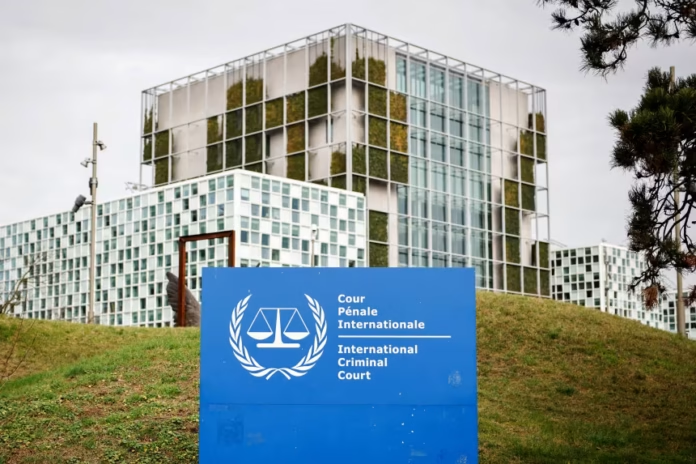
The United States has imposed new sanctions on two senior International Criminal Court officials, intensifying the Trump administration’s campaign against the tribunal and its investigations.
US Secretary of State Marco Rubio announced the measures Tuesday against ICC President Tomoko Akane of Japan and senior trial lawyer Abdoulaye Seye of Senegal.
The administration says the two officials were involved in efforts to investigate or prosecute people whose countries have not accepted the court’s jurisdiction. Washington argues that allowing the ICC to pursue American officials would threaten US sovereignty.
The latest sanctions mark another major step in the administration’s broader effort to weaken the international court and persuade other countries to distance themselves from it.
Rubio said the sanctioned officials had taken part in the ICC’s efforts to investigate, arrest, detain or prosecute government officials from countries that are not parties to the court.
He also warned that Washington could take further action if the ICC continues pursuing cases involving American nationals.
The Trump administration has repeatedly criticized the court, particularly over investigations involving the United States and Israel. Neither country is a member of the ICC.
The latest measures follow Rubio’s announcement last month of a broader US campaign aimed at dismantling the court. Washington has urged other governments to stop funding and cooperating with the ICC and has warned that countries refusing to support the campaign could face greater scrutiny from the United States.
Rubio said the administration expects more nations to join its effort. The International Criminal Court strongly rejected the latest sanctions, arguing that they threaten international efforts to hold individuals accountable for serious crimes.
The court said it would continue carrying out its responsibilities independently and in accordance with the Rome Statute, the treaty that established the ICC.
The dispute highlights a fundamental disagreement between Washington and the court over the limits of international criminal jurisdiction.
The United States maintains that the ICC should not have authority over American citizens because the US never joined the court. ICC officials, however, argue that the tribunal’s jurisdiction can apply in certain circumstances involving crimes committed on the territory of member states or by nationals of those states.
The disagreement has become particularly contentious because of cases involving Israel and the war in Gaza.
The Trump administration’s confrontation with the ICC is not limited to sanctions against individual officials.
Washington has been encouraging countries to reconsider their relationship with the court, particularly governments that cooperate closely with the United States or depend on American security support.
US officials have called on countries hosting American military forces, working with US law enforcement agencies or benefiting from American security arrangements to reject what Washington describes as the ICC’s claimed authority over American personnel.
The campaign has already coincided with decisions by some countries to distance themselves from the court.
Venezuela announced in late July that it would withdraw from the ICC, describing the court’s approach as geographically biased. The US State Department welcomed the decision and criticized the court’s long-running investigation into Venezuelan officials.
Chad also announced its intention to withdraw from the ICC later in July.
The ICC’s Assembly of States Parties expressed concern over the withdrawals, warning that losing members could weaken international efforts to prosecute serious crimes and combat impunity.
The conflict between the United States and the ICC has also been closely tied to the court’s investigation into alleged crimes in Gaza.
In November 2024, the ICC issued an arrest warrant for Israeli Prime Minister Benjamin Netanyahu, saying there were reasonable grounds to believe he bore criminal responsibility for alleged war crimes and crimes against humanity.
The case generated strong opposition from Israel and the United States, which has consistently rejected the court’s authority over American or Israeli officials in the matter.
Trump’s hostility toward the ICC is not new. During his first administration, Washington also took measures against court officials after the tribunal moved toward investigating alleged war crimes involving US forces in Afghanistan.
The current campaign, however, represents a broader attempt to challenge the institution itself.
The new sanctions are likely to deepen an already serious confrontation between the United States and the international court.
For Washington, the issue is centered on national sovereignty and the protection of American officials from a court the US does not recognize as having authority over them.
For the ICC and its supporters, the issue is the ability of an international institution to investigate alleged atrocities even when powerful countries reject its jurisdiction.
As the Trump administration presses other governments to withdraw support from the court, the ICC faces growing political pressure at a time when its role in international justice is already being heavily contested.
The outcome could have consequences far beyond the officials targeted by the latest sanctions. If more countries abandon the ICC, its ability to investigate and prosecute major international crimes could be weakened. If the court withstands the pressure, the confrontation could instead reinforce the debate over whether international justice can operate effectively when major powers refuse to recognize its authority.
This article was produced by the Maple Epoch Editorial Team. See our editorial standards and AI-use disclosure and editorial policy.