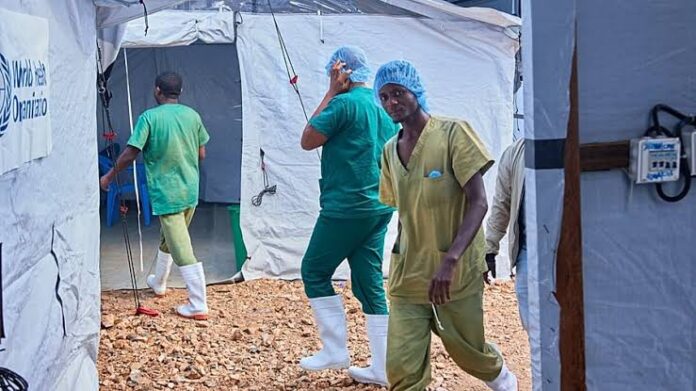
The Ebola outbreak in the Democratic Republic of Congo is placing growing pressure on health workers as surveillance efforts struggle with unpaid staff, limited resources and insecurity.
Health workers in eastern Congo are continuing to search communities for people who may have been exposed to Ebola, but their ability to contain the virus is being threatened by serious challenges within the response system.
In Nizi, community health worker and contact tracing team leader Gédéon Banga Ngbape said his team is dealing with a shortage of mobility and a more immediate problem: health workers have reportedly gone more than three months without receiving their salaries.
The financial strain has already affected operations. Health workers at the Nizi Treatment Center went on strike Thursday, temporarily forcing the facility to close.
For contact tracing teams, the work is demanding. Workers respond to dozens of alerts each day, visit communities, identify people who may have come into contact with infected individuals and try to ensure that people showing symptoms receive medical attention quickly.
But as the outbreak expands, surveillance teams are finding it increasingly difficult to keep up.
Ebola outbreak puts contact tracing under pressure
Ngbape said the effectiveness of the entire Ebola response depends heavily on reliable surveillance. When health workers cannot respond quickly to alerts or follow suspected contacts, opportunities to identify and interrupt chains of transmission can be lost.
Teams in Nizi reportedly receive between 60 and 70 alerts every day. Community health workers such as Ana Ndroy Kasime visit homes to explain how Ebola spreads, encourage people to report suspected infections and relay information to health authorities.
However, Kasime said workers often lack basic protective equipment needed to carry out their duties safely.
The challenges come as the Ebola outbreak continues to claim lives at an alarming rate. Government figures show that the outbreak has recorded 4,381 confirmed cases and 2,011 deaths.
Health authorities initially declared the outbreak on May 15, but later sequencing work indicated that the virus had been circulating since February.
The speed of the outbreak has raised particular concern. Based on the figures available, the current death toll was reached almost three times faster than during the 2014 to 2016 Ebola outbreak in West Africa, which remains the deadliest Ebola outbreak on record.
Ebola outbreak faces multiple obstacles
The response is unfolding in an extremely difficult environment. The current outbreak is being caused by the Bundibugyo species of Ebola virus, a relatively rare strain for which there are no approved vaccines or treatments, although clinical trials are underway.
Health officials must also contend with insecurity in parts of eastern Congo. Threats from rebel groups can make it dangerous or impossible for response teams to reach some communities.
Mistrust is another major obstacle. Some communities that have endured years of conflict and previous health emergencies remain deeply skeptical of authorities. Misinformation claiming that Ebola is not real has further complicated efforts to persuade residents to report symptoms and cooperate with health workers.
The strikes by unpaid health workers add another layer of difficulty. Treatment centers and surveillance teams depend on trained personnel who can respond consistently as new cases and alerts emerge.
For workers on the ground, the situation means trying to contain a rapidly spreading disease while operating with limited resources and growing pressure.
Ebola outbreak threatens to overwhelm the response
The situation in Nizi highlights a wider concern about whether health authorities have enough capacity to keep pace with the outbreak. Contact tracing is one of the most important tools for containing Ebola because identifying exposed people allows health teams to monitor them and quickly isolate those who develop symptoms.
When that system weakens, undetected transmission can continue in communities.
The combination of unpaid health workers, inadequate protective supplies, limited transportation, insecurity and misinformation is therefore creating significant risks for the Ebola response.
Containing the outbreak will require health workers to have the resources, protection and support needed to reach affected communities. Without a functioning surveillance network and sustained cooperation from residents, stopping the spread of Ebola will become increasingly difficult.
The growing death toll serves as a stark warning of what can happen when a dangerous virus gains ground faster than the systems designed to contain it.
Related: Ebola Patients Flee After Attacks on Congo Health Facilities Disrupt Response
This article was produced by the Maple Epoch Editorial Team. See our editorial standards and AI-use disclosure and editorial policy.