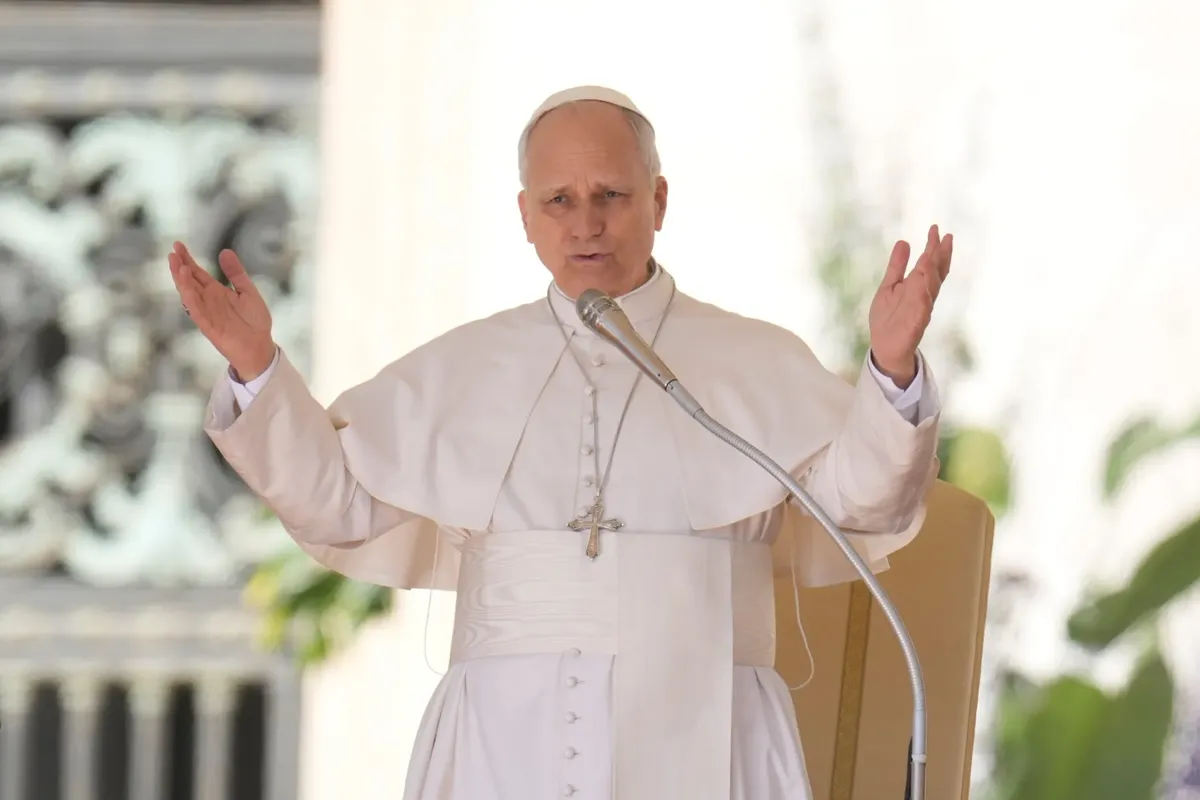
U.S. President Donald Trump has launched a blistering attack on Pope Leo XIV, describing him as “weak on crime” and “terrible for foreign policy” in a strongly worded social media post that has intensified attention on the uneasy relationship between political power and religious leadership.
In the post on X, Trump described the pontiff as “weak on crime” and “terrible for foreign policy,” while accusing him of making statements that reflect “fear” of his administration. The remarks mark a significant escalation in rhetoric directed at a global religious figure, highlighting how faith leaders are increasingly drawn into geopolitical debates.
“He talks about ‘fear’ of the Trump Administration, but doesn’t mention the FEAR that the Catholic Church, and all other Christian Organisations, had during COVID when they were arresting priests, ministers, and everybody else, for holding Church Services,” Trump wrote.
The reference to pandemic-era restrictions touches on a deeply contested period in the United States and beyond, when governments imposed limits on gatherings, including religious services, in an effort to curb the spread of COVID-19. While public health officials defended such measures as necessary, critics, including Trump and many religious groups, argued that they infringed on fundamental freedoms.
Clash Over Global Security and Values
Trump went further, criticising the Pope’s stance on international security issues, including nuclear weapons and U.S. foreign policy, and suggesting disagreement over the administration’s actions abroad.
“I don’t want a Pope who thinks it’s OK for Iran to have a Nuclear Weapon,” he said, also accusing the pontiff of political bias and of “catering to the Radical Left.”
The comments reflect a broader ideological divide that has emerged in recent years between some political leaders and religious figures on issues ranging from war and peace to migration and economic justice. The Vatican has traditionally advocated for nuclear disarmament and diplomatic engagement, positions that at times put it at odds with more hardline national security policies.
Observers note that disagreements between U.S. administrations and Catholic leadership are not new. Past tensions have surfaced over topics such as the Iraq War, climate change, and immigration policy. However, the direct and personal tone of Trump’s remarks stands out, particularly in the context of the Pope’s role as a spiritual leader for more than a billion Catholics worldwide.
The mention of Iran underscores the continuing importance of nuclear proliferation concerns in global politics. Successive U.S. administrations have taken varying approaches to the issue, ranging from diplomatic agreements to economic sanctions and military pressure, while the Catholic Church has consistently called for dialogue and non-proliferation.
Questions Over Leadership and Influence
Trump also referenced the Pope’s leadership selection, claiming he “was a shocking surprise” and suggesting his appointment was influenced by political considerations. While papal elections are conducted through a conclave of cardinals in a process that is officially insulated from external politics, speculation about ideological leanings within the Church often accompanies such transitions.
He added that he preferred the Pope’s brother, Louis, describing him as “all MAGA,” and aligned with his political movement. The comment introduces a personal dimension to the criticism, blending political allegiance with family ties in a way that has drawn scrutiny from commentators.
The post, published on Trump’s official platform, also included broader criticism of the Catholic Church’s leadership and its engagement with political figures, as tensions between the U.S. president and religious commentary continue to draw attention.
Analysts say the exchange highlights a growing pattern in which political leaders respond directly to criticism from religious authorities, rather than maintaining the more traditional separation between secular governance and spiritual guidance. This dynamic has been amplified by social media, where statements can be issued instantly and reach global audiences within minutes.
Reactions to Trump’s comments have been mixed, reflecting the polarized nature of both American politics and global debates about religion’s role in public life. Supporters of the president have echoed concerns about perceived political bias within religious institutions, while critics argue that the attack undermines respect for a major faith leader and risks deepening divisions.
Historically, relations between the United States and the Vatican have evolved over time, shaped by changing political landscapes and shared interests. Cooperation has often been evident on humanitarian issues, conflict resolution, and human rights advocacy. At the same time, differences in perspective have periodically surfaced, particularly when moral teachings intersect with policy decisions.
The COVID-19 pandemic, referenced in Trump’s post, remains a key point of contention in these discussions. Restrictions on worship services sparked legal challenges and public protests in several countries, including the United States. Courts were often called upon to balance public health concerns with constitutional protections for religious freedom, resulting in a patchwork of rulings and ongoing debate.

For the Catholic Church, navigating these tensions requires balancing its spiritual mission with its engagement in worldly affairs. For political leaders, responding to religious criticism involves weighing domestic political considerations against the broader implications for international relationships.
As the exchange continues to reverberate, it underscores the complex intersection of faith, politics, and public discourse in the modern era. The episode serves as a reminder that in an age of instant communication and heightened polarization, even longstanding institutions and traditions are not immune to sharp and highly public disagreements.
This article was first published on Reuters