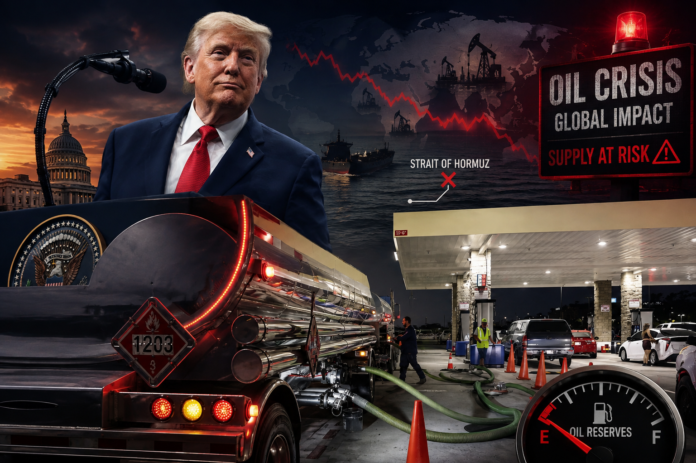
President Donald Trump’s earlier warning about a potential oil catastrophe has returned to the spotlight following renewed tensions in the Middle East. As the Strait of Hormuz faces another shutdown and fuel markets remain under pressure, questions are growing over whether the global economy is heading toward the kind of disruption Trump warned about months ago.
Although oil prices have remained relatively stable compared to previous geopolitical crises, energy experts say the situation is more complicated than the market currently reflects. Beneath the surface, shrinking reserves, strained refining capacity, and supply chain disruptions continue to raise concerns about future energy security.
Why the Trump Oil Catastrophe Warning Matters Again
Earlier this year, Trump argued that prolonged conflict in the Middle East could trigger severe economic consequences if energy supplies became restricted. He warned that depleted reserves could create widespread economic instability, forcing governments and consumers into another energy crisis.
At the time, temporary diplomatic progress allowed oil shipments to resume through the Strait of Hormuz, easing immediate concerns. Millions of barrels that had been delayed were finally released into global markets, buying valuable time for major economies.
However, that relief has proven temporary. With negotiations collapsing and regional tensions escalating once again, the world’s most important oil shipping route has become a source of uncertainty.
The Strait of Hormuz Remains the Biggest Concern
The Strait of Hormuz handles a significant share of global crude oil exports every day. Any prolonged disruption immediately affects energy markets worldwide.
Unlike the previous closure, analysts note there is now considerably less oil waiting to exit the waterway. That means reopening the route would provide only limited short term relief compared to earlier in the year.
At the same time, another critical shipping route has also become increasingly unstable.
The Bab el Mandeb Strait in the Red Sea has experienced growing security threats, reducing alternative export options for Middle Eastern producers and placing additional pressure on global supply chains.
Why the Crisis Is Becoming More About Fuel Than Oil
One of the biggest challenges facing global markets is no longer simply producing enough crude oil.
Instead, refining that oil into usable fuels has become the larger problem.
Several refineries across the Middle East have reportedly suffered extensive damage during the conflict, reducing their ability to produce diesel, jet fuel and other refined petroleum products.
Russia has also seen refining capacity affected by continued attacks on its energy infrastructure, while China has imposed tighter restrictions on refinery operations as it accelerates its transition toward electric transportation.
These combined developments have significantly reduced global fuel production even where crude oil remains available.
Can the United States Avoid Trump’s Oil Catastrophe Warning?
The United States currently produces more crude oil than any other country, generating substantially more barrels each day than it consumes.
On paper, this appears to provide a comfortable safety margin.
The reality is more complicated.
American production largely consists of light sweet crude, which is ideal for manufacturing gasoline. However, industries also require heavier crude varieties for products such as diesel, jet fuel, lubricants and asphalt.
These heavier grades are traditionally imported from regions including the Middle East.
As global buyers search for alternative suppliers, increasing amounts of American fuel are also being exported overseas, reducing domestic availability.
Strategic Petroleum Reserve Faces Growing Questions
The Strategic Petroleum Reserve was created decades ago to protect the United States during major energy emergencies.
Today, however, experts have raised concerns about both its size and condition.
Key concerns include:
- Lower inventory levels than in previous years.
- Aging underground storage facilities.
- Questions over how much stored oil can actually be recovered efficiently.
- Higher costs required to replenish reserves after emergency releases.
Although government plans aim to rebuild stockpiles over time, doing so while oil prices remain elevated could prove expensive.
Commercial Stockpiles Are Becoming More Important
Industry attention is increasingly shifting toward commercial oil inventories rather than emergency government reserves.
The storage hub at Cushing, Oklahoma serves as one of America’s most important oil distribution centers and acts as a key benchmark for market health.
Analysts warn that inventory levels have fallen close to operational thresholds where moving oil through the system becomes increasingly difficult.
While supplies have not yet reached critical levels, continued declines could complicate distribution even if sufficient oil technically remains in storage.
Why Oil Prices Have Not Exploded
Despite geopolitical tensions, oil prices have remained well below the historic highs seen during previous global crises.
Several factors explain this surprising resilience.
Reduced Global Demand
Many countries have reduced oil consumption through efficiency improvements, slower economic activity, and increased use of alternative energy sources.
Market Confidence
Investors continue to believe diplomatic efforts could eventually reopen key shipping routes, limiting panic buying.
Large Existing Inventories
Some major economies entered the conflict with unusually large stockpiles, allowing them to rely on stored reserves instead of purchasing additional oil immediately.
This combination has prevented prices from reaching the record levels many analysts expected.
Could Diplomacy Prevent the Trump Oil Catastrophe Warning From Becoming Reality?
Some energy analysts argue that a negotiated solution remains the fastest path toward market stability.
One proposal receiving increased attention involves allowing regulated commercial transit through the Strait of Hormuz under internationally accepted arrangements.
Supporters believe restoring shipping would quickly ease pressure on global fuel markets while giving governments time to develop longer term alternatives.
Others suggest the current crisis could accelerate investment in new pipelines and export routes that reduce dependence on a single strategic waterway.
Such infrastructure projects would require years to complete but could permanently reshape global energy logistics.
What Happens Next?
The coming months may determine whether Trump’s earlier warning proves accurate.
If shipping disruptions continue, refining capacity remains constrained, and commercial inventories keep falling, fuel shortages could become a greater concern than crude oil availability itself.
For now, markets remain relatively calm because investors continue to expect a diplomatic breakthrough.
Whether that optimism is justified will depend largely on political developments in the Middle East and how quickly major energy exporters can restore stable supply routes.
The Trump oil catastrophe warning is once again drawing attention as geopolitical tensions threaten one of the world’s most critical energy corridors. While current market conditions have avoided widespread panic, underlying challenges including reduced refining capacity, declining inventories, and restricted shipping routes continue to create significant risks.
Whether the global economy experiences another major energy shock will depend on how quickly diplomatic efforts succeed and how effectively nations adapt to an increasingly uncertain energy landscape.
This article was produced by the Maple Epoch Editorial Team. See our editorial standards and AI-use disclosure and editorial policy.