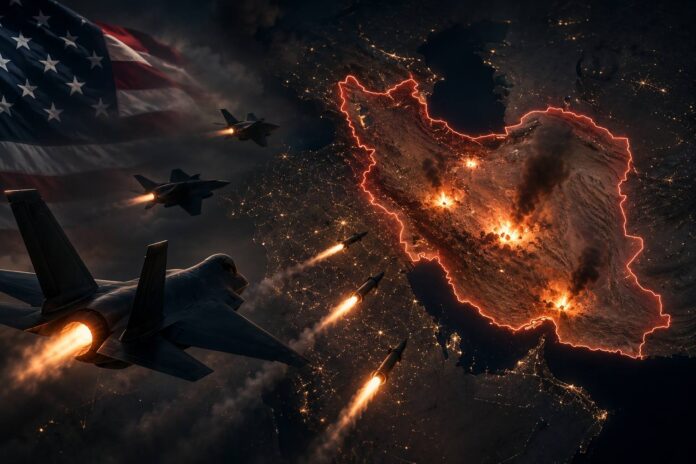
The United States launched another round of airstrikes against targets in Iran early Thursday after President Donald Trump warned that Tehran would “pay the price” if negotiations remained stalled, while Iran responded with attacks targeting Bahrain, Kuwait and Jordan, prompting heightened military alerts across several Gulf states.
Central Command said the latest operation targeted Iranian military communications systems, surveillance infrastructure, and air defense positions. Officials described the strikes as part of an ongoing response to what they called continued Iranian aggression.
The announcement followed earlier U.S. strikes linked to the downing of an American Army Apache helicopter near the Strait of Hormuz, an incident that significantly heightened regional tensions.
The strikes hit multiple locations across Iran as diplomatic efforts to end the conflict appeared deadlocked. Iran continued to insist it would maintain control over the Strait of Hormuz, a vital shipping route whose disruption has driven global energy prices higher.
The exchange marked the third major cycle of attacks this week despite previous attempts to stabilize the conflict.
Trump has repeatedly urged Iran to agree to a deal to end the war and earlier suggested an agreement could be reached within days. Iran, however, has maintained that its leverage over the Strait of Hormuz provides it with a significant bargaining position.
Iran’s representative to the United Nations said the United States should refrain from threats of force if it wants negotiations to succeed.
At the same time, both governments have signaled interest in finding a diplomatic solution, although major differences remain.
Israeli Prime Minister Benjamin Netanyahu has continued to pursue objectives that complicate negotiations, including dismantling Iran’s nuclear program and confronting the Iran-backed Hezbollah movement in Lebanon.
Kuwait temporarily restricted airspace operations as precautionary measures, while Jordan reported missile and drone activity and activated its air defense systems. Authorities in the region said they were closely monitoring the situation amid fears of further escalation.
Iran condemned the continued U.S. strikes and warned that it would respond to any further attacks, raising concerns that the conflict could expand beyond the immediate bilateral confrontation.
Tehran is also demanding sanctions relief and the release of frozen assets before a final agreement is reached, conditions that Washington has rejected.
 The Strait of Hormuz remains a central flashpoint in the confrontation, with growing concerns that the exchanges could widen beyond the immediate U.S.-Iran conflict and further destabilize the Gulf region.