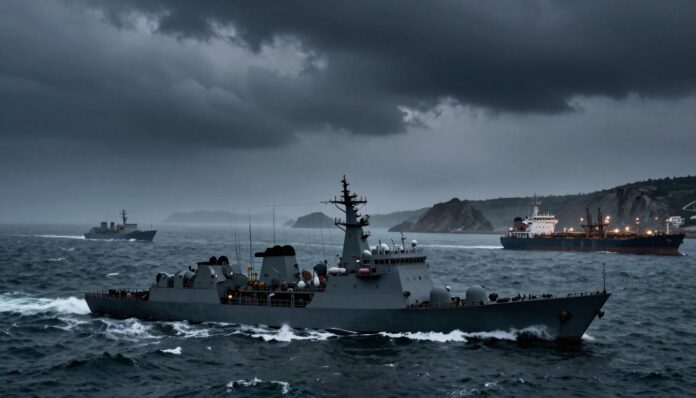
Three Indian sailors have been confirmed dead after a U.S. strike on the Palau-flagged tanker MT Settebello, while India also reported a separate incident involving another vessel carrying Indian crew members off the Omani port of Shinas, marking the third maritime incident linked to U.S. operations this week.
The latest incident involved the Guinea-Bissau-flagged MT Jalveer, which came a day after the U.S. military fired on the MT Settebello off the coast of Oman.
The Settebello had 24 Indian sailors on board. Three crew members who were initially reported missing on Wednesday were confirmed dead on Thursday.
“It is deeply unfortunate to learn of the tragic incident aboard the Palau-flagged MT Settebello,” India’s Shipping Minister Sarbananda Sonowal said in a statement.
“Sadly, three Indian seafarers initially reported missing are now confirmed dead after bodies have been located and identified,” he said.
Sonowal said he had directed officials to ensure the immediate repatriation of the rescued crew members and the return of the bodies of the deceased to India.
According to Indian newspaper The Hindu, citing Forward Seamen’s Union of India General Secretary Manoj Yadav, the victims were identified as deck cadet Aditya Sharma, engine fitter Shivanand Chaurasiya and Chief Engineer Patnala Suresh.
India’s foreign ministry summoned a senior U.S. diplomat in New Delhi on Wednesday to lodge what it described as “a strong protest” over the attack on the Settebello.
The U.S. military had earlier said it targeted both the Marivex and Settebello, two tankers carrying Indian crew members.
On Thursday, Indian Foreign Ministry spokesperson Randhir Jaiswal told reporters that the Guinea-Bissau-flagged MT Jalveer had also been attacked by the U.S. Navy.
Soon afterward, U.S. Central Command (CENTCOM) confirmed that it had disabled a third oil tanker in the Gulf of Oman overnight.
According to CENTCOM, the MT Jalveer was attempting to transport Iranian oil through the Gulf of Oman when a U.S. aircraft fired two Hellfire missiles into the vessel’s engine room after the crew allegedly failed to comply with directions from U.S. forces.
The vessel later issued a distress call near the Omani port of Shinas after a fire broke out around its engine room and funnel, according to British maritime risk management company Vanguard.
An Indian shipping ministry official said all 20 Indian crew members aboard the Jalveer were safe and were being evacuated.
Images shared on social media by the Forward Seamen’s Union of India appeared to show crew members being lifted from the vessel by helicopter while thick black smoke rose from the bridge and accommodation areas.
The Indian Embassy in Oman said it was aware of the incident and was coordinating with local authorities.
The maritime incidents come as Indian Prime Minister Narendra Modi is expected to hold bilateral talks with U.S. President Donald Trump on the sidelines of the Group of Seven summit next week.
The attacks also add pressure to an already fragile ceasefire surrounding the ongoing U.S.-Israeli conflict with Iran.
Torbjorn Soltved, an analyst at global risk intelligence firm Verisk Maplecroft, described the current situation as a “low intensity conflict.”
“The main problem at the moment is that both sides are trying to negotiate from a position of strength,” Soltved said.
He said the United States appears to believe that increasing pressure on Iran could strengthen its negotiating position, while Iran sees pressure on shipping through the Strait of Hormuz as leverage that increases economic pressure on the international community and could improve its bargaining position.
CENTCOM has said it disabled the Palau-flagged Settebello and Marivex because they violated the ongoing U.S. blockade against Iran. According to the U.S. military, the Settebello was transporting Iranian oil, while the Marivex was attempting to sail to an Iranian port.
On June 8, Omani authorities airlifted 24 Indian sailors from the Marivex after the U.S. action against that vessel.