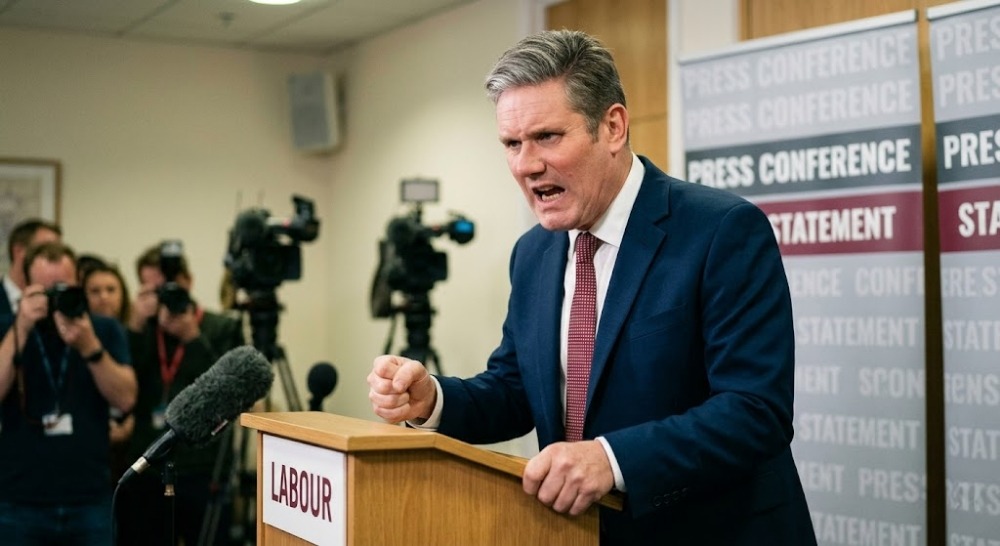
Keir Starmer announced Monday that he is resigning as leader of the Labour Party, a move that will also see him replaced as Prime Minister of the United Kingdom. The announcement came less than two years after Labour’s sweeping national election victory in July 2024 and caps weeks of mounting pressure from within his own party.
Delivering his resignation statement outside 10 Downing Street, Starmer framed his decision around the question of whether he remained best placed to lead Labour into the next general election.
“The question my party is asking now is whether I am best placed to lead us into the next election. I have heard the answer… and I accept that answer with good grace. Every decision I have made has been about putting the country I love first.” He added that he would give his successor “my full and unequivocal support.”
Starmer appeared to choke up toward the end of his remarks as he spoke about his children, whom he called his “pride and joy,” and said that after stepping down from “the biggest job in the country,” he would focus on “the most important job… being the best husband I can, to my fantastic wife Vic, who has been a rock by my side through good times and bad.”
His position had become increasingly untenable in recent weeks. Labour suffered a catastrophic round of local elections in early May, shedding 1,000 council seats and losing its grip on the Welsh legislature, which the party had controlled for 27 years.
The populist, anti-immigration Reform UK party, led by Nigel Farage, was the dominant winner of the day, taking nearly 1,300 local council seats in England and making significant gains in both the Scottish and Welsh legislatures.
The final blow appeared to come in the days before his resignation, when Defence Secretary John Healey, regarded as a Starmer loyalist, resigned over the prime minister’s military spending plans. Armed forces minister Al Cairns followed shortly after. In total, 20 ministers resigned during Starmer’s tenure.
Starmer had vowed repeatedly to fight on despite the pressure. “I know I have my doubters and I know I need to prove them wrong, and I will do so,” he said in a speech weeks ago.
The effort failed to persuade Labour lawmakers. Several MPs told the media his post-local-elections speech in May “made me feel sorry for the PM,” that it “really didn’t cut the mustard,” and, more bluntly: “Meh.” Throughout his time in office, Starmer struggled to shake criticism that he was more of a manager than a leader.
The timetable for his departure accelerated significantly after former Manchester Mayor Andy Burnham entered Parliament. In January, Labour leadership had blocked an attempt by Burnham to run in a separate local election, widely interpreted as an effort to limit his ability to build a rival power base.
But Burnham ultimately won the seat of Makerfield last week after the sitting MP stepped aside to give him the opportunity, and made clear in his victory speech that he intended to challenge for the leadership. “Everyone knows that politics isn’t working,” Burnham said. “Everyone can feel that the country isn’t where it should be. Tonight could, just could, be the turning point.”
Burnham, 56, often referred to as the King of the North after nearly a decade as Mayor of Manchester, is now widely expected to succeed Starmer. If the party unites around him without a formal contest, Starmer could be out of the premiership by July. If a leadership contest takes place, a new leader would be confirmed by the time Parliament returns from its summer recess in September.
Burnham previously ran unsuccessfully for the Labour leadership in 2010 and 2015. Former Health Secretary Wes Streeting, who resigned from cabinet in May saying “where we need vision, we have a vacuum,” has said he will run in any contest, describing himself as a “plucky underdog” and calling for a “genuine contest” rather than a coronation.
Under Britain’s political system, the public does not directly elect its prime minister. Voters elect local members of parliament, and the leader of the party holding a decisive majority in the House of Commons is appointed prime minister.
As long as Labour maintains its majority, the party can replace its leader through an internal vote or by consensus, with the new leader becoming prime minister without the need for a national election.
Such changes have become increasingly common, with six prime ministers having occupied 10 Downing Street over the past decade. Any new leader may nonetheless face pressure to call a national election to demonstrate they hold the confidence of the country, not just their party.
 On Sunday, President Trump posted on Truth Social that Starmer had “failed badly on two very important subjects which are IMMIGRATION AND ENERGY (OPEN NORTH SEA OIL!). I wish him well!”