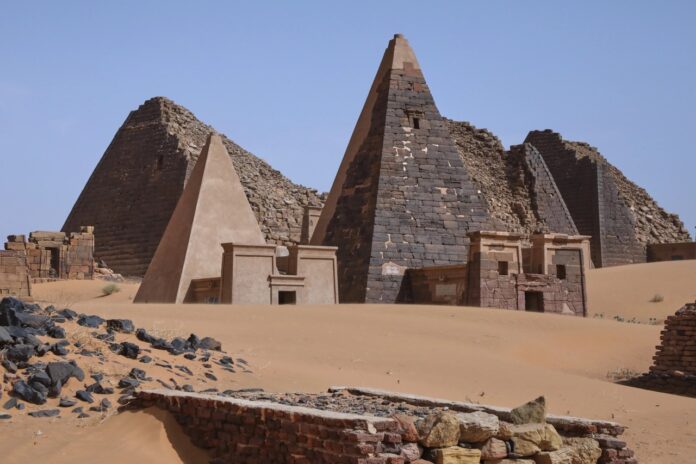
Sudan’s ancient Meroë pyramids are facing a growing threat as the country’s prolonged civil war leaves one of Africa’s most important archaeological sites without the protection and preservation work it needs.
Located about 200 kilometres north of Khartoum, the Meroë complex contains more than 200 pyramids dating from roughly 800 BC to 350 AD. The structures were built as royal burial sites during the Kingdom of Kush and are recognized for their distinctive narrow, angular designs.
The site is part of the UNESCO World Heritage designation covering the Archaeological Sites of the Island of Meroë, reflecting its importance to Sudanese and African history.
Unlike the much larger pyramids of ancient Egypt, the Meroë pyramids are generally smaller, ranging from around 6 to 30 metres in height. Many feature entrances facing east, reflecting the religious traditions and beliefs of the Kushite civilization.
But centuries of exposure have taken a toll. Some of the pyramids were damaged as early as the 19th century when European treasure hunters used explosives in attempts to reach their burial chambers. Others have gradually deteriorated under the effects of wind, sand and rain.
Today, archaeologists and antiquities officials face an even more difficult challenge.
The war that erupted in Sudan in 2023 between the country’s military and the paramilitary Rapid Support Forces has disrupted archaeological work and severely restricted access to cultural sites. International preservation missions have been halted, leaving fewer people available to monitor and protect the ancient structures.
Archaeologist Mahmoud Suleiman said several factors are contributing to the deterioration, including climate change, the conflict and the interruption of conservation programs.
For those responsible for monitoring the site, the damage can be visible from one visit to the next. Antiquities inspector Mohamed Mubarak said stones have been found fallen from the structures, while salt deposits have appeared inside some funerary temples.
The salt is particularly concerning because it can weaken the stone and gradually destroy ancient inscriptions and artwork that have survived for thousands of years.
Before the war, Meroë was one of Sudan’s most important tourist attractions. Visitors came to explore the pyramids while archaeological teams worked to study and preserve the remains of the Kushite kingdom.
That activity largely disappeared after the conflict began.
Mustafa Ahmed, one of the site’s guards, recalled a time when visitors and archaeological missions regularly came to Meroë. The war changed that situation almost completely, leaving the ancient site largely deserted.
The absence of tourists is only part of the problem. With preservation activities disrupted, the pyramids are increasingly exposed to environmental damage without the regular conservation work needed to slow their deterioration.
The situation highlights a broader danger facing Sudan’s cultural heritage. The country’s conflict has not only created a humanitarian crisis but has also placed archaeological sites, historic buildings and priceless artifacts at risk.
For the Meroë pyramids, the combination of armed conflict and a harsh desert climate could have lasting consequences. Every year without proper monitoring and conservation increases the possibility that inscriptions, stones and other evidence of the ancient Kushite civilization could be permanently lost.
The Meroë pyramids have survived wars, weather and centuries of neglect before. But as Sudan’s conflict continues with no clear end in sight, protecting them has become increasingly difficult.
Preserving the pyramids will ultimately require stability, renewed international archaeological cooperation and sustained conservation efforts. Until those conditions return, one of Sudan’s greatest links to its ancient past remains dangerously exposed.