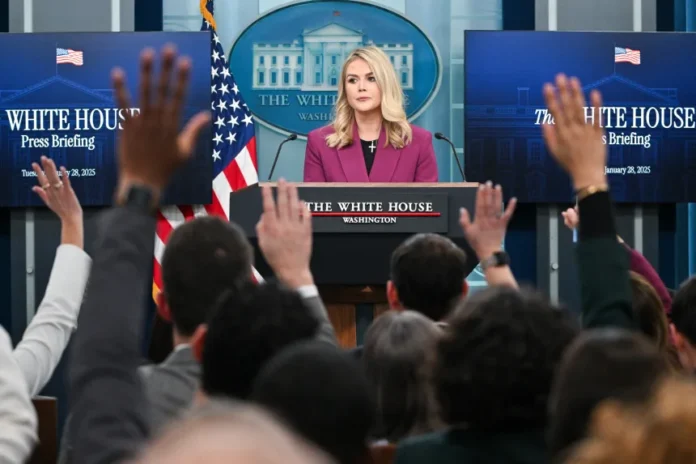
Karoline Leavitt’s departure as White House press secretary marks a significant change for President Donald Trump, removing one of the administration’s most visible and loyal defenders from the briefing room.
Leavitt is leaving the position to spend more time with her family following the birth of her second child in May. Trump has praised her performance and indicated that she will remain involved as an outside adviser.
At just 28, Leavitt became the youngest person to serve as White House press secretary. During her time in the role, she developed a reputation for aggressively defending Trump, frequently confronting journalists and embracing a communication style that closely reflected the president’s own approach to politics and the media.
Her departure therefore represents more than the routine replacement of a government spokesperson. It creates a gap in Trump’s communications team at a time when his administration is facing intense political scrutiny and continued questions about its relationship with the press.
The traditional role of a White House press secretary is to explain the administration’s policies, answer questions from journalists and communicate the president’s position to the public. Under Trump, however, the job has taken on a very different character.
Trump frequently communicates directly with Americans through social media, interviews and public appearances. That has reduced his reliance on a press secretary as the administration’s primary public voice.
Even so, Leavitt became an important part of Trump’s political operation because she understood how to communicate with his supporters while defending his agenda in highly confrontational media environments.
Her briefings often became political events in their own right. Rather than simply providing information, she regularly challenged reporters, criticized media coverage and presented the administration’s arguments in language familiar to Trump’s political base.
That approach made her popular among Trump supporters while attracting criticism from journalists and political opponents.
Leavitt also helped reshape how the White House interacted with the media. During her tenure, the administration expanded access to newer forms of media, including podcasters, online personalities and conservative broadcasters.
Supporters viewed the changes as a way of breaking the traditional media establishment’s influence over presidential communications. Critics, however, argued that the shift weakened the traditional press corps and gave greater access to outlets considered more sympathetic to Trump.
The administration’s clashes with established news organizations became particularly contentious during disputes over press access and the terminology used by the White House. Leavitt was frequently at the center of those confrontations, making her one of the most recognizable faces of Trump’s second administration.
Leavitt has said her decision to leave is primarily about her family. After giving birth to her second child on May 1, she returned to one of the most demanding communications positions in the US government. She has said the experience made her realize how difficult it was to give her children the time and attention she wanted while maintaining the intense schedule required by the job.
Trump has publicly supported her decision and praised her work, while indicating that she will continue to have a relationship with his administration as an outside adviser.
Her continued connection to Trump means her political influence is unlikely to disappear completely when she leaves the White House.
Still, replacing her could prove difficult.
Trump has historically valued loyalty, media experience and the ability to withstand intense public scrutiny. His next press secretary will have to operate in an environment where the president himself remains an exceptionally active communicator who can change the political conversation with a single social media post or public statement.
Whoever takes over the briefing room will also face the challenge of matching Leavitt’s ability to speak directly to Trump’s political base while defending the administration under pressure from reporters.
Leavitt’s tenure demonstrated how closely presidential communication has become tied to social media, partisan audiences and direct engagement with supporters. It also highlighted the growing tension between political administrations and conventional journalism.
For Trump, her departure does not mean losing a voice entirely. But it does remove one of the people most closely associated with defending his administration before the cameras.
Karoline Leavitt leaves the White House at a pivotal moment, but the communication style she helped establish is likely to remain part of Trump’s political operation long after she steps away from the podium.