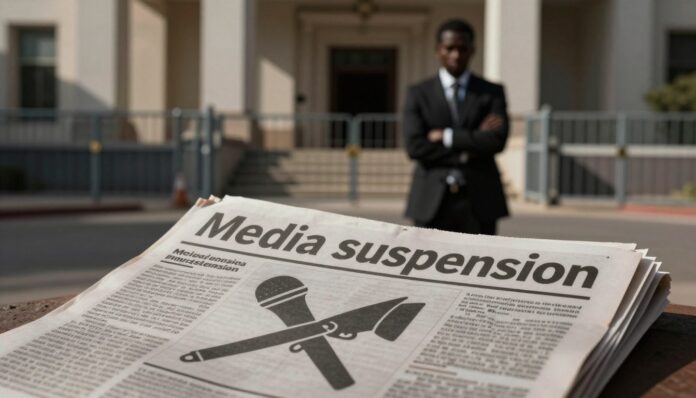
Authorities in Niger have suspended nine French media organizations, accusing them of threatening public order and national security in the latest crackdown on foreign media under the country’s military-led government.
The decision, announced by the National Observatory of Communication (ONC), affects France 24, Radio France Internationale (RFI), France Afrique Média, LSI Africa, Agence France-Presse (AFP), TV5 Monde, TF1 Info, Jeune Afrique, and Mediapart.
In a statement, the media regulator said the suspensions were necessary to “preserve peace, social cohesion and the stability of institutions.” It accused the outlets of repeatedly broadcasting content capable of seriously disrupting public order and undermining the morale of the country’s defense and security forces.
However, international press freedom organization Reporters Without Borders (RSF) strongly condemned the decision, describing the allegations as “fabricated.” The group accused Niger’s authorities of pursuing a “coordinated strategy to repress press freedom” and called for the immediate reversal of the suspensions.
The ONC did not specify how long the restrictions would remain in place and did not provide detailed examples of the reports or broadcasts that allegedly violated national security or public order.
The move comes as Niger’s military government continues to tighten its control over the political and media landscape following the July 2023 coup, which brought Gen. Abdourahamane Tchiani to power. Since then, Niger has joined neighboring Mali and Burkina Faso in distancing itself from France and other Western partners while strengthening security and diplomatic ties with Russia.
The three Sahel nations have formed the Alliance of Sahel States (AES), presenting it as an alternative regional security framework after withdrawing from the Economic Community of West African States (ECOWAS). Their governments argue that previous partnerships with Western countries failed to curb the region’s escalating extremist violence.
Despite these policy shifts, security analysts note that attacks by Islamist militant groups have continued to intensify across the Sahel. Earlier this year, militants attacked an air force base in Niger’s capital, Niamey, killing four soldiers.

Following the attack, Gen. Tchiani accused the governments of France, Benin, and Côte d’Ivoire of supporting the armed group responsible, although no public evidence was presented to substantiate the claims.

Human rights organizations and press freedom advocates have repeatedly warned that military-led governments in Niger, Mali, and Burkina Faso have increasingly restricted political opposition, civil society organizations, and independent journalism as they consolidate power.

The suspension of the nine French media outlets is expected to further strain relations between Niger and France, whose political and military influence in the Sahel has sharply declined in recent years following a series of military coups across the region.