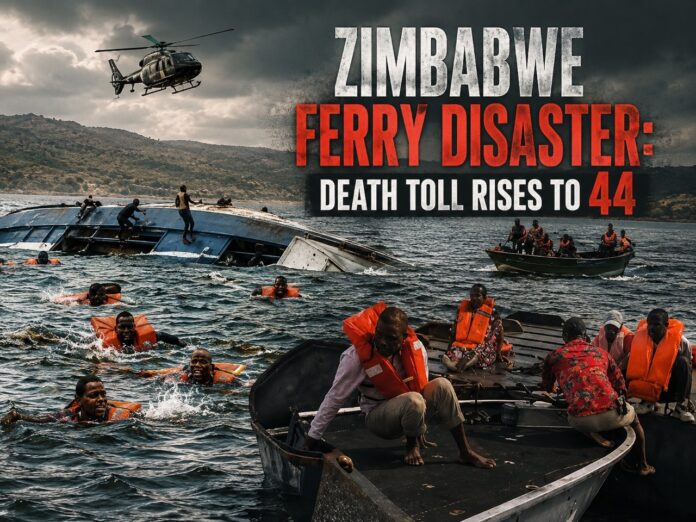
At least 44 people have died in the Zimbabwe ferry disaster on Lake Kariba after an overcrowded passenger vessel overturned in rough weather, authorities said Wednesday.
The vessel was carrying 114 adult passengers and five crew members when it capsized Tuesday. Officials said an unknown number of children were also aboard the boat.
The latest death toll was released as rescue teams continued searching the lake for people who may still be missing.
The vessel was operated by the Rural Infrastructure Development Agency and normally transports passengers between Kariba town in northern Zimbabwe and communities scattered across the lake, including islands and fishing settlements.
Authorities said the boat had a stated capacity of about 90 passengers, meaning the number of people aboard when it sank was significantly higher.
Initial figures indicated that 77 people had survived the accident and 15 bodies had been recovered. The Zimbabwe Republic Police later confirmed that the death toll had climbed to 44.
The disaster is now considered one of the most serious passenger boat accidents recorded on Lake Kariba.
Lake Kariba sits along the border between Zimbabwe and Zambia and is located more than 300 kilometres northeast of Zimbabwe’s capital, Harare. It is also recognized as the world’s largest man made lake by volume.
The search operation has involved police, military personnel, divers, larger boats and a helicopter supplied by a nearby national park.
A specialized aquatic rescue team was also transported to the area by air to strengthen the search.
The survivors who were rescued from the water were taken to Long Island, located in the middle of Lake Kariba, where they could receive assistance.
Two funeral homes were brought in to help recover and transport the bodies as authorities worked to account for everyone who had been aboard the vessel.
Witnesses described difficult conditions during the rescue.
Maxton Kanhema, who was aboard a smaller boat that responded to the emergency, said the ferry had departed earlier in the day despite poor weather conditions.
He recalled seeing signs of distress on the water before nearby boats moved toward the stricken vessel.
Bodies could be seen in the water as rescue crews worked to reach those who had survived the capsizing.
The precise cause of the accident remains under investigation. Kanhema said the vessel may have been struck by a large wave, potentially causing its engines to shut down before the boat overturned.
However, officials have not yet established an official cause.
The number of passengers aboard the vessel is also likely to form an important part of the investigation. With the boat reportedly designed to carry about 90 people but carrying at least 119 adults and crew, questions are likely to be raised about passenger safety and operating procedures.
Authorities will also examine the weather conditions, the condition of the vessel and the decisions made before the boat departed.
For communities that depend on Lake Kariba for transportation, fishing and commerce, the accident has brought renewed attention to the dangers of travelling on the vast waterway.
The lake stretches across a large area and serves as an important part of daily life for people living along its shores and on its islands. Passenger boats are particularly important for reaching communities that are difficult to access by road.
The scale of Tuesday’s tragedy has nevertheless shocked the region. As rescue crews continue searching the waters, families are waiting for information about loved ones who remain unaccounted for.
The Zimbabwe ferry disaster has also raised urgent questions about passenger capacity, weather assessments and safety procedures on Lake Kariba. As authorities work to establish exactly what went wrong, the immediate priority remains recovering those still missing and supporting the survivors and families affected by one of the lake’s deadliest recent accidents.