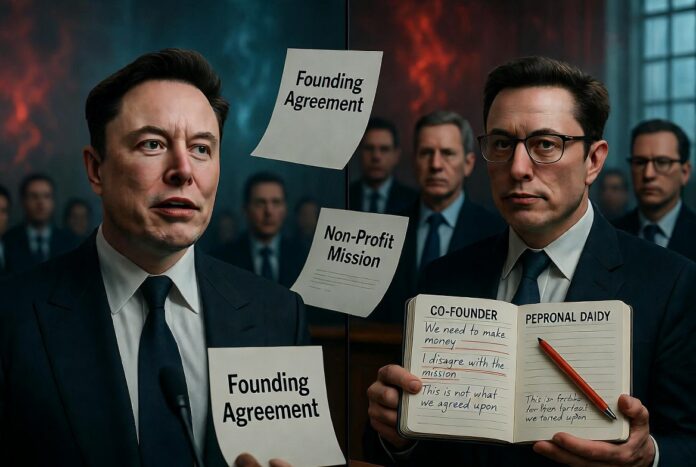
The high-stakes trial between Elon Musk and OpenAI entered a dramatic phase this week as testimony focused on the personal diary of Greg Brockman, OpenAI’s president and co-founder.
Musk alleges that Brockman, Sam Altman, and others betrayed the company’s original nonprofit mission to benefit humanity by shifting toward massive profits.
Diary entries from 2017, in which Brockman reflected on financial ambitions and internal decisions, have become central evidence. As of May 7, 2026, the case in Oakland, California, continues to reveal deep divisions over the future of artificial intelligence development.
This report examines the background of the lawsuit, key testimony surrounding the diary, broader implications for the AI industry, and what the proceedings mean for governance of powerful technology companies.
Origins of the Lawsuit
Elon Musk co-founded OpenAI in 2015 as a nonprofit organization dedicated to developing artificial intelligence safely and for the benefit of all humanity.
He left the board in 2018. Musk filed suit in 2024, claiming that OpenAI and its leaders abandoned this founding promise when they created a for-profit arm and pursued commercial deals, including a major partnership with Microsoft.
Musk argues the company was meant to operate as a “charity” focused on safety rather than profit. OpenAI counters that the shift was necessary to attract talent and funding to compete with companies like Google.
The trial, which began in late April 2026, has featured heated exchanges and previously private documents.
Greg Brockman took the stand in the second week. Musk’s legal team used his personal diary entries to question his motivations and those of other leaders.
“It was specifically meant to be for a charity that does not benefit any individual person. I could have started it as a for-profit and I specifically chose not to.” — Elon Musk, during his testimony.
The Diary Testimony: Private Reflections Under Scrutiny
Brockman kept a personal journal on his laptop starting around 2010. Entries from 2017 have drawn intense focus. Musk’s attorney Steven Molo questioned Brockman at length, forcing him to read several passages aloud in court.
One notable entry discussed financial goals: “Financially, what will take me to $1B?” Another reflected on converting OpenAI to a for-profit structure without Musk, with Brockman writing it would be “pretty morally bankrupt” or difficult to justify. He also noted concerns about “stealing the nonprofit from him.”
Brockman testified that these were private thoughts written during stressful times. He explained that while personal financial success mattered, decisions always aimed to advance OpenAI’s mission of safe AI development. His current stake in the for-profit entity is reportedly worth around $30 billion.

Musk’s side argues the entries prove leaders planned to prioritize personal gain. OpenAI’s team portrays them as normal human reflections that do not override the company’s achievements in advancing AI responsibly.
The diary was entered as evidence after discovery processes. Brockman described the experience of reading his old words in open court as “very painful.”
Key Diary Entries and Trial Context (2017 Reflections)
| Diary Entry Theme | Approximate Date | Brockman’s Testimony Explanation | Musk Team Interpretation | Potential Trial Impact |
|---|---|---|---|---|
| Financial ambition ($1B goal) | 2017 | Private reflection during early company stress | Shows profit motive over mission | Questions credibility |
| Converting structure without Musk | November 2017 | Morally difficult but necessary for mission | Evidence of betrayal and “stealing” charity | Central to breach claim |
| Concerns about honesty with Musk | 2017 | Acknowledged tension in decision-making | Proof of deception | Supports fraud allegations |
| Overall mission commitment | Various | Entries show ongoing focus on safe AI | Contradicted by later profit shift | Jury weighs intent |
Compiled from court testimony and reported diary excerpts as of May 7, 2026. Entries are paraphrased based on public reporting.
This table highlights how personal writings from nearly a decade ago are now being used to interpret founding intentions.
Musk’s Testimony and Broader Evidence
Musk testified for several hours earlier in the trial. He described OpenAI as a counterweight to Google’s AI efforts and insisted the nonprofit structure was fundamental. He admitted not reading all founding documents in detail but focused on the overall mission.
Other evidence includes emails, text messages, and details about internal discussions. Witnesses have addressed topics ranging from safety concerns to competitive pressures in the fast-moving AI field. The trial has also touched on broader issues like AI doomsday risks, though the judge has limited some speculative testimony.
Brockman disputed aspects of Musk’s account, noting that Musk himself explored for-profit ideas early on. He defended the need for significant capital to develop advanced models like those powering ChatGPT.
Industry and Legal Implications
The case raises important questions about how nonprofit organizations can evolve when facing rapid technological change. OpenAI argues the hybrid structure was essential to remain competitive and attract top talent. Musk warns that profit motives could lead to rushed, unsafe AI development.
A ruling in Musk’s favor could force structural changes at OpenAI or significant payouts. Victory for OpenAI would affirm the company’s right to adapt its model. Either outcome could influence how future AI companies are governed and funded.
The proceedings have drawn global attention. Tech leaders, investors, and policymakers watch closely as the trial reveals inner workings of one of the most influential AI organizations.
“The journal entries did the rest. It’d be wrong to steal the non-profit from him sits uncomfortably close to Musk’s framing.” — Analysis from court coverage highlighting the diary’s weight.
Legal experts note that contract interpretation, intent of the founders, and evidence of breach will decide the outcome. The diary provides a window into private thinking but requires context about the era’s uncertainties.

Reactions and Public Interest
Public opinion remains divided. Supporters of Musk see him as defending original principles against corporate greed. OpenAI backers view the suit as an attempt to hinder competition or settle personal scores. The livestream of proceedings has attracted significant viewers at peak moments.
Within the AI community, the trial underscores ongoing debates about safety, openness, and commercialization. Some researchers worry it distracts from critical work on responsible development.