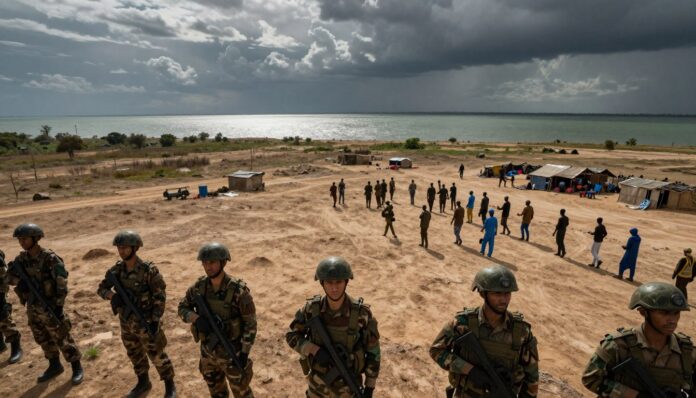
Chad has declared three days of national mourning after a Boko Haram ambush in the volatile Lake Chad Basin killed two senior generals, sending shockwaves through the country’s military and raising renewed concerns over worsening insecurity in the region.
The deaths are being viewed as a major blow to Chad’s counterinsurgency efforts and underscore the persistent threat posed by Boko Haram and affiliated armed groups operating around Lake Chad. The loss of the two commanders is also expected to have significant implications for Chad’s military strategy in one of Africa’s most unstable border regions.
In a government statement, authorities announced that national mourning would run from midnight on May 6 until midnight on May 9 “in memory of the martyrs who fell on the field of honour during the attacks by terrorist groups that occurred on May 4 and 6.”
The ambush came just two days after Boko Haram fighters attacked the Barka Tolorom military base near Lake Chad, killing at least 24 Chadian soldiers. The army said a “significant number” of attackers were also killed during the assault.
Escalating insurgency in the Lake Chad Basin
The Lake Chad region, a vast area of marshland and remote islands shared by Chad, Nigeria, Niger and Cameroon, has witnessed a sharp increase in militant activity in recent months.
Boko Haram’s Jama’atu Ahlis Sunna Lidda’awati wal Jihad faction, commonly known as JAS, has intensified kidnappings and attacks on military positions across the basin. The area’s difficult terrain and porous borders have continued to provide insurgents with key transit routes and operational hideouts.
Lake Chad’s islands and marshes are also used by Boko Haram’s rival faction, the Islamic State West Africa Province, or ISWAP, which remains active across the wider region.
Security analysts say insurgent groups have become increasingly sophisticated in their tactics, relying heavily on ambushes, improvised explosive devices and coordinated assaults that make it harder for government forces to respond effectively.
According to reports, the attack that killed the two generals occurred in a remote area where the terrain favored the militants. Insurgents reportedly used concealed positions and coordinated tactics to isolate the convoy carrying the commanders. Analysts believe intelligence gaps and limited real time surveillance may have contributed to the success of the ambush.
Loss of senior commanders raises military concerns
The two generals were regarded as experienced leaders within the Chadian Armed Forces and had played major roles in border security and counterinsurgency operations in the Lake Chad Basin.
They were also involved in mentoring younger officers and overseeing major military deployments in high risk areas. Their deaths represent a significant loss of operational experience and institutional knowledge for Chad’s military at a time when security threats are intensifying.
In response, the military has begun reorganizing parts of its command structure while deploying additional elite forces to vulnerable border regions. Authorities are also reviewing security procedures and convoy protection measures following the deadly ambush.
Maintaining troop morale and operational readiness has become a key priority as the armed forces attempt to adapt to the loss of senior leadership.

The attack also highlights the continuing challenges facing the Multi National Joint Task Force, a regional coalition involving Chad, Nigeria, Niger and Cameroon that coordinates military operations against Boko Haram and ISWAP. Despite years of operations, intelligence sharing and logistical coordination problems have continued to hinder efforts to fully dismantle insurgent networks.
Continuing instability and humanitarian strain
The latest violence comes months after Chad launched a major military counteroffensive following another deadly Boko Haram attack in October 2024 that killed around 40 Chadian soldiers at a military base in the Lake Chad Basin.
President Mahamat Deby responded at the time by ordering a large scale operation aimed at “destroying Boko Haram’s capacity to cause harm.” When the campaign concluded in February 2025, the army declared that Boko Haram no longer had “any sanctuary on Chadian territory.”
However, attacks against security forces have continued despite those claims, reflecting the resilience of insurgent groups in the region.
Beyond the security crisis, the violence has also deepened humanitarian challenges across the Lake Chad Basin. Thousands of civilians have been displaced by ongoing fighting, while access to healthcare, education and humanitarian aid remains severely restricted due to insecurity.
Aid organizations warn that both Chad and its regional partners face the difficult task of sustaining military operations while also addressing the growing needs of communities affected by years of conflict and instability.
The landlocked Central African nation has endured decades of political instability, rebellions and military coups, while chronic poverty and underdevelopment have further complicated efforts to stabilize the country and its border regions.