The DR Congo Ebola outbreak is approaching a devastating milestone, with the World Health Organization warning that the epidemic is spreading faster than any previous Ebola outbreak.
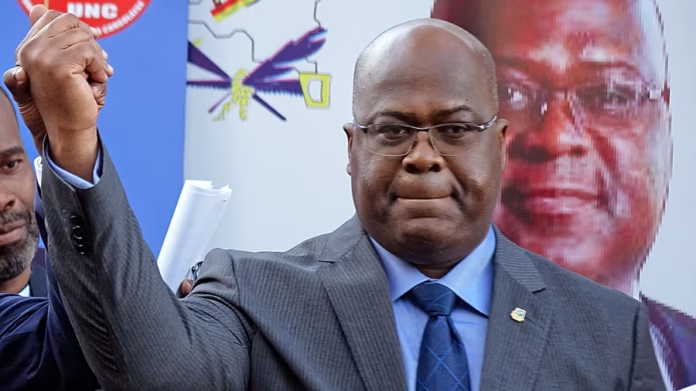
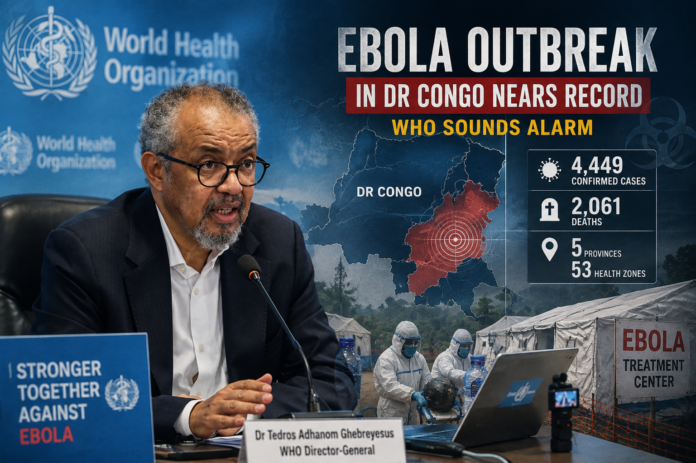
WHO Director-General Dr Tedros Adhanom Ghebreyesus issued the warning after returning from the Democratic Republic of Congo, where he met President Félix Tshisekedi and discussed the government’s response to the crisis.
Tedros praised the president’s efforts to contain the disease but said much more needs to be done to bring the outbreak under control.
According to figures cited by the WHO chief, 4,449 confirmed Ebola cases had been recorded, while the death toll had reached 2,061 across five provinces and 53 health zones.
The scale and speed of the outbreak have raised fears that it could eventually surpass the devastating West African Ebola epidemic of 2014 to 2016, which remains the largest Ebola outbreak ever recorded.
A major concern for health officials is that many people are dying outside medical treatment facilities. This suggests that the virus may be spreading through transmission chains that have not yet been identified by health authorities.
For disease control teams, finding people who have come into contact with infected patients is one of the most important tools for stopping Ebola. When deaths occur in communities without being detected by health workers, identifying those contacts becomes significantly more difficult.
Tedros warned that the presence of unknown transmission chains means the outbreak cannot be considered under control.
The DR Congo Ebola outbreak has also placed enormous pressure on health workers operating in affected communities. Treatment centres, surveillance teams and other medical personnel have been working to identify infections, trace contacts and prevent further transmission.
However, insecurity in parts of the country has made the response considerably more difficult. Some affected areas have limited access for health workers, creating additional challenges for teams attempting to investigate suspected cases and reach vulnerable communities.
During his visit, Tedros met with Tshisekedi as the government and international health organisations continued their efforts to contain the epidemic. The WHO has been supporting local authorities with medical expertise, surveillance and other resources.
Despite those efforts, the continued appearance of cases outside known contact networks remains one of the biggest obstacles facing the response.
The current outbreak has therefore become a race against time. Health officials need to identify hidden chains of transmission before the virus spreads further into communities that have not yet been affected.
The experience of the West African Ebola crisis demonstrated how quickly the disease can overwhelm health systems when transmission is not brought under control. That outbreak, which began in 2013, eventually caused thousands of deaths across Guinea, Liberia and Sierra Leone.
The WHO’s latest warning underscores the seriousness of the situation in DR Congo. With the outbreak already among the largest in history and continuing to spread rapidly, health authorities face an urgent task to find undetected cases, protect communities and break every remaining chain of transmission.
For DR Congo, the challenge is not simply reducing the number of new infections. It is ensuring that people carrying the virus are identified and treated before they can unknowingly pass it to others. Until those hidden chains are found and stopped, the Ebola outbreak will remain a major threat to the country.