A deadly bombing on a Colombian highway has killed at least 14 people and left dozens more seriously injured, including minors, in one of the country’s worst recent attacks as political and security tensions deepen ahead of national elections.
The blast struck a roadway in the southern department of Cauca, an area long plagued by guerrilla violence, drug trafficking, and clashes between armed factions. Images and videos shared online showed mangled vehicles, shattered wreckage, and debris scattered across the highway, while large craters marked the force of the explosion.
Authorities linked the attack to dissident rebels associated with the former Revolutionary Armed Forces of Colombia, whose breakaway factions continue to operate despite Colombia’s 2016 peace accord.
President Petro blames dissident rebels
Colombian President Gustavo Petro condemned the bombing and directly blamed insurgents tied to Farc dissident networks.
“Those who carried out this attack are terrorists, fascists and drug traffickers,” Petro said in a statement posted on X.
“I want our very best soldiers to confront them,” he added, signaling a likely intensification of military operations in the region.
Petro, himself a former guerrilla fighter in his youth, came to office promising a sweeping strategy known as “total peace,” aimed at negotiating with multiple armed groups simultaneously. That policy has produced intermittent ceasefires and localized truces, but critics say it has also allowed some criminal and insurgent factions to regroup.
The latest bombing is likely to intensify scrutiny of that strategy as Colombia heads toward a heated presidential election.
Cauca once again at the centre of violence
Governor Octavio Guzman described the bombing as indiscriminate and said the region has been overwhelmed by sustained violence.
Posting footage of overturned vehicles and damaged road surfaces, Guzman wrote that Cauca could not continue facing such barbarity alone.
Cauca has long been one of Colombia’s most volatile regions because of its strategic location between Pacific trafficking routes, coca growing zones, and mountainous terrain favorable to insurgent groups.
Residents and travelers in the area have frequently faced road blockades, extortion, bombings, kidnappings, and firefights involving rebels, criminal organizations, and state forces.
Witnesses told Agence France-Presse that the explosion was so powerful it threw some people several metres backward.
Dozens of those injured were reported to be in serious condition, with minors among the victims. Emergency crews were dispatched to transport survivors to nearby hospitals.
Wave of attacks raises alarm
Officials said the highway bombing was not an isolated incident.
Governor Guzman reported a series of smaller attacks in Cauca since Friday, suggesting a coordinated escalation. One of those incidents allegedly targeted a military base in the city of Cali, leaving two people injured.
Defence Minister Pedro Arnulfo Sánchez said security forces also intercepted a bus packed with explosives earlier in the day in Cauca before it could detonate.
He attributed that attempted attack to members of a drug trafficking cartel, underscoring the blurred lines in Colombia between ideological insurgencies and organized crime.
Analysts have long noted that many armed factions now finance themselves primarily through narcotics trafficking, illegal mining, extortion, and territorial control rather than political ideology alone.
Election season shadowed by violence
The bombing comes roughly one month before Colombia’s presidential election scheduled for May 31, increasing fears that political violence is once again shaping the country’s democratic process.
Security concerns have already been heightened by recent attacks on political figures. Right wing candidate Miguel Uribe Turbay was assassinated by a 15-year-old gunman at a rally in the capital Bogotá in June, dying two months later in hospital, according to the account provided.
That killing shocked Colombia and revived memories of the country’s darkest periods when candidates, judges, journalists, and activists were routinely targeted.
Current polling has placed leftist senator Ivan Cepeda, a prominent supporter of Petro’s negotiations with armed groups, among leading contenders.
The renewed violence may now become a defining campaign issue, with opponents likely to argue that the government’s peace approach has failed to contain armed actors.
Peace process under strain
Colombia’s 2016 peace deal with the Farc was hailed globally as a historic breakthrough after more than five decades of conflict. But not all fighters demobilized, and dissident factions later emerged in remote areas.
Those breakaway groups have since challenged the state, fought rivals, and sometimes entered intermittent talks with Petro’s administration.
Recent years have shown both the promise and fragility of negotiations. Some ceasefires reduced clashes temporarily, yet attacks like the Cauca bombing reveal how quickly violence can return.
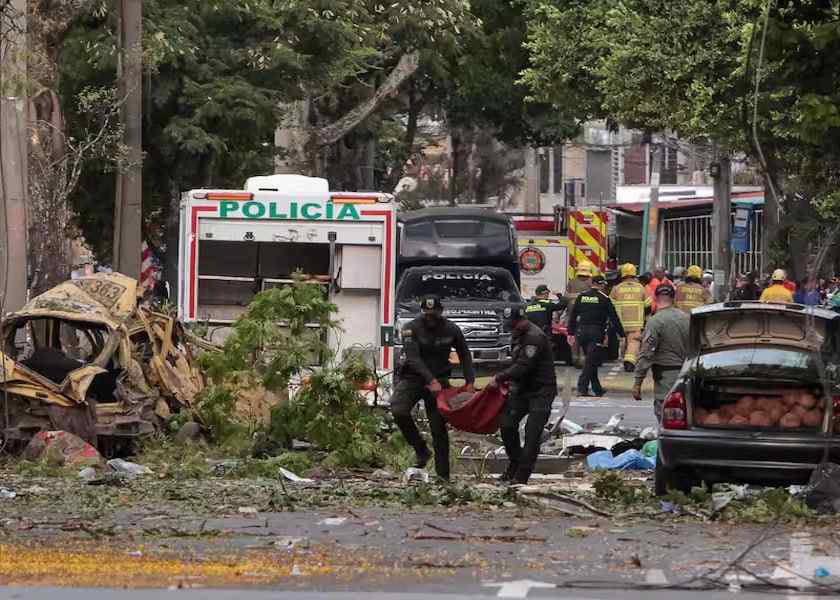

Investigators are expected to examine explosive remnants, communications intercepts, and intelligence reports to determine exactly which faction carried out the bombing.
Meanwhile, families of the dead and injured are demanding accountability as emergency teams continue treating survivors.
With elections nearing and public anxiety rising, the attack is likely to deepen debate over whether Colombia should continue negotiating with armed groups or pivot toward a harder military response.