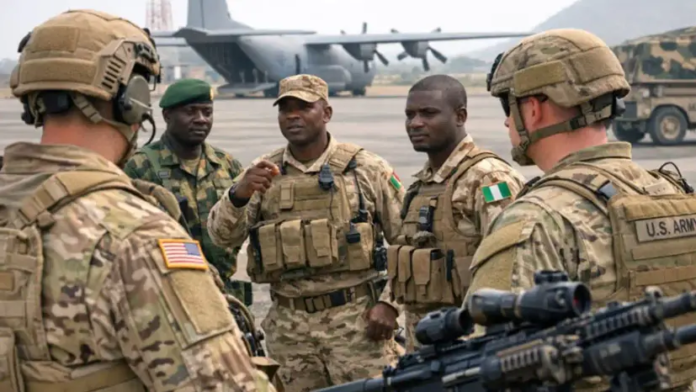
The US troops withdrawal from Nigeria marks a new phase in security cooperation between Washington and Abuja, as the United States shifts its focus from direct military deployment to intelligence sharing and strategic support in the fight against terrorism.
American officials say most of the military personnel sent to Nigeria earlier this year for counterterrorism operations in the Lake Chad Basin have now returned home after completing their mission. However, both countries will continue working closely on intelligence and security matters.
US Troops Withdrawal From Nigeria Signals New Counterterrorism Strategy
General Dagvin R.M. Anderson, Commander of US Air Forces in Africa, announced the development during a virtual briefing following the African Chiefs of Defence Conference 2026.
According to Anderson, the operation that required the deployment of American forces has successfully ended, leading to the withdrawal of most US personnel from Nigeria.
Despite the move, he emphasized that intelligence cooperation between the two nations remains strong and will continue based on requests from the Nigerian government.
He explained that the mission in the Lake Chad Basin contributed significantly to disrupting ISIS activities, not only within the region but also across the global terrorist network.
“The operation helped countries beyond the immediate region because it weakened the wider ISIS structure,” Anderson stated.
Intelligence Sharing Remains Central After US Troops Withdrawal From Nigeria
Although American troops have largely departed, US troops withdrawal from Nigeria does not mean the end of security cooperation between both nations.
The United States has pledged to maintain intelligence support that helps Nigerian forces track and combat extremist groups operating within the country and neighboring regions.
Anderson noted that intelligence sharing has proven to be one of the most effective tools in modern counterterrorism efforts.
He explained that future partnerships would focus more on providing specialized capabilities rather than maintaining large numbers of foreign troops on the ground.
According to him, this approach allows local forces to remain in control while benefiting from advanced intelligence resources and technical support.
Nigeria Praised as a Strong Regional Security Partner
The American military commander described Nigeria as one of Africa’s most capable and influential countries.
He praised the nation’s strong economy, educated population, and experienced military forces, noting that these strengths have made cooperation between both countries highly effective.
Anderson said the United States contributed specialized intelligence resources that complemented Nigeria’s military operations rather than replacing them.
This collaborative approach, he noted, has delivered important victories against terrorist organizations operating in West Africa.


Joint Operation Eliminated Senior ISIS Leader
One of the most significant outcomes of the security partnership came in May 2026, when a joint operation led to the death of Abu-Bilal Al-Minuki, the second-highest-ranking official within ISIS.
The operation took place in Borno State, where Nigerian and American intelligence capabilities worked together to locate and eliminate the militant leader.
According to Anderson, the ISIS commander played a major role in the group’s international activities, including media operations, recruitment efforts, and global coordination.
He described the mission as an example of how intelligence cooperation can produce stronger results than prolonged foreign military deployments.
“Bringing unique capabilities to support local partners allows them to succeed in these difficult operations,” he explained.
African Intelligence Cooperation Seen as Key to Regional Security
Beyond Nigeria, Anderson called for stronger intelligence partnerships among African countries to tackle growing security challenges across the continent.
He argued that terrorism, organized crime, and drug trafficking require coordinated efforts that extend beyond national borders.
The commander highlighted a recent multinational operation that resulted in the seizure of a record 31 tons of cocaine traveling from South America through West African waters.
The vessel was eventually intercepted by Spanish authorities following intelligence cooperation involving African partners, AFRICOM, and several American agencies.
The operation marked the largest maritime cocaine seizure ever recorded and demonstrated the value of international collaboration in fighting transnational crime.
Background to the US Military Deployment in Nigeria
The US troops withdrawal from Nigeria follows a deployment that began in February 2026.
At the time, approximately 200 American military personnel arrived in Nigeria to support intelligence gathering, surveillance operations, and counterterrorism activities within the Lake Chad Basin.
The deployment came as both countries increased efforts against ISIS and other extremist organizations operating in northern Nigeria and surrounding areas.
It also followed President Donald Trump‘s decision to redesignate Nigeria as a Country of Particular Concern while promising stronger American support for counterterrorism initiatives in the region.
In December 2025, American forces conducted air strikes against terrorist camps in the Bauni Forest area of Sokoto State as part of broader operations targeting extremist networks.
A New Chapter in US-Nigeria Security Relations
The US troops withdrawal from Nigeria represents a shift in strategy rather than a reduction in cooperation.
Both governments appear committed to maintaining a strong security partnership based on intelligence sharing, specialized support, and joint operations against terrorism.
Officials believe this model allows Nigeria to lead its own military efforts while benefiting from American technological capabilities and intelligence resources.
As security threats continue evolving across West Africa, sustained cooperation between regional governments and international partners is expected to remain essential for promoting stability, economic growth, and long-term peace throughout the continent.