As President Donald Trump’s second term progresses through May 2026, political attention is beginning to shift toward the 2028 presidential race, the first open contest without an incumbent seeking reelection since 2016.
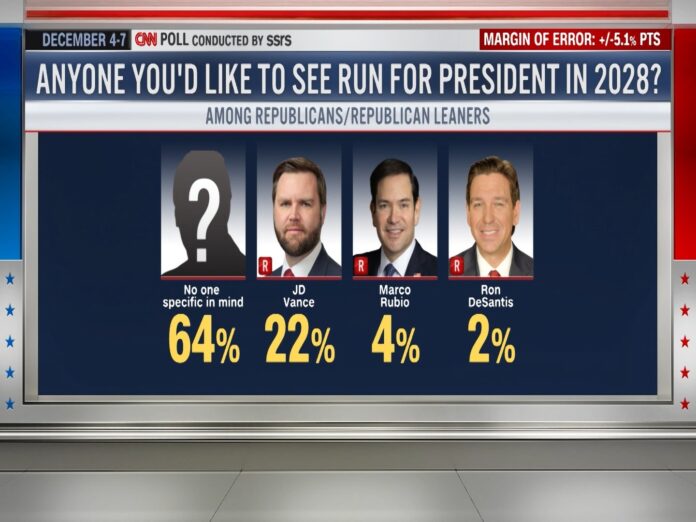
Early polling and prediction markets show Vice President JD Vance as the clear Republican frontrunner, while Democrats remain without a dominant leader in a fragmented field.
On the Republican side, Vance holds a commanding lead among potential contenders, with recent polls showing him drawing support between 40 and 53 percent among GOP voters, far outpacing his closest rivals. Secretary of State Marco Rubio consistently places second in the mid-teens, followed by Donald Trump Jr. and Florida Governor Ron DeSantis in single digits.
Vance’s position benefits from his role as vice president, his close alignment with Trump, and strong performances in early straw polls, including a 53 percent showing at CPAC. Prediction markets currently assign him roughly 37 to 40 percent odds of winning the Republican nomination.
Other names occasionally mentioned include Ted Cruz, Nikki Haley in some surveys, and governors such as Greg Abbott, though none have come close to challenging Vance’s early dominance.
The Democratic primary picture looks considerably less settled. Former Vice President Kamala Harris narrowly leads several national polls with around 22 percent support, closely trailed by California Governor Gavin Newsom at 21 percent. Transportation Secretary Pete Buttigieg and Rep.
Alexandria Ocasio-Cortez follow in the low teens. Other potential contenders include governors Gretchen Whitmer of Michigan, Josh Shapiro of Pennsylvania, and Andy Beshear of Kentucky, along with senators such as Cory Booker. Many prominent Democrats appear to be holding off on signaling 2028 ambitions while focused on this year’s midterm elections.
According to April 2026 polling averages compiled from Echelon Insights, YouGov, and other public surveys, Vance’s Republican support ranges between 42 and 53 percent, with Rubio between 14 and 27 percent, Trump Jr. between 10 and 13 percent, and DeSantis at roughly 8 percent. On the Democratic side, Harris polls between 22 and 23 percent, Newsom between 17 and 21 percent, Buttigieg between 11 and 17 percent, and Ocasio-Cortez between 10 and 13 percent.
Prediction markets such as Polymarket and Kalshi currently favor Vance as the individual candidate most likely to win the presidency outright, giving him roughly a 19 to 20 percent chance, with Newsom and Rubio close behind.
However, broader market sentiment gives Democrats an overall edge heading into the general election, with odds suggesting a 60 to 62 percent chance the party retakes the White House in 2028, a reflection of perceived headwinds for Republicans after two Trump terms.
One market analysis noted that “markets currently assign a slight edge to Democrats overall, even as Vance leads individual betting odds,” adding that the 2026 midterms and any Trump endorsement will significantly shape the race’s trajectory.
Early hypothetical general election matchups remain mixed and carry limited predictive weight this far from the election. Vance often leads or ties Newsom in head-to-head polling but trails Harris in some earlier surveys.
Several factors are likely to shape how the race develops over the coming two years. Performance in the 2026 midterms could solidify Vance’s standing if Republicans do well, or boost the profiles of Democratic governors like Newsom or Whitmer if Democrats make gains. Trump’s eventual endorsement remains a potentially decisive factor within the Republican field.
Economic conditions, including inflation and energy prices affected by ongoing global tensions, along with foreign policy developments, are expected to weigh heavily on voter sentiment.

Democratic candidates have so far emphasized abortion rights, concerns about democratic institutions, and economic populism, while Republicans have focused on border security, the economy, and cultural issues.
Demographic shifts, particularly among younger voters and in swing states such as Michigan, Pennsylvania, and parts of the Sun Belt, are also expected to play a significant role.
Despite the early polling, observers caution that the race remains highly volatile this far from the primaries. Historical precedent shows that early frontrunners often falter and that unexpected candidates can emerge as the field develops.