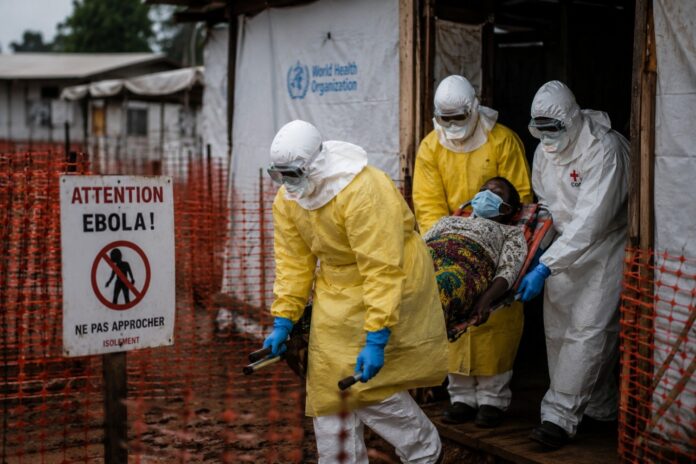
When three members of his hospital team fell ill and died within days of caring for the same patient, Dr. Richard Lokudu began to suspect that Ebola had already been circulating long before officials confirmed an outbreak. The patient had been admitted to Mongbwalu General Hospital in Ituri Province for surgery in early April, weeks before the Democratic Republic of Congo formally announced that Ebola had returned to the country.
By the time health authorities declared the outbreak on May 15, the surgical assistant, the anaesthetist, and a member of the post-operative care team who had treated that patient were all dead. Those losses were among the earliest warning signs of what has since become the deadliest Ebola outbreak in the country’s history.
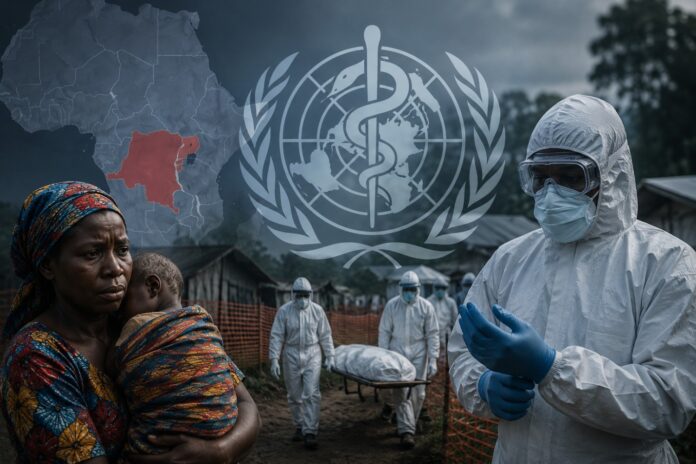
Three months after the declaration, more than 4,900 confirmed cases and over 2,300 deaths have been recorded, according to health authorities and international agencies tracking the crisis. That toll has now overtaken the previous worst outbreak, which struck between 2018 and 2020 and claimed roughly 2,300 lives.
Unlike that earlier epidemic, which was driven by the Zaire strain of the virus and met with approved vaccines and treatments, the current wave is caused by Bundibugyo virus disease, a rarer form of Ebola first identified in Uganda in 2007. No licensed vaccine or specific approved therapy currently exists for this strain, leaving medical teams dependent on early detection, supportive care, strict infection-control measures, and cooperation from local communities to slow its spread.
The World Health Organization says the outbreak was first identified in Ituri Province before spreading into neighboring areas. Officials have pointed to armed conflict, the movement of displaced populations, and delays in identifying early cases as key factors that allowed transmission chains to grow before response teams could be fully deployed.
For families in the region, the statistics translate into personal grief. Furaha Gisèle, 35, lost her uncle to the disease in Rwampara, a community roughly ten kilometers from Bunia, the provincial capital. She said residents are already contending with insecurity, weak governance, and poverty, and now fear what the epidemic will bring next.
Congolese officials acknowledge that the Ebola virus was likely spreading silently for weeks before it was formally identified, giving it a head start that response teams have struggled to overcome. Professor Pierre Akilimali, who leads the national response effort, said laboratory capacity in Ituri has expanded significantly since the crisis began — from having no testing facilities at the outset to more than a dozen labs now operating in the province. Early reliance on labs outside the region, he said, slowed the confirmation of cases when speed mattered most.
Ituri’s decades-long conflict has compounded the challenge. Armed groups contesting control of mineral-rich territory have restricted movement and made it difficult for health workers to reach some communities. Dr. Justus Nsio, an incident manager with the Africa Centres for Disease Control and Prevention, described operating in a province under a state of siege, saying teams are doing what they can with limited resources to stand alongside affected communities.
Dr. Thierno Balde, who oversees the World Health Organization’s response to the outbreak, said the uncontrolled movement of sick individuals between affected localities and nearby areas has been a major driver of the virus’s geographic spread. For health workers on the ground, containing the disease has become as much a struggle against conflict and restricted access as it is a medical fight. As one hospital director in the region put it, when gunfire breaks out, no one can hold their position and neither can the response.

The Democratic Republic of Congo has confronted Ebola outbreaks repeatedly since the virus was first identified in the country in 1976, building what is often described as unmatched institutional experience in fighting it. Yet health workers in Ituri say that experience alone has not been enough this time. Conflict, difficult terrain, delayed detection, and mistrust among some communities have combined to make this Ebola outbreak uniquely difficult to contain, turning what might have been a manageable flare-up into the deadliest chapter in the country’s long history with the disease.
Related: Some Health Workers in DR Congo’s Ebola Outbreak Go on Strike Over Pay Issues As Deaths Near 600
This article was produced by the Maple Epoch Editorial Team. See our editorial standards and AI-use disclosure and editorial policy.