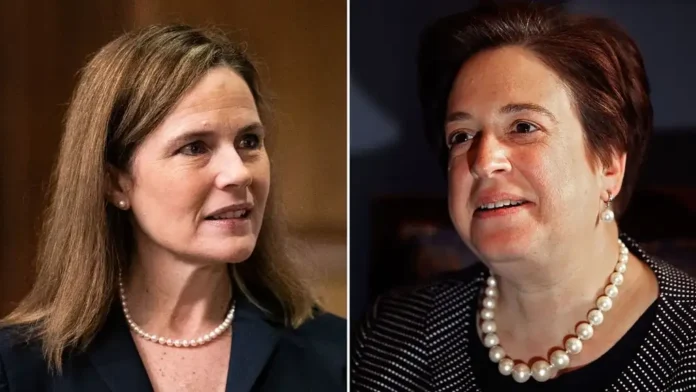
The U.S. Supreme Court is making a rare appeal to Congress for additional security funding as threats against federal judges continue to rise across the country. Justice Amy Coney Barrett and Justice Elena Kagan are scheduled to testify before lawmakers, highlighting growing concerns about the safety of judges and their families.
The hearings come at a politically sensitive time, just days after the Supreme Court delivered several high-profile rulings involving President Donald Trump. While the primary focus is expected to be judicial security, lawmakers are also likely to question the justices on ethics, court transparency, and recent controversial decisions.
The federal judiciary is requesting nearly $9.7 billion in discretionary funding for the next fiscal year, including approximately $921 million dedicated to court security. The request represents a $29 million increase over the previous year and is intended to strengthen security at federal courthouses across the United States.
Part of the proposal includes nearly $15 million to expand the Supreme Court Police, allowing officers to provide greater protection for the justices and their families both at the court and at their private residences.
Judicial officials argue the increased funding is necessary as security threats against judges continue to escalate. According to the U.S. Marshals Service, serious security incidents involving members of the federal judiciary rose by 57 percent in 2025 compared with the previous year.
Justice Amy Coney Barrett is expected to play a leading role during Tuesday’s congressional hearings because she has personally experienced several security threats since joining the Supreme Court in 2020.
In May, police responded to Barrett’s Virginia home after receiving a false emergency report, commonly known as a “swatting” incident. Authorities later determined the report was fabricated and intended to draw heavily armed officers to her residence.
A year earlier, Barrett’s sister’s home in South Carolina was targeted by a bomb threat. In 2024, Barrett also revealed that court officials had once provided her with a bulletproof vest due to unspecified security concerns.
Court transparency advocate Gabe Roth said Barrett’s firsthand experience makes her well-positioned to explain why additional security resources are necessary. The push for additional funding follows several alarming incidents involving Supreme Court justices in recent years.
One of the most serious occurred in 2022 when a California man traveled to Justice Brett Kavanaugh’s neighborhood carrying firearms and other weapons with the intention of killing the justice. He was later arrested and sentenced to more than eight years in prison.
Justice Clarence Thomas has also spoken publicly about the growing security challenges facing members of the court. During a legal conference earlier this year, he said heightened threats have significantly limited his ability to participate in public activities outside the courthouse.
Supporters of the funding request argue that stronger security measures are essential to protect judges from increasingly sophisticated physical and cyber threats.
Although the hearings are officially focused on the judiciary’s budget, members of Congress are expected to raise several other issues involving the Supreme Court.
Among the likely topics are ethics reforms, internal efforts to prevent confidential leaks, and the court’s handling of prediction markets related to its decisions.
Justice Barrett may also face questions about several recent rulings in which she joined majorities that rejected key policies advanced by President Donald Trump.
Most notably, Barrett joined Chief Justice John Roberts and the court’s liberal justices in concluding that Trump’s attempt to end automatic birthright citizenship through executive action was unconstitutional.
She also supported a decision limiting the president’s global tariff authority earlier this year.
Although Barrett remains one of the court’s conservative justices and has consistently supported conservative rulings on issues such as abortion, religious liberty and presidential immunity, some conservative activists have criticized her recent decisions involving the Trump administration.
Legal commentator Mike Davis, who has been critical of Barrett’s vote in the birthright citizenship case, nevertheless said congressional budget hearings are not the appropriate venue to challenge Supreme Court justices over their judicial decisions.
As Congress considers the judiciary’s funding request, the hearings are expected to underscore the growing security challenges facing the nation’s highest court while also highlighting the continuing political scrutiny surrounding several of its most consequential rulings.