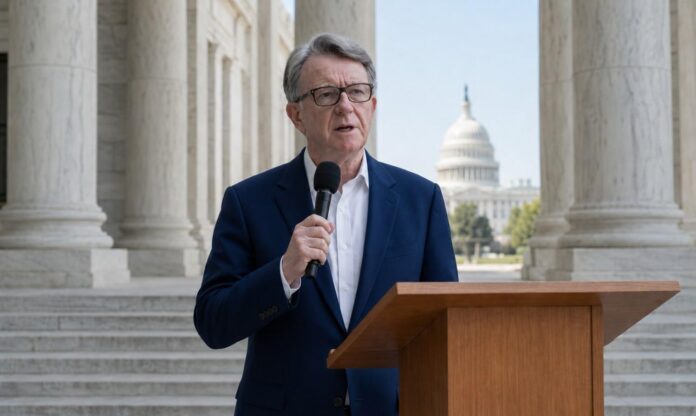
Andy Burnham, the popular Mayor of Greater Manchester, has won a special election for a seat in Parliament and signalled he intends to use it to challenge embattled Prime Minister Keir Starmer for leadership of the country.
Burnham decisively won the seat of Makerfield in northwestern England on Friday, taking almost 55 percent of the 45,510 votes cast across a field of more than a dozen candidates, over 9,000 votes more than his nearest rival, Rob Kenyon of the anti-immigration party Reform UK. The result cements the status of Burnham, 56, nicknamed the King of the North, as the leading contender to replace Starmer as Labour leader and prime minister.
Starmer said he planned to fight for his job, but a growing number of colleagues urged him to make a dignified exit. “There is this sense of collective movement,” former Labour Deputy Leader Harriet Harman told the Electoral Dysfunction podcast. “Andy Burnham is going to become prime minister. Keir Starmer is going to be leaving office.”
Burnham’s acceptance speech left little ambiguity about his ambitions. “Everyone knows that politics isn’t working,” he told supporters. “Everyone can feel that the country isn’t where it should be. Tonight could, just could, be the turning point.” He pledged to lay out “a new path for Britain,” promising an economy that “works for everybody, not a few in far-off places from here.”
He also warned that Labour had “a final chance to change” and win back voters’ trust, saying the result offered an opportunity to “build a new politics based on unity and hope, turning away from the path that takes us to a divided, dark politics of the kind we see in the United States.”
Starmer congratulated Burnham on X, writing that voters had “chosen Labour’s campaign of hope and optimism over division and hate,” but insisted he would fight any attempt to oust him. “I will run, I will stand,” he said of a potential leadership contest. “I’ve said repeatedly I’m not going to walk away from that.”
Burnham has led Manchester since 2017, overseeing significant regeneration for the city, and is pledging to apply his brand of so-called Manchesterism on a national scale.
Rob Ford, professor of political science at the University of Manchester, said the Makerfield victory strengthens Burnham’s claim to be Labour’s most valuable asset. “The narrative he can bring is, ‘No one else could have won that seat. I won that. I bring something unique. I bring an ability to renew our appeal,'” Ford said.
Voters in Makerfield, which drew intense international media attention throughout the five-week campaign, were acutely aware their votes carried unusual weight. “I voted Andy Burnham because I don’t believe Keir Starmer has done a good job,” said Ernest Sherman, 70. “So I voted tactically knowing that Andy Burnham has a chance to replace Starmer. So it will still be Labour, but he will have different views.”
Starmer’s popularity has collapsed since he led Labour to a landslide election victory in July 2024. He has struggled to deliver promised economic growth, repair public services, and ease the cost of living, and has been dogged by repeated missteps, including his decision to appoint Peter Mandelson, a scandal-tarnished associate of Jeffrey Epstein, as UK ambassador to the United States.
Labour is losing liberal voters to the growing Green Party while simultaneously facing a surging Reform UK, which consistently leads in national opinion polls. Reform leader Nigel Farage acknowledged he was “disappointed, no question about it,” with the Makerfield result, which had been seen as fertile territory for his party’s expansion in post-industrial northern England.
Labour’s poor performance in May’s local elections prompted scores of lawmakers to demand Starmer’s resignation. Health Secretary Wes Streeting resigned in May, saying “where we need vision, we have a vacuum,” and has since said he will run in any leadership contest. It was Labour MP Josh Simons, the sitting member for Makerfield, who stepped down to trigger the special election and give Burnham the opportunity to return to Parliament.
Under Britain’s parliamentary system, governing parties can change leaders mid-term, with the winner automatically becoming prime minister without the need for a national election. Under Labour rules, a challenger must secure the backing of at least a fifth of the party’s House of Commons lawmakers, currently a threshold of 81 MPs.
Burnham is expected to travel to London to be sworn in as a lawmaker as soon as Monday, and is likely to seek a meeting with Starmer to argue that the prime minister should set a timetable for his departure.
Burnham’s supporters wasted no time in pressing Starmer to go. Labour MP Louise Haigh, a Burnham ally, said Starmer should “consider an orderly and managed transition,” telling Sky News: “Andy won’t be doing anything rash or hasty. I’m really hopeful the prime minister and Andy can come to an agreement.”
Starmer insisted Friday he was elected on a “mandate for change” and would continue delivering it. An earlier suggestion that he might offer Burnham a Cabinet post was rebuffed by Burnham’s allies.
Despite his stated determination to stay, Starmer could be forced out if senior Cabinet members quit or threaten to quit in protest. A leadership contest or a coronation could then follow, depending on whether other potential candidates judge that Burnham’s position is unassailable.
“When things begin to slide away from a prime minister, they begin to slide away very, very quickly,” said Tim Bale, professor of politics at Queen Mary University of London. “Over the weekend there will be all sorts of talks behind closed doors, mainly I suspect people trying to persuade Keir Starmer that the game is up.”