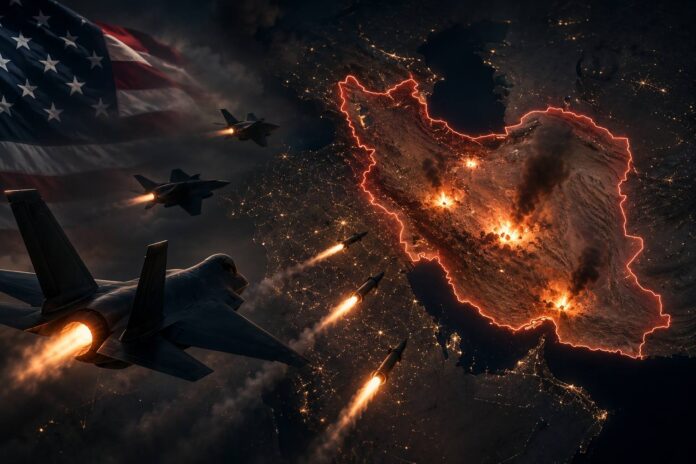
The United States launched another round of airstrikes against targets in Iran early Thursday after President Donald Trump warned that Tehran would “pay the price” if negotiations remained stalled, while Iran responded with attacks targeting Bahrain, Kuwait and Jordan.
The latest U.S. strikes hit multiple locations across Iran as diplomatic efforts to end the conflict appeared deadlocked. Iran continued to insist it would maintain control over the Strait of Hormuz, a vital shipping route whose disruption has driven global energy prices higher.
The exchange marked the third major cycle of attacks this week despite previous attempts to stabilize the conflict.
Trump has repeatedly urged Iran to agree to a deal to end the war and earlier suggested an agreement could be reached within days. Iran, however, has maintained that its leverage over the Strait of Hormuz provides it with a significant bargaining position.
Iran’s representative to the United Nations said the United States should refrain from threats of force if it wants negotiations to succeed.
At the same time, both governments have signaled interest in finding a diplomatic solution, although major differences remain.
Israeli Prime Minister Benjamin Netanyahu has continued to pursue objectives that complicate negotiations, including dismantling Iran’s nuclear program and confronting the Iran-backed Hezbollah movement in Lebanon. Iran and Israel also exchanged attacks earlier this week.
U.S. and Iranian Military Actions
U.S. Central Command said it had completed a series of airstrikes shortly before sunrise in Iran, describing the operation as a response to what it called Iran’s continued aggression.
According to the military, the strikes targeted Iranian military surveillance capabilities, communication systems and air defense sites. The operation involved assets from the U.S. Air Force, Marine Corps and Navy, although officials did not provide an assessment of the damage.
Explosions were reported in Tehran as well as Bandar Abbas and other areas near the Strait of Hormuz.
Iran subsequently launched strikes toward Bahrain, Kuwait and Jordan. Kuwait temporarily closed its airspace while its air defense systems responded, and the country’s civil aviation authority said flights were diverted to other airports.
Kuwaiti authorities said the decision was taken because of the security risks posed by the Iranian attacks.
Israel also issued warnings for residents in northern areas to seek shelter following reports of incoming fire from Lebanon. The U.S. Embassy in Jordan warned that missiles, drones or rockets had been reported in Jordanian airspace.
Iran later said it had again targeted Jordan’s Muwaffaq Salti Air Base.
Strait of Hormuz Remains a Central Issue
Since the conflict began in late February, disruptions around the Strait of Hormuz have contributed to volatility in global energy markets.
International benchmark crude oil prices rose above $93 per barrel on Wednesday, an increase of more than 25% since the start of the conflict.
Trump said the U.S. military has conducted operations to help commercial oil shipments move through the Strait of Hormuz despite Iranian pressure. He claimed that more than 100 million barrels of oil had successfully passed through, although no independent confirmation of that figure was immediately available.
A spokesman for U.S. Central Command said American forces coordinate with commercial vessels in the region but did not provide additional operational details.
The command also disputed Iranian claims that the Strait of Hormuz is effectively closed, saying commercial shipping continues to transit the waterway.
Earlier Wednesday, the U.S. military said it also struck the engine room of the Palau-flagged tanker M/T Settebello, alleging the vessel was attempting to breach a naval blockade while transporting Iranian oil.
India’s foreign ministry said three Indian sailors were missing after the incident, while 21 others were rescued. U.S. officials said the vessel’s crew had been warned before the strike.
Iran also said U.S. attacks damaged two water reservoirs in the southern city of Sirik, temporarily disrupting water supplies for thousands of residents. U.S. officials did not immediately comment on that claim.
Iranian Foreign Minister Abbas Araghchi condemned the American strikes as violations of Iranian sovereignty.
Meanwhile, mediation efforts continued. Following consultations with Washington, a delegation from Qatar arrived in Tehran for discussions, according to an official familiar with the visit.
The exchanges came a day after a U.S. Army attack helicopter crashed near the Strait of Hormuz following a collision with an Iranian drone, according to a U.S. official speaking on condition of anonymity. Both crew members were rescued, and Trump said they were uninjured.
Significant obstacles still continue to stand in the way of a negotiated settlement.
The United States is seeking the elimination of Iran’s stockpile of highly enriched uranium, arguing that it could be quickly converted for weapons use. Iran maintains that its nuclear program is peaceful and has refused to surrender the material.


Iran has further insisted that any agreement should address fighting involving its ally Hezbollah and Israel, while Israel has continued military operations against the Lebanon-based group.