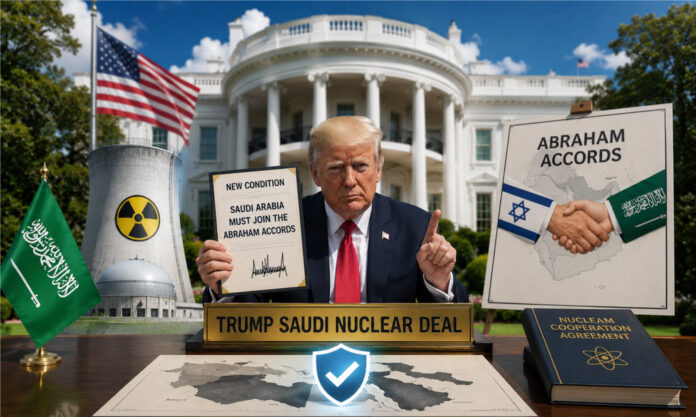
President Donald Trump has added a major new requirement to the Trump Saudi Nuclear Deal, declaring that Saudi Arabia must join the Abraham Accords before the recently signed nuclear cooperation agreement can move forward.
The announcement came just one day after US and Saudi officials finalized the civilian nuclear agreement, introducing uncertainty over a deal that had already been presented as a significant step in strengthening ties between Washington and Riyadh.
Trump made the announcement on social media, stating that although the agreement had been signed, its approval now depends entirely on Saudi Arabia establishing diplomatic relations with Israel through the Abraham Accords.
He also reiterated that the agreement would not allow uranium enrichment, despite earlier reports suggesting Saudi Arabia could eventually enrich fuel for peaceful nuclear energy under strict conditions.
Trump Saudi Nuclear Deal Now Linked to Abraham Accords
The new condition marks a significant shift in the administration’s approach to the Trump Saudi Nuclear Deal.
White House Press Secretary Karoline Leavitt confirmed that Trump personally made the decision and emphasized that the president has the final authority over any international agreement negotiated by his administration.
According to Leavitt, the deal cannot proceed unless Saudi Arabia agrees to normalize relations with Israel. She added that Trump has consistently supported expanding the Abraham Accords and has discussed the issue with Saudi leaders in previous conversations.
However, she noted that Trump had not spoken with Saudi Crown Prince Mohammed bin Salman after announcing the new condition.
The Saudi crown prince has repeatedly maintained that his country will not establish formal diplomatic relations with Israel without a credible pathway toward the creation of a Palestinian state.
The civilian nuclear agreement was signed on Wednesday by US Energy Secretary Chris Wright and his Saudi counterpart.
The deal is designed to help Saudi Arabia develop a civilian nuclear energy program while maintaining restrictions intended to prevent the spread of nuclear weapons technology.
Earlier plans reportedly called for a joint US Saudi assessment to determine whether uranium enrichment would be necessary and commercially practical before any enrichment activities could begin. Under that proposal, American experts would build the required facilities without transferring sensitive nuclear technology to Saudi Arabia.
The agreement also contains inspection provisions, but Saudi Arabia is not required to adopt the International Atomic Energy Agency’s Additional Protocol, a higher level of transparency accepted by countries such as the United Arab Emirates under its nuclear agreement with the United States.
This aspect of the agreement has already drawn attention from lawmakers and regional allies concerned about nuclear safeguards in the Middle East.
Longstanding Link Between Nuclear Cooperation and Israel
For years, diplomatic recognition of Israel has been viewed as an important factor in US discussions over nuclear cooperation with Saudi Arabia.
During Trump’s first administration, the Abraham Accords led to normalization agreements between Israel and several Arab nations, including the United Arab Emirates, Bahrain, Morocco and Sudan.
Previous US administrations also viewed normalization between Saudi Arabia and Israel as an important objective during negotiations over civilian nuclear cooperation.
However, regional tensions following the October 7, 2023 Hamas attack and the subsequent conflict in Gaza made normalization significantly more difficult for Saudi Arabia, prompting negotiators to explore a more limited framework for nuclear cooperation.
Trump’s latest announcement appears to restore normalization as a central requirement for the agreement.
Mixed Reactions After Trump’s Announcement
Trump’s new condition reportedly surprised members of the administration involved in negotiating the agreement, raising questions about how the signed deal will proceed.
Saudi officials have not publicly responded to Trump’s latest remarks.
Meanwhile, Israeli Prime Minister Benjamin Netanyahu’s office welcomed the announcement, describing Saudi Arabia’s potential participation in the Abraham Accords as a historic opportunity to advance peace and strengthen regional cooperation.
Despite the agreement already being signed, it remains unclear whether implementation will be delayed until Saudi Arabia formally commits to the normalization process.
The future of the Trump Saudi Nuclear Deal now depends on diplomatic developments that extend far beyond nuclear energy.
While the agreement was intended to strengthen strategic cooperation between the United States and Saudi Arabia, Trump’s decision has transformed it into a broader geopolitical negotiation involving Middle East diplomacy and Israel Saudi relations.
Whether Riyadh accepts the new condition or seeks further negotiations could determine not only the fate of the nuclear agreement but also the direction of regional diplomacy in the coming months.