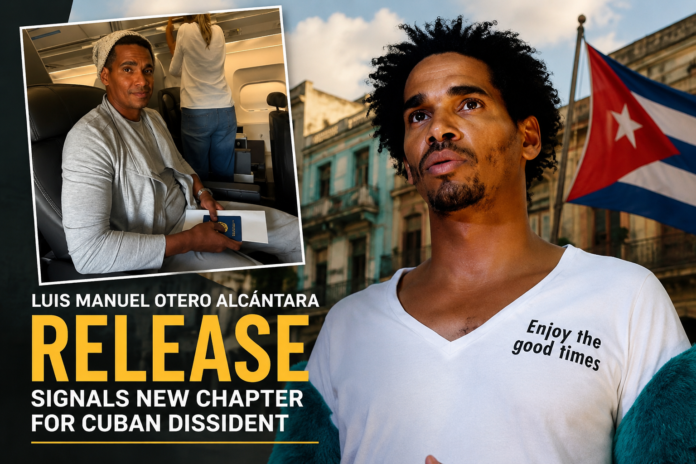
The Luis Manuel Otero Alcántara release has become a major development in Cuba’s ongoing human rights debate after the internationally recognized performance artist and political activist arrived in Miami following years of imprisonment and repeated confrontations with Cuban authorities.
Supporters confirmed that Otero Alcántara landed in South Florida on Saturday after departing Havana, bringing an end to a lengthy period in detention that had made him one of Cuba’s most prominent political prisoners. Images shared by his family and close associates showed him smiling aboard the flight while holding his Cuban passport, a moment widely celebrated by supporters as the beginning of a new chapter in his life.
His arrival was welcomed by members of the Cuban exile community, many of whom have followed his activism for years. Messages shared on social media described his freedom as a victory after years of legal battles, arrests and government restrictions that limited both his artistic work and public advocacy.
US Secretary of State Marco Rubio also welcomed the Luis Manuel Otero Alcántara release, describing his imprisonment as unjust and saying the activist had spent years facing persecution for advocating greater freedom in Cuba. Rubio argued that Otero Alcántara was repeatedly targeted because he challenged the country’s communist leadership and continued to speak openly despite repeated arrests and imprisonment.
Human rights organizations have long regarded Otero Alcántara as one of Cuba’s best-known political prisoners. His detention attracted widespread international attention, with campaigners repeatedly calling on Cuban authorities to release him and respect freedom of expression and artistic independence.
According to statements released by people close to the activist, exile had become the only realistic option for him to continue both his artistic career and his advocacy work. Supporters explained that since early 2023, Otero Alcántara had accepted that leaving Cuba would likely be the only path to regaining his freedom after enduring years of constant surveillance, detention and pressure from state security agencies.
Following his arrival in Miami, supporters announced plans for a public gathering where he would meet members of the Cuban community and others who have supported his work throughout the years. The event is expected to provide Otero Alcántara with his first opportunity to publicly address supporters since leaving Cuba.
At the time of his departure, Cuban authorities had not issued any official statement regarding his release or his arrival in the United States.
The Luis Manuel Otero Alcántara release carries significance beyond the story of one individual. It highlights the continuing debate over political freedoms, artistic expression and human rights in Cuba, issues that have drawn increasing international attention over the past several years.
Before his imprisonment, Otero Alcántara emerged as one of the country’s most recognizable dissident voices through his involvement in the San Isidro Movement, a collective of artists and activists that challenged censorship and restrictions on free expression. Together with fellow campaigners, he used art exhibitions, public performances and social media to document alleged government repression and advocate for greater civil liberties.
His activism frequently brought him into conflict with Cuban authorities. Peaceful demonstrations, public performances and several hunger strikes resulted in multiple arrests and temporary detentions before his eventual imprisonment following the nationwide protests that erupted across Cuba on July 11, 2021.
Those demonstrations, driven by economic hardship, shortages of essential goods and growing calls for political reform, became one of the largest waves of public unrest in modern Cuban history. Many protesters and activists were arrested afterward, with Otero Alcántara becoming one of the highest-profile figures detained during the government’s crackdown.
Beyond his political activism, Otero Alcántara is internationally respected as a performance artist. His creative work often explored themes of freedom, identity and social justice while challenging official narratives. His international reputation grew further after contributing to the Grammy Award-winning song Patria y Vida, or Homeland and Life, a powerful anthem that criticized the Cuban government and called for democratic change.
The song resonated with Cubans both on the island and abroad, becoming a symbol of resistance and a rallying point for many advocating political reform. Its international success also helped bring greater global attention to the challenges faced by independent artists in Cuba.
Now living in the United States, Otero Alcántara is expected to continue his artistic and human rights work without the restrictions he experienced in Cuba. Many observers believe his move into exile will allow him to engage more freely with international audiences while continuing to speak about conditions inside his home country.
The Luis Manuel Otero Alcántara release closes one chapter in the life of one of Cuba’s most recognizable dissidents while opening another. Although he now begins life in exile, his story remains closely tied to the broader conversation surrounding freedom of expression, political rights and human rights in Cuba. As he settles into his new life in Miami, supporters and international observers alike expect his voice to remain influential in discussions about the island’s future.