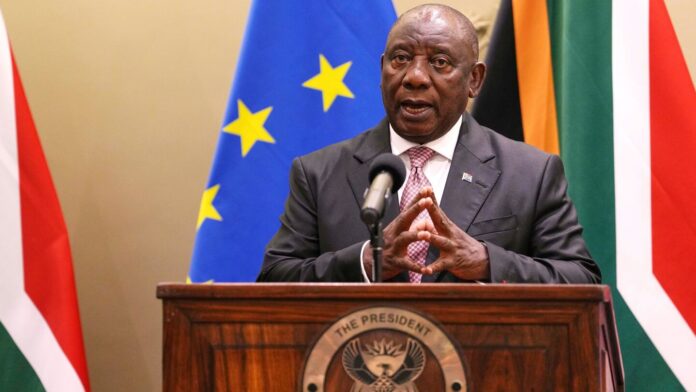
Three people went on trial in South Africa on Monday over the theft of $580,000 hidden inside a couch at a game farm owned by President Cyril Ramaphosa, reviving scrutiny over one of the country’s most controversial political scandals in recent years.
The case, widely known in South Africa as “Farmgate,” erupted into national controversy after allegations emerged that large sums of U.S. currency had been concealed at Ramaphosa’s Phala Phala game farm in Limpopo province.
The three accused, identified as Imanuwela David, Ndilinasho Joseph and Froliana Joseph, appeared in court charged with housebreaking, conspiracy to commit housebreaking and theft linked to the February 2020 break in at the farm. David also faces additional money laundering charges.
All three pleaded not guilty on the opening day of the trial.
Scandal That Shook Ramaphosa’s Presidency
The scandal nearly derailed Ramaphosa’s presidency after accusations surfaced that he had attempted to conceal the theft and failed to properly report the incident to authorities. The matter became public only in 2022, two years after the alleged burglary took place.
Ramaphosa has consistently denied wrongdoing and rejected claims that he attempted to cover up the incident. He said the money came from the legitimate sale of animals at his Phala Phala game and livestock farm, though questions have persisted over why such a large amount of cash was reportedly hidden inside furniture.
The controversy intensified when former state security chief Arthur Fraser filed a criminal complaint against the president in June 2022. Fraser alleged that approximately $4 million had been concealed in couches at the property and accused Ramaphosa of using members of his presidential protection unit to track down suspects and silence them.
Authorities and Ramaphosa disputed the claim that $4 million was stolen, maintaining that the amount involved was closer to $580,000.
Fraser claimed to possess supporting evidence, including photographs, videos and bank account information linked to the alleged theft. His involvement added another layer of political intrigue because of his close ties to former President Jacob Zuma, Ramaphosa’s longtime rival within the ruling African National Congress.
Cleared of Wrongdoing But Questions Remain
The Farmgate controversy sparked widespread allegations of corruption against Ramaphosa, who rose to power promising to tackle graft following the scandal plagued Zuma era.
Although investigations by police and financial authorities ultimately cleared Ramaphosa of criminal wrongdoing, the scandal placed significant political pressure on his administration. In December 2022, he survived an attempt by opposition parties to initiate impeachment proceedings after lawmakers from the governing African National Congress used their parliamentary majority to block the move.
Ramaphosa maintained that he reported the burglary to the head of his presidential protection unit and denied claims that he deliberately concealed the matter from law enforcement authorities.
Despite being cleared officially, the affair continued to shadow his presidency and became a symbol for critics who accused the government of lacking transparency.
Trial Expected to Attract National Attention
The trial is expected to last around three weeks, with prosecutors planning to call approximately 20 witnesses, including employees who worked at the Phala Phala farm.
Court proceedings are likely to be closely followed across South Africa, particularly because they could reveal further details about the handling of the burglary and the events that followed.
The case also comes at a politically sensitive time for Ramaphosa. Although he secured a second term as president last year, the African National Congress lost its parliamentary majority for the first time since the end of apartheid, forcing the party to form a coalition government.

The trial had previously been delayed several times, including because one of the defendants, Froliana Joseph, was pregnant and later gave birth.
As testimony begins, many South Africans will be watching to see whether the proceedings shed new light on a scandal that has remained one of the defining controversies of Ramaphosa’s presidency.