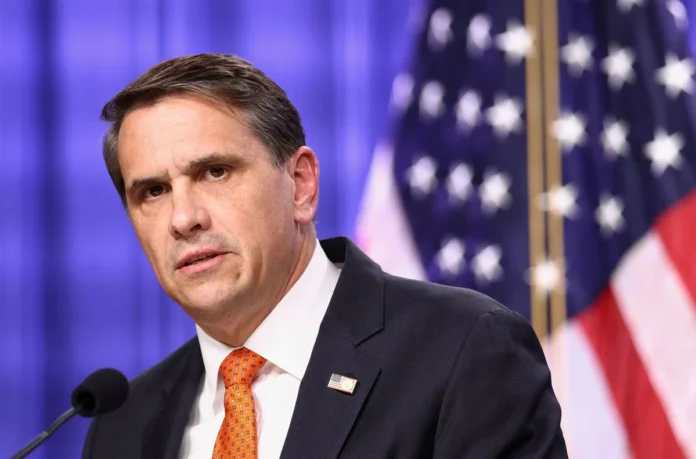
Todd Blanche has officially taken another major step in his transformation from Donald Trump’s personal lawyer to one of the most powerful figures in the US government. The Senate confirmed Blanche as attorney general on Saturday, placing him permanently at the head of the Justice Department after months of serving in an acting capacity.
The 52 year old lawyer was approved by a 50 to 49 vote. Republican Senators Susan Collins and Lisa Murkowski joined Democrats in opposing his confirmation.
Blanche’s appointment gives Trump a close and trusted ally in charge of the federal agency responsible for enforcing US law. His rise has attracted considerable attention because of the unusual path that brought him to the position. Before joining Trump’s legal team, Blanche had built a career as a federal prosecutor and later became a partner at the prominent New York law firm Cadwalader, Wickersham & Taft.
That career changed dramatically in 2023 when he left private practice to represent Trump, who was facing multiple criminal investigations and prosecutions. Blanche quickly became one of the former president’s most trusted legal advisers and played a central role in several of his most consequential court battles.
His work for Trump eventually became a pathway into government. Trump nominated Blanche to become deputy attorney general, and he later assumed greater responsibility at the Justice Department. His confirmation now formalizes a role he had already been performing for months.
Since returning to the White House, Trump has sought to reshape the Justice Department around his administration’s priorities, and Blanche has been closely involved in that effort. His responsibilities have included overseeing major personnel changes, supporting legal arguments involving presidential authority and helping direct the department’s approach to cases that Trump and his allies have described as politically motivated.
The Justice Department has also pursued several high profile actions during Blanche’s time in leadership, including criminal cases involving political figures, investigations involving journalists’ sources and initiatives aimed at addressing what the administration considers abuses within federal law enforcement.
Blanche’s growing influence became particularly visible during the controversy surrounding the handling of the Jeffrey Epstein files. He stepped into a more prominent public role as the administration faced intense scrutiny over its response to the issue and was involved in managing the department’s response.
His relationship with Trump dates back to the former president’s criminal cases. Blanche was part of Trump’s legal team during the New York hush money trial and helped develop arguments intended to protect Trump from the most serious consequences of the case. Although Trump was convicted, the legal strategy helped push his sentencing beyond the 2024 presidential election.
Blanche and his legal team also played important roles in Trump’s federal cases involving election interference and classified documents. The litigation surrounding presidential immunity ultimately reached the Supreme Court, while a separate federal case concerning classified documents was dismissed by a judge in Florida.
Those victories strengthened Blanche’s reputation inside Trump’s political circle and helped establish him as a lawyer capable of handling some of the most difficult legal challenges facing the president.
His confirmation, however, was not without resistance from Republicans. Murkowski remained one of his most prominent opponents despite efforts to win her support. She argued that the country needed an attorney general willing to challenge what she described as the administration’s worst impulses and said she lacked confidence that Blanche would do so.
Senator Bill Cassidy also raised concerns about the direction of the Justice Department, particularly over issues involving alleged political weaponization. Other Republican senators questioned controversial initiatives, including a fund created to investigate claims of misconduct within federal law enforcement and a tax related agreement involving the president and the Internal Revenue Service.
Blanche ultimately took steps to address some of those concerns. He signed a memorandum ending the anti weaponization fund and issued another document clarifying the terms of the tax immunity arrangement.
Despite the difficult confirmation process, Blanche secured enough support to take permanent control of the Justice Department. His appointment marks a significant moment for an agency undergoing major changes under Trump.
As attorney general, Todd Blanche is now positioned to influence federal prosecutions, immigration enforcement, government investigations and the administration’s broader effort to reshape the Justice Department. His close history with Trump is likely to remain a defining feature of his tenure, while his decisions in office will determine how the department balances the president’s priorities with its broader responsibility to enforce federal law.