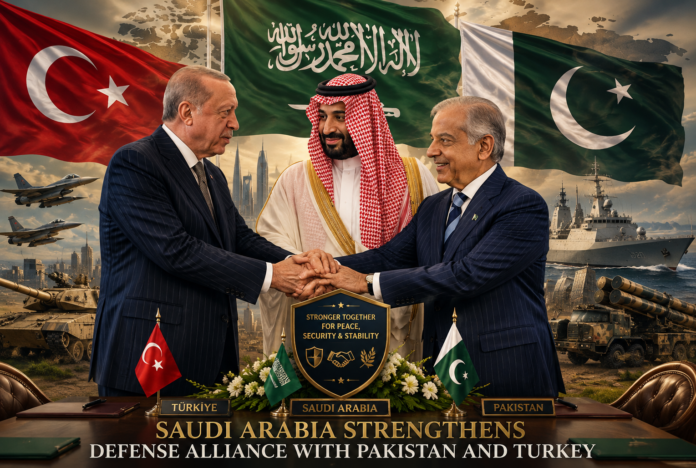
Saudi Arabia has strengthened its military position in the Middle East by entering a new mutual defense agreement with Pakistan and Turkey as the conflict involving Iran continues to raise concerns across the region.
The three countries signed the agreement in Mecca on Friday, establishing a collective security arrangement under which an attack against one member would be treated as an attack against all three. The deal represents a significant expansion of their existing defense relationships and gives Saudi Arabia another layer of security at a time when the kingdom is facing growing regional threats.
The Saudi Arabia defense pact could also have consequences beyond the three countries. Pakistan has nuclear weapons and maintains one of the largest militaries in the Muslim world, while Turkey has the second-largest military in NATO after the United States. Their involvement gives Riyadh two powerful partners if the regional conflict expands.
Officials from the three countries have described the agreement as an effort to strengthen collective deterrence and expand cooperation in areas including defense. They have also emphasized that the pact is not intended to create a sectarian military bloc or target a particular country.
The agreement reportedly leaves room for additional countries to join, potentially allowing the partnership to grow into a broader regional security arrangement.
However, important details about the pact remain unclear. The agreement does not publicly spell out exactly what military assistance each country would be required to provide if another member came under attack. It is therefore uncertain how quickly or extensively Pakistan and Turkey would become involved in an actual conflict involving Saudi Arabia.
The timing of the Saudi Arabia defense pact is particularly significant. The kingdom has faced attacks linked to Iran and its regional allies, including strikes against energy facilities, civilian infrastructure and other targets. Although direct attacks from Iran declined following a ceasefire, Iran-aligned groups operating in countries such as Yemen and Iraq have continued to pose security concerns for Riyadh.
Saudi Arabia has also been urging caution as tensions between Washington and Tehran have increased. The kingdom has strong economic and strategic reasons to prevent the conflict from spreading across the Gulf, where attacks on energy infrastructure or major transportation routes could have consequences for global markets.
The new alliance could therefore serve two purposes for Riyadh. It strengthens the kingdom’s ability to deter future attacks while sending a message that any major assault could potentially involve countries beyond the immediate Gulf region.
Pakistan and Turkey, however, have their own reasons for being cautious.
Both countries share borders with Iran and have longstanding interests in maintaining stable relations with Tehran. Pakistan must also manage its large Shiite population and avoid further instability along its border with Iran. Turkey, meanwhile, has complex relations with Tehran and shares concerns about Kurdish militant groups operating across the region.
For those reasons, neither country has an obvious interest in being pulled directly into a wider war. The defense pact could increase deterrence, but it could also create difficult choices if Saudi Arabia were attacked and requested military assistance.
The agreement also comes as Saudi Arabia’s relationship with the United Arab Emirates has experienced growing tensions, while Israel continues to expand its military activities across the region. These developments are contributing to a rapidly changing security environment in the Middle East.
Iran has already expressed opposition to the new arrangement. Ebrahim Rezaei, a member of Iran’s parliament’s National Security and Foreign Policy Committee, dismissed the agreement as insufficient to guarantee Saudi security. He argued that Riyadh’s previous reliance on the United States had not provided lasting protection and suggested that the new pact would face similar limitations.
For Saudi Arabia, however, the agreement reflects a broader effort to diversify its security partnerships. Riyadh has maintained a close defense relationship with Washington for decades, but recent regional conflicts have prompted questions about the reliability and limits of American protection.
The new Saudi Arabia defense pact builds on military cooperation that was already developing between the three countries. Saudi Arabia and Pakistan had previously reached their own mutual defense agreement before Iran began directly targeting Saudi territory.
The latest arrangement brings Turkey into that framework and potentially gives Riyadh access to a wider network of military cooperation.
Whether the pact will actually be tested remains uncertain. But its message is clear: Saudi Arabia is seeking stronger collective defenses as the risk of a wider Middle Eastern conflict grows. If the fighting spreads and the kingdom comes under another major attack, the agreement could turn a regional confrontation into a much larger international security crisis.