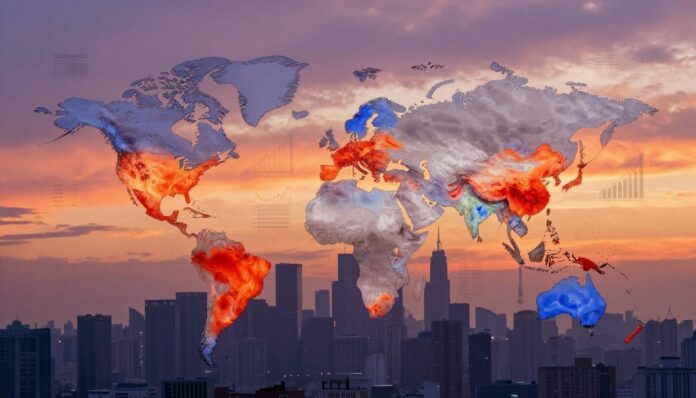
Global climate change often focuses on surface temperatures. Yet, a more dangerous process unfolds hidden beneath massive ice shelves. Scientists now identify basal melting as a primary driver of rapid ice decay.
This phenomenon mirrors other environmental crises across our planet. For instance, freshwater loss in the Euphrates basin has exceeded 34 cubic miles. This loss has happened just in the last 20 years, signaling a broader decline in vital resources.
Current models struggle to track these shifts accurately. Understanding this hidden erosion is essential. It helps us see how global stability faces risks from rising sea levels. We must look deeper to see how ice sheets respond to warming oceans.
The Unseen Crisis Beneath the Antarctic Ice Shelves
The real danger of the Antarctic continent lies beneath its surface. The dark, submerged ice shelves hold back the glaciers inside. These huge, floating ice extensions slow down the ice flow into the sea. Without them, ice would flow faster, raising sea levels quickly.
These hidden shelves are changing silently. Warmer ocean currents are eroding the ice’s underside. This process, hard to see, is changing the Antarctic’s stability.
Warm waters weaken the shelves from below. This thinning makes the ice less strong against glacier pressure. Scientists watch closely, fearing a catastrophic collapse of these shelves.
Knowing about this hidden world is key to understanding our planet’s future. By studying ocean currents and ice interaction, researchers can predict risks. This helps us understand the complex decay of the Southern Continent.
Understanding the Mechanism of Basal Melting
Beneath Antarctica’s frozen surface, a silent force is changing the continent’s future. This process, called basal melting, happens when warm, salty ocean water flows under ice shelves. This water erodes the ice from below, causing it to thin significantly.
The strength of this process is tied to climate change. Like the Euphrates River’s possible disappearance by 2040, Antarctica’s ice sheets face a critical point. The imbalance from ocean currents is pushing the continent toward a point of no return.
The Role of Circumpolar Deep Water
Circumpolar Deep Water is a warm layer of the Southern Ocean that plays a key role in this decay. Changes in wind patterns push this water onto the continental shelf and into ice cavities. This intrusion creates a persistent thermal stress that prevents the ice from staying in balance.
When this warm water meets the ice, it causes a rapid change. The heat transfer is more efficient than warming from the air, making it a main cause of ice loss. Scientists see this process speeding up, like environmental degradation in other parts of the world.
Thermal Erosion at the Grounding Line
The most dangerous part of this process is at the grounding line. This is where the glacier moves from resting on bedrock to floating on the ocean. Thermal erosion here weakens the glacier’s support. As the ice thins, it loses its grip on the seafloor, sliding faster into the sea.
This explains why ice loss rates are now much higher than before. The ocean’s effect on the grounding line removes the “plug” that held back ice streams. This makes the entire system more likely to collapse, threatening global sea levels.
Recent Satellite Observations and Data Trends
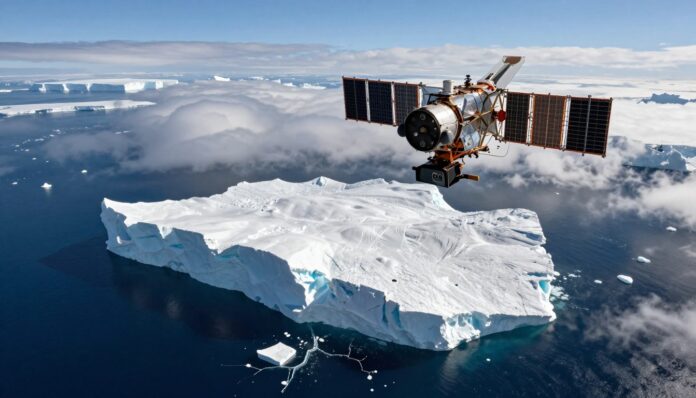
Satellites give us a clear view of how Antarctic ice melts from below. They use advanced sensors to show the fragile state of the cryosphere. This helps scientists check if climate models are right about sea level changes.
Advancements in CryoSat-2 and ICESat-2 Monitoring
CryoSat-2 and ICESat-2 have changed polar science a lot. They use lasers and radar to measure ice height changes very precisely. This lets scientists see how much ice melts into the ocean.
These tools give us data we couldn’t get before. This technological leap helps us see how warming waters affect ice shelves. It also helps us tell if climate changes are natural or caused by humans.
Mapping the Sub-Ice Cavities
Now, satellites can map hidden cavities under ice. By comparing new images with old ones, scientists can see how fast these cavities are melting. This is key to understanding the Antarctic ice sheet’s strength.
Finding these cavities shows where ice is most at risk from melting. This data keeps our knowledge of the cryosphere real. As these systems get better, predicting sea level rise will get more accurate.
The Antarctic Threat to Global Sea Level Rise
The Antarctic Threat is now a real concern for global sea level rise. Big ice sheets losing their shape means more freshwater in our oceans. This change could alter coastlines worldwide.
Quantifying the Contribution of Meltwater
Scientists are trying to figure out how much meltwater gets into the ocean each year. This water change is a big reason for rising sea levels. Even a little bit of extra water can affect ocean currents and how warm it gets.
We’re getting close to irreversible thresholds. Once we pass these points, ice will melt faster than we can stop it. Keeping a close eye on these changes is key.
Projections for Coastal Cities in the United States
Coastal areas in the United States are facing big risks from The Antarctic Threat. Big cities are at risk of more storm surges and flooding. These problems can hurt the economy and people’s lives.
Experts say low-lying areas will see more flooding soon. Strategic planning is needed to protect important places and keep people safe. If we ignore this, we could lose a lot of valuable things.
Oceanic Warming and Its Impact on Ice Stability
As the Southern Ocean warms, the balance keeping Antarctic ice shelf stability starts to break down. This change is not just on the surface but affects the ocean’s core. Scientists see how warmer temperatures are changing the ice shelves’ structure.
Changes in Southern Ocean Circulation Patterns
The water around Antarctica is moving in ways that bring warmer, saltier currents closer to the ice. These currents are pushed by changes in wind patterns. When warm water hits the ice’s base, it melts it quickly, unlike before.
This change in oceanic warming means areas once safe are now facing heat. The heat keeps coming, stressing the ice’s underside. This makes the ice shelves weaken fast.
The Feedback Loop Between Warming and Ice Loss
A feedback loop has started where losing ice speeds up melting. As ice shelves thin and move back, they can’t hold back glaciers anymore. This lets glaciers flow faster into the sea.
The more ice that melts, the more freshwater flows into the ocean. This can pull even more warm water toward the coast. This cycle makes it hard to keep ice shelf stability. Knowing these complex interactions is key to predicting the Antarctic ice sheet’s future.
Regions Facing Accelerated Decay
In the Amundsen Sea Embayment, two huge glaciers are getting a lot of attention. The whole continent is under environmental stress, but these areas are losing ice at an alarming rate. This is due to deep ocean currents and unique underwater features.
The Vulnerability of the Thwaites Glacier
The Thwaites Glacier, known as the “Doomsday Glacier,” is a major worry for scientists. Its size and location make it a big risk for sea-level rise. The glacier is very sensitive because its bedrock deepens as it moves inland.
Warm, salty water can get under the ice shelf. This melts the ice from below, weakening the glacier. This leads to a cycle of accelerated ice sheet decay. Losing this ice could destabilize other areas, causing a chain reaction.
Pine Island Glacier and the Amundsen Sea Embayment
The Pine Island Glacier is next to the Thwaites Glacier. It has been losing ice at a fast rate for years. The warm Circumpolar Deep Water and the glacier’s grounding line cause this retreat.
The Amundsen Sea Embayment funnels warm ocean currents to the Pine Island Glacier. This keeps the glacier under constant heat stress. Scientists watch these areas closely to understand how Antarctica might change with ocean warming. Knowing about these spots helps predict global coastal stability.
Scientific Consensus on Ice Shelf Thinning
Recent expeditions have given us a clearer, yet more worrying, view of basal melting on the Southern Continent. Scientists are working hard to make sense of a lot of data. They aim to understand the quick changes happening in these distant places.
This team effort is key to figuring out how these huge structures will handle a warmer climate.
Peer-Reviewed Findings from Recent Expeditions
New studies show ice loss is speeding up in several important areas. Researchers have used advanced sensors to see how ice is thinning from below. They found that warm ocean currents are getting deeper into ice cavities than thought.
This shows how fragile the Antarctic ice sheet is with changing ocean temperatures.
Discrepancies Between Models and Real-World Observations
There’s a big challenge in the difference between climate models and what’s really happening. Many models can’t fully grasp the detailed, local effects of basal melting. This often means they underestimate ice loss.
This gap shows we need more detailed data to improve our predictions. By using real-world data to fine-tune models, scientists can better forecast the future of ice shelf stability.
Keeping up with field research is the only way to close these gaps. This ensures global policies are based on the most accurate data. Precision in data collection is essential in modern glaciology.
The Role of Bedrock Topography in Ice Flow
Just as ancient riverbeds like the Wadi al-Batin show the Middle East’s past, Antarctica’s hidden terrain shapes our future coastlines. The subglacial topography is the base of the ice sheet. It guides how glaciers move and react to warmer oceans.
How Subglacial Landscapes Influence Melt Rates
The shape of the ground under the ice affects how warm water can get deep into the continent. Uneven or troughed bedrock lets circumpolar deep water reach the ice base. This speeds up ice melting from below, often unseen by surface views.
Geological mapping is key for scientists to uncover these hidden paths. By studying the land’s contours, they can forecast where ice is most at risk of melting. This subglacial topography is like a map showing how ice interacts with the ocean.
The Danger of Retrograde Slopes
Glaciologists warn about retrograde slopes, where the bedrock slopes inward. This setup poses a precarious situation for ice stability.
As ice retreats on a retrograde slope, the grounding line moves into deeper water. This starts a cycle of ice sheet decay hard to stop. The ice grows thicker as it moves into deeper basins, leading to more ice discharge into the ocean. Knowing about these slopes is vital for predicting ice sheet decay and its effect on sea levels.
Technological Innovations in Sub-Ice Exploration
Modern engineering is now letting us explore under Antarctica’s ice shelves. The cryosphere‘s extreme conditions used to block our access. Now, special tools are helping us bridge the gap between theory and reality.
Autonomous Underwater Vehicles and Their Findings
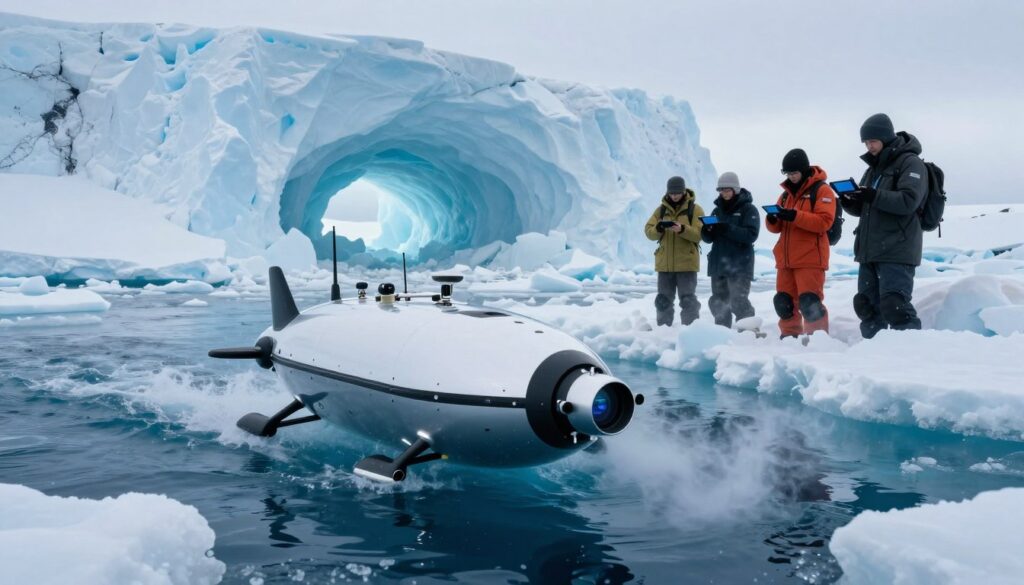
Autonomous Underwater Vehicles, or AUVs, are key explorers in the icy depths. They move through dark, high-pressure areas under ice. They collect precise data on oceanic warming and salt levels.
These robots have advanced sensors for the dark. They send back important info to the surface. This info shows how oceanic warming speeds up ice melting.
Drilling Techniques for Direct Measurement
Researchers also use drilling to get samples from the ice. These methods help them get deep core samples. These samples act as a historical archive of the cryosphere.
By analyzing these layers, experts can learn about past climates. They can also predict future ice stability. Direct measurement through boreholes is more accurate than remote sensing. These samples show the ice’s chemical makeup and meltwater history.
Global Climate Implications Beyond Sea Levels
Antarctic ice loss is a catalyst for profound changes that threaten both ecological stability and human health globally. While the focus often remains on sea level rise, the broader environmental consequences are alarming. Like the public health crisis in Iraq due to water scarcity, Antarctic environmental changes have far-reaching global consequences.
Impacts on Marine Ecosystems and Biodiversity
The influx of freshwater into the Southern Ocean is changing its chemistry. This shift makes it hard for many species to survive. It threatens the balance of marine ecosystems and the food chain that depends on them.
As habitats change, biodiversity in the region faces an uncertain future. Key species, like krill, may decline, affecting predators like whales, seals, and penguins. Protecting these marine ecosystems is key for our oceans’ biological health.
Alterations to Global Thermohaline Circulation
The melting ice disrupts the global thermohaline circulation, or the ocean’s conveyor belt. This system helps regulate the Earth’s climate by distributing heat. When the Southern Ocean‘s density changes due to freshwater, it can slow down or redirect these currents.
A disruption in this circulation could lead to unpredictable weather and temperature shifts far from Antarctica. While sea level rise gets most of the attention, the risk of oceanic changes destabilizing global climate systems is a critical concern for scientists. The health of the Southern continent is linked to our global environment’s stability.
Policy Responses and International Research Initiatives
The issue of polar ice loss needs global cooperation. As Antarctica changes, countries must work together. Effective policy depends on sharing research across borders.
The International Thwaites Glacier Collaboration
The International Thwaites Glacier Collaboration is a key example of this teamwork. It’s a joint effort between the United States and the United Kingdom. Dozens of scientists are studying the Thwaites Glacier in great detail.
This project aims to understand why ice in the area is unstable. By working together, they share resources and data. This way, everyone in the scientific world can access the findings. It shows how countries can face big environmental challenges together.
Funding and Prioritizing Antarctic Climate Research
Science needs money to keep going. Policymakers must make sure there’s enough money for Antarctic research. This is key for making good plans for coastlines.
Studying the Thwaites Glacier and its surroundings is critical. When governments fund long-term research, it helps a lot. Robust international policy must match the scale of the scientific challenges.
The Future of the Southern Continent and Global Coastal Resilience
Antarctic ice loss is a big challenge for us today. The fast melting of these huge ice shelves makes us rethink our shoreline management. We need to change how we see the Southern Ocean’s stability because of climate change.
Tools like the ICESat-2 satellite give us real-time data on these changes. We must use this info to build stronger defenses for our cities. The only way to protect our homes and buildings from higher sea levels is to boost global coastal resilience.
Working together internationally is key. Projects like the International Thwaites Glacier Collaboration show what happens when experts team up. We must focus on these partnerships to ensure a safer future for all.
Our ability to adapt depends on today’s choices. Science gives us a clear guide to handle climate change risks. By investing in research and green infrastructure, we can create a stable future. Your support for these efforts helps push for important policy changes.