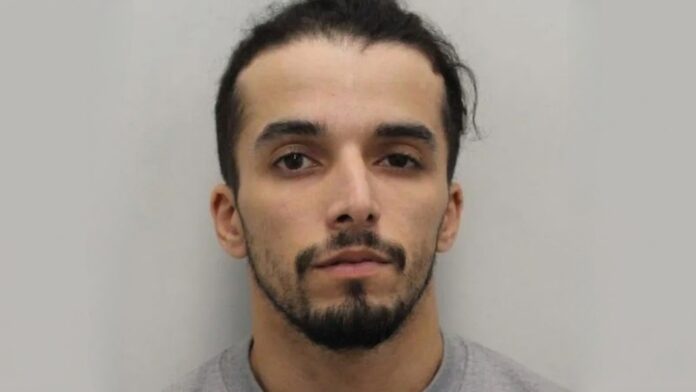
Algerian sex offender Brahim Kaddour-Cherif, 24, who was mistakenly released from prison, has been arrested by police after being spotted by a member of the public in the Finsbury Park area of London just before 11:30 GMT on Friday.
Kaddour-Cherif had been let out of HMP Wandsworth in south London on October 29, though police said they were not informed of the error until Tuesday. He was one of two men separately released by mistake from the prison within the same week. Both are now back in custody, after William Smith handed himself in on Thursday. Smith had been let go on Monday, the same day he was sentenced to prison.
At least four prisoners released in error in the year to March remain at large, the BBC has been told. Some 262 prisoners in England and Wales were mistakenly released in that period, up from 115 the previous year.
The Metropolitan Police said Kaddour-Cherif was spotted by a member of the public near Capital City College on Blackstock Road. Officers responded immediately and arrested him at 11:30, on suspicion of being unlawfully at large and on suspicion of assaulting an emergency worker in relation to a previous incident. Before being placed in a police van, he told those gathered: “Look at the justice of the UK, they release people by mistake… it’s not my fault.”
Nadjib Mekdhia, 50, an Algerian man who is homeless but stays in Finsbury Park, said he recognised Kaddour-Cherif while walking past a cafe on Blackstock Road. “The individual approached to me.
I don’t know what he was doing. I recognised him. I asked a member of the public to give me a phone. Straight away I called the police. The police vans came quickly,” he said, adding: “I am glad he is in prison. We do not need people like that in our community. I am proud Algerian. I am proud British. We do the right thing.”
Another witness, Deelo Morgenegg, told the BBC he saw an altercation between Kaddour-Cherif and a person who appeared to recognise him, before police arrived and the situation escalated. “Things started to escalate and then eventually they handcuffed him,” he said, adding that once in the police van, Kaddour-Cherif “started kicking the van and kind of shaking about and stomping.”
Kaddour-Cherif was convicted of indecent exposure in November 2024, relating to an incident from March of that year, and was given an 18-month community order along with a five-year placement on the sex offenders’ register.
He is understood to have entered the UK legally on a visitor’s visa in 2019 but overstayed it and was in the early stages of the deportation process. He was released the day after being found not guilty of breaching the sex offenders’ register requirements, but should have remained in custody on other outstanding charges.
Prison officers’ representatives said a clerical error meant no warrant from the court was in place to hold him, leading to his release following a series of prosecutions and court appearances dating back two years.
His release came just weeks after migrant sex offender Hadush Kebatu, who arrived in the UK on a small boat, was mistakenly released from HMP Chelmsford in Essex in late October. Sources told the BBC that Wandsworth’s prison governor was not at the jail on the day Kaddour-Cherif was released because he was conducting the inquiry into how Kebatu had been let go. Kaddour-Cherif was ultimately caught just a three-minute walk from where Kebatu was re-arrested.
The case has intensified political pressure on the government. Shadow Justice Secretary Robert Jenrick said the unaccounted-for prisoners revealed “the incompetence of this government,” adding that Justice Secretary David Lammy “must finally come clean about how many prisoners have been accidentally released and how many are still at large.” Liberal Democrat spokeswoman Jess Brown-Fuller said “every resource” must go into finding the remaining prisoners, calling the situation “a disgrace and an omnishambles.”
Conservative leader Kemi Badenoch said Lammy “doesn’t know what he’s doing,” adding that offenders “clearly feel that the UK is a soft touch.” Reacting to footage of the arrest, she said: “I thought it was also extraordinary that he was just wandering around just outside the justice secretary’s own constituency. They are laughing at us and what the Labour government needs to do is show that it will enforce our laws.”
In a statement following Friday’s arrest, Lammy said: “We inherited a prison system in crisis and I’m appalled at the rate of releases in error this is causing.
I’m determined to grip this problem, but there is a mountain to climb which cannot be done overnight. That is why I have ordered new tough release checks, commissioned an independent investigation into systemic failures, and begun overhauling archaic paper-based systems still used in some prisons.”
A Ministry of Justice spokesperson added that “the vast majority of offenders released by mistake are quickly brought back to prison, and we will do everything we can to work with the police to capture the few still in the community.”
Lammy had previously promised the “strongest checks ever” following the Kebatu case, but those measures have drawn criticism from within the prison system itself. The new protocol places greater responsibility on duty governors, who must now personally oversee the release of all inmates, completing additional checks, calculations, and paperwork.
One senior prison staffer described the changes as a “significant burden,” saying they have “only increased the paperwork” and that release checks are now taking up to a full day to complete in some cases, a particular strain given existing staffing shortages.
The broader prison system has faced mounting pressure for years, with the inmate population continuing to grow faster than staffing levels.


Almost 40,000 inmates have already been released under the scheme, which has also contributed to the rise in mistaken releases. The government has pledged to build additional prisons to ease overcrowding, though projections show the prison population will continue to grow, and any new capacity will take time to materialize.