Huawei’s photography-focused flagship arrives outside China with a reworked 200MP telephoto system, a steep price tag, and a handful of puzzling design choices
Huawei has taken the wraps off the global version of its camera-first flagship, the Pura 90s Pro Max, bringing the phone that launched in China as the Pura 90 Pro Max to international markets including Europe, the Middle East, and Southeast Asia. The device leans hard into Huawei’s imaging pedigree, pairing a redesigned 200-megapixel telephoto sensor with a body built for durability, while working around the absence of Google Mobile Services that has defined every Huawei release since 2019.
The Pro Max sits at the top of a two-model Pura 90s lineup alongside the standard Pura 90s Pro. Both share a 6,000mAh battery, but the Pro Max gets the faster 100W wired SuperCharge compared with 66W on the standard Pro, along with the more ambitious camera hardware. Huawei is pricing the Pro Max from 1,149 euros, or roughly $1,300, placing it squarely against the newest flagships from Samsung and Apple.
Design and Display
The Pura 90s Pro Max centers on a 6.9-inch, flat LTPO OLED panel running at a 2880 x 1308 resolution with an adaptive 1-120Hz refresh rate. Huawei has fitted the screen with its own Kunlun Glass, a proprietary cover glass the company says cuts reflections by up to 70%, roughly quadruples scratch resistance, and dramatically improves drop resistance compared with standard glass. Hands-on testing in bright outdoor conditions in Kuala Lumpur backed up at least the anti-glare claim, according to early impressions from tech outlet PetaPixel.
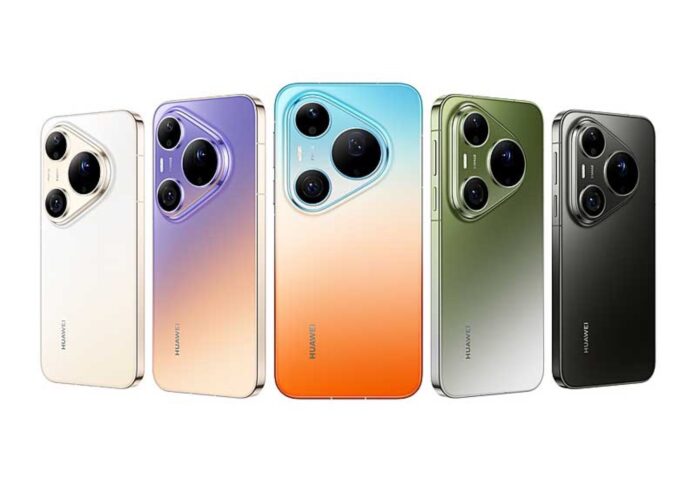
Global buyers get four color options for the Pro Max: Blush Gold, Orange Ocean, Blaze Purple, and Graphite Black, with the lighter-toned standard Pro getting its own separate palette. The Orange Ocean finish uses a dual-tone gradient fused directly into the aluminum frame rather than a painted or coated layer, giving it a distinctive look, though reviewers note the glossy back attracts fingerprints easily. Huawei ships a clear silicone case in the box to protect the finish without hiding it.
Both the Pro and Pro Max carry IP68 and IP69K ratings, meaning the phones are rated for both dust and full submersion as well as exposure to high-pressure, high-temperature water jets, a durability tier increasingly common among 2026 flagships but still a meaningful selling point for a device this expensive.
One notable design decision has drawn criticism: rather than the in-display fingerprint sensor Huawei helped popularize as far back as 2018, the Pura 90s Pro Max places its fingerprint reader on the side, integrated into the power button. Reviewers testing the phone say the button sits slightly too high for comfortable reach with the left hand, forcing an awkward stretch for left-handed users, and that side-mounted placement is generally harder to use when the phone is lying flat on a table.
Camera System
Camera performance is the centerpiece of the Pura 90s Pro Max pitch. Huawei says it rebuilt the array around three priorities: telephoto reach, dynamic range, and color accuracy, branding the overall approach “True-to-Colour Camera 2.0.”
The headline component is a 200-megapixel Ultra Large Sensor Telephoto Camera, equivalent to a 96mm lens, built on a Type 1/1.28 sensor with an f/2.6 aperture and optical image stabilization. Huawei pairs it with what it calls a “first-of-its-kind” 3-in-1 Ultra Lighting Prism designed to boost light intake, along with CIPA 7.0-rated stabilization aimed at keeping distant shots sharp. The telephoto system supports 20x hybrid zoom, and Huawei says chip-level 200-megapixel RAW real-time processing roughly doubles video clarity output compared with the previous generation, a claim aimed at use cases like shooting concerts or sports from a distance.
The 50-megapixel main camera, equivalent to a 24mm lens, uses the same RYYB sensor type as the telephoto unit and includes a mechanical variable aperture ranging from f/1.4 to f/4, though the widest range is only accessible in the phone’s Pro shooting mode. A 40-megapixel ultra-wide camera, equivalent to 13mm, rounds out the rear array at f/2.2. Huawei has not disclosed exact sensor suppliers for any of the three rear cameras, beyond confirming they come from Sony, continuing a pattern of vagueness around component sourcing that predates this generation.
Early hands-on impressions describe strong color output and dynamic range, with a camera app that shoots quickly and processes images with minimal lag. Users can toggle standard 12.5-megapixel pixel binning up to a full 25 megapixels for images that hold up better to cropping, at the cost of longer processing time.
Reviews have flagged interface quirks around the camera app, however. There’s no on-screen shortcut to jump straight to 20x zoom despite Huawei promoting the feature heavily users must pinch to zoom and land on the number manually and there’s similarly no shortcut to a 35mm focal length on the main camera. Notably, the Chinese domestic version of the phone includes both shortcuts, meaning they were removed specifically for the global release, with reviewers speculating the omissions could be addressed in future software updates. Other interface complaints include a timer control buried deep in settings rather than in the quick-access menu, no exposure compensation outside Pro mode, and a lack of 24fps as a video frame rate option across any shooting mode.
A more substantial critique comes from long-time Huawei reviewer Ben Sin at Forbes, who tested the phone against last year’s Pura 80 Ultra and found the newer model a step sideways rather than forward. The Pura 90s Pro Max drops the dual-lens periscope zoom system that defined the Pura 80 Ultra, and at 10x zoom, shots reportedly show visible AI sharpening artifacts that a dedicated optical periscope lens would likely have avoided. Sin also noted the rear sensor size shrank slightly compared with the prior generation, to 1/1.3-inch, though he found no obvious loss in low-light performance thanks to the LOFIC RYYB sensor design.
AI Features and Software
The Pura 90s Pro Max runs EMUI 16, Huawei’s Android-based operating system, layered with a range of camera-focused AI tools. Master AI reads a scene and automatically tunes color and processing, while a separate AI Composition feature analyzes the frame and overlays guide markers to help less experienced photographers improve their shot composition.
Not every AI feature makes it to every region. The Chinese variant includes tools like AI De-glare and AI Move that are absent from European units, which ship with only AI Composition. Asia-Pacific markets outside China reportedly get the fuller AI feature set that Europe misses.
The most significant software hurdle remains the absence of Google Mobile Services, a consequence of the US trade restrictions Huawei has operated under since 2019. Huawei’s workaround for global buyers is an app called GBox, an installable package that runs alongside the native EMUI system and, once set up through Huawei’s Petal Search or downloaded via browser, grants access to the Google Play Store. In practice, that allows global users to install apps like Lightroom, Spotify, and YouTube, and to make purchases through Google Play as normal though the setup process, while described as largely automated, still requires configuring the phone’s region setting to one where Huawei devices are officially sold.
Huawei’s own voice assistant, Celia, also ships across the Pura 90s lineup with expanded English-language natural-language handling and on-device processing for offline use, positioned as a more deeply integrated alternative to the third-party assistants users can sideload through GBox.
Reception and Market Context
The Pura 90s Pro Max marks one of Huawei’s most visible pushes back into international smartphone markets since the company’s global standing was curtailed by trade sanctions beginning in 2019. Domestically, Huawei has continued to lead the Chinese smartphone market throughout that period, but the Pura 90s series represents a renewed attempt to compete for camera-focused buyers in Europe and Asia-Pacific specifically, rather than the broader mainstream flagship market where Google service access remains a bigger obstacle.
Early comparisons position the phone against the Samsung Galaxy S26 Ultra, Apple’s iPhone 17 Pro Max, and Xiaomi’s 17 Ultra, with most early reviewers crediting Huawei’s telephoto system as a genuine strength against all three, even as opinions diverge on whether it beats last year’s own Pura 80 Ultra or rivals like the Vivo X300 Ultra. Battery capacity also varies meaningfully by region: the 6,000mAh cell available in Asia-Pacific and Middle Eastern markets drops to a smaller capacity for European units, a regional split Huawei has not fully explained.
Whether the Pura 90s Pro Max succeeds in winning back global buyers may hinge less on the camera hardware, which multiple reviewers rate among the best available, and more on whether Huawei can smooth over the software friction and interface inconsistencies that separate the global release from its Chinese counterpart.
This article was produced by the Maple Epoch Editorial Team. See our editorial standards and AI-use disclosure and editorial policy.