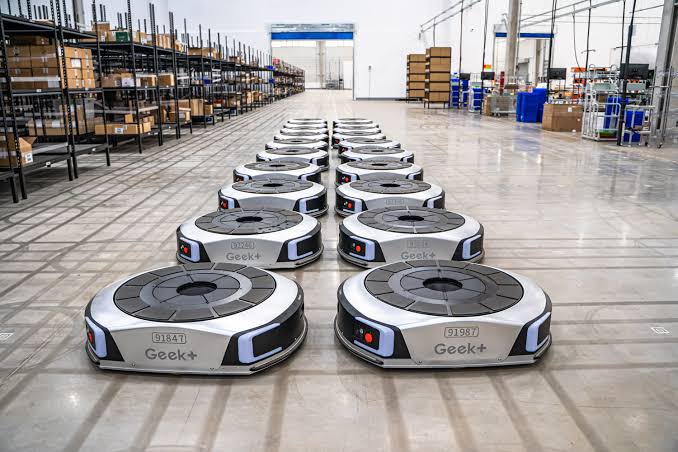
A weak decade of productivity growth and a persistent labour shortage have opened the door for automation firms, with one Chinese supplier now running thousands of robots inside British warehouses made by Geek+
Every time a shopper clicks “buy” on an online order in the UK, there’s a good chance the fulfilment process now begins with a small, low profile robot sliding underneath a storage shelf, lifting it off the ground, and carrying it across a warehouse floor to a worker waiting at a picking station. The robots are built at a factory in Hefei, a city in eastern China, by a company called Geek+, and they now sit inside distribution centres used by some of Britain’s largest retailers, including Tesco, Asda and Next.
Geek+ makes what the industry calls autonomous mobile robots, or AMRs. Unlike older forms of warehouse automation, which typically rely on fixed conveyor belts and permanent infrastructure that’s expensive to install and hard to change, these robots navigate using QR code markers on the floor and portable safety fencing. That makes them far quicker and cheaper to deploy, since a warehouse operator can add or reconfigure a fleet without ripping out existing infrastructure. Geek+ says the approach lets retailers pick orders faster, use storage space more efficiently, including areas that are awkward for human workers to reach, and cut down on picking errors.
The company has grown into the world’s largest supplier of AMRs and listed its shares in Hong Kong last year, in what was one of the biggest robotics stock offerings of 2025. It’s now also developing humanoid robots aimed at picking and packing tasks, a step beyond the wheeled shelf carriers that currently dominate its business.
Why the UK has become fertile ground
Britain’s warehouses have turned into an early proving ground for this technology largely because of two long running problems: sluggish productivity growth and a shortage of workers willing to do repetitive warehouse jobs. The UK has struggled with weak productivity for more than a decade, and economists broadly agree that wider use of robotics will be necessary if businesses want to close that gap.
The Organisation for Economic Co-operation and Development addressed this directly in a 2026 report on SME technology adoption in the UK. The OECD noted that it’s somewhat surprising Britain lags in robotics and automation given its manufacturing history, even though UK firms have been relatively quick to adopt more mature digital tools.
That gap is exactly the opening companies like Geek+ have been looking for. The UK has one of the largest e-commerce and logistics sectors in Europe, yet a large share of its warehouses are still only in the early stages of automating their operations. Britain has become Geek+’s biggest market in Europe, and its UK partner, a firm called MotionTech, has already deployed more than 2,000 of the company’s robots across ten warehouse sites nationwide.
Barry Pemberton, an account director at MotionTech, says customers are mainly asking for solutions that can be installed quickly and scaled up without a lot of upfront cost. He points to a persistent shortage of warehouse labour in the UK as one of the main reasons businesses are turning to automation just to keep up with demand.
Not everyone views the shift the same way. The Trades Union Congress, which represents close to six million workers across the UK, has argued that robotics should be deployed in a way that raises productivity and improves working conditions, rather than simply being used to reduce headcount and cut labour costs. In its submission to the government’s consultation on a new AI and innovation strategy, the TUC called for workers and unions to have a say in how automation gets rolled out, and for employers to invest in retraining rather than treating job losses as the default outcome.
Beijing’s push into robotics
China’s rise as a robotics manufacturing power isn’t accidental. Robotics has become a strategic priority under President Xi Jinping’s push to build what Chinese policy documents describe as “new quality productive forces.” With the country’s working age population shrinking, officials increasingly see automation as central to keeping manufacturing competitive and sustaining economic growth.
Kyle Chan, a researcher at the Brookings Institution, has described China’s robotics industry as building directly on the country’s electric vehicle supply chain. Batteries, electric motors, cameras, sensors and semiconductors originally developed for EVs are increasingly finding a second life in robotics, creating overlapping industrial ecosystems that give Chinese manufacturers a cost and speed advantage.
That overlap is visible at companies like XPeng, the Chinese EV maker that unveiled its own humanoid robot, called Iron, last year. XPeng’s founder, He Xiaopeng, has said he no longer thinks of the company purely as a carmaker, predicting that most car companies will eventually become both car and robotics businesses. Analysts expect China’s robotics sector to follow a path similar to its EV industry, using manufacturing scale, dense supplier networks and fast product development cycles to build an early lead in global markets. Tesla is chasing a comparable vision in the US with its Optimus robot, which Elon Musk has suggested could eventually become a larger business than the company’s car division.
A setback in the US
China’s broader ambitions in robotics hit a obstacle at the end of July, when the US Federal Communications Commission announced it would ban imports of new foreign made humanoid and quadruped robots, along with certain power inverters, citing cybersecurity and national security concerns. The FCC said these devices could expose critical infrastructure to remote manipulation and could be used to collect data on Americans.
The rule doesn’t affect robots already approved for sale in the US, and it applies only to new models seeking authorization going forward, but it lands at a moment when Chinese manufacturers account for the large majority of humanoid robots sold worldwide, with market share estimates put at around 85%. China’s embassy in Washington criticized the move, saying it amounted to politicizing trade policy through unfounded justifications. The decision arrives ahead of a planned September meeting between President Trump and Chinese leader Xi Jinping, adding another point of friction to an already tense trade relationship between the two countries.
Industry analysts expect the ban to disrupt near term US sales for Chinese robotics firms, though several have said the broader impact should be limited given how long tensions between the two governments have already been building. For now, the restriction is specific to the US market and hasn’t affected deployments in the UK or the rest of Europe.
What comes next
For now, the robots operating in British warehouses are largely focused on a narrower job: moving goods from one point to another. Geek+ says its next objective is to automate more of what happens around that movement. Yanyu Liu, the company’s head of communications, has said Geek+ is working toward end to end unmanned warehouse systems that would also handle picking, handling and eventually packing.
Other Chinese firms, including AgiBot and Unitree, are investing heavily in humanoid robots designed to take on tasks currently done by people in factories and warehouses. But the commercial case for humanoids remains less clear cut than it is for wheeled robots. If a simpler machine can already move goods reliably and cheaply, or if a robotic arm can handle picking tasks on its own, it isn’t obvious what problem a two legged, two armed humanoid actually solves. Supporters argue that because factories, warehouses and offices were all designed around human bodies, humanoid robots could eventually operate in those spaces without requiring costly redesigns. Even so, most people working in the field, developers and outside experts alike, agree the technology isn’t yet reliable enough for many repetitive tasks that require finer dexterity.
Pemberton says he doesn’t expect humanoids to reshape the kind of automation being deployed in UK warehouses any time soon, describing them instead as likely to complement existing wheeled and arm based systems rather than replace them. Chinese firms already account for most humanoid robot deployments worldwide, but widespread use inside ordinary warehouses still looks to be some years away.
What’s clearer is the immediate picture: persistent labour shortages and stagnant productivity have made UK warehouses an early and willing testing ground for automation technology built in China, and that trend shows little sign of slowing regardless of how trade tensions play out elsewhere.
This article was produced by the Maple Epoch Editorial Team. See our editorial standards and AI-use disclosure and editorial policy.