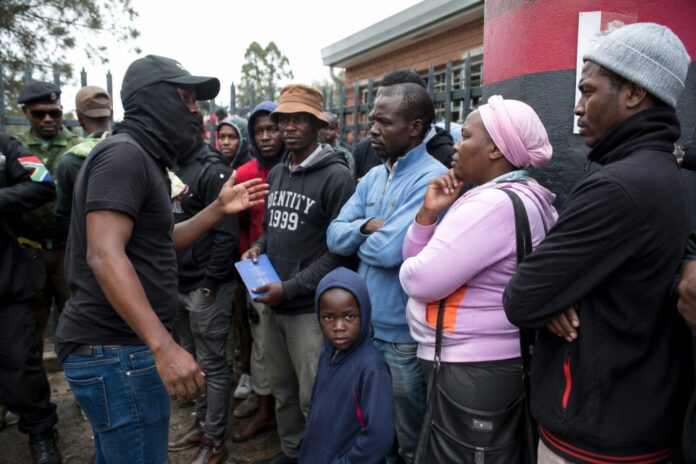
A community clinic just north of Johannesburg has become the frontline of an increasingly bitter battle in South Africa over whether foreign nationals should have access to public healthcare.
What began as a small local action in one area in 2022 has spread into a wider national campaign. Activists from the openly anti migrant movement Operation Dudula have staged pickets outside hospitals and clinics in Gauteng and KwaZulu Natal provinces, checking identity documents and blocking people they believe are not South African from entering.
“Dudula” means “to push out” or “remove by force” in the Zulu language, a name critics say reflects the movement’s confrontational tactics.
Although several activists have been arrested in recent weeks, authorities have struggled to stop the demonstrations, which rights groups describe as unlawful vigilantism. Health activists and legal experts warn that the situation is exposing deep tensions over immigration, poverty and access to state services in Africa’s most industrialised economy.
The latest flashpoint is Diepsloot, a sprawling township near Johannesburg that is home to more than 200,000 residents. The area has long faced high unemployment, crime and pressure on public services, making it fertile ground for anti migrant anger.
On a cold spring morning, Sicelokuhle Moyo set out early for the local clinic, as she had done many times before. Dressed in a blue and beige skirt, a thick windbreaker and a black headwrap, the Zimbabwean national hoped only to collect medication for a chronic condition.
Instead, she found the entrance guarded by two men wearing white T shirts carrying the slogan “Operation Dudula – Mass Deportation”.
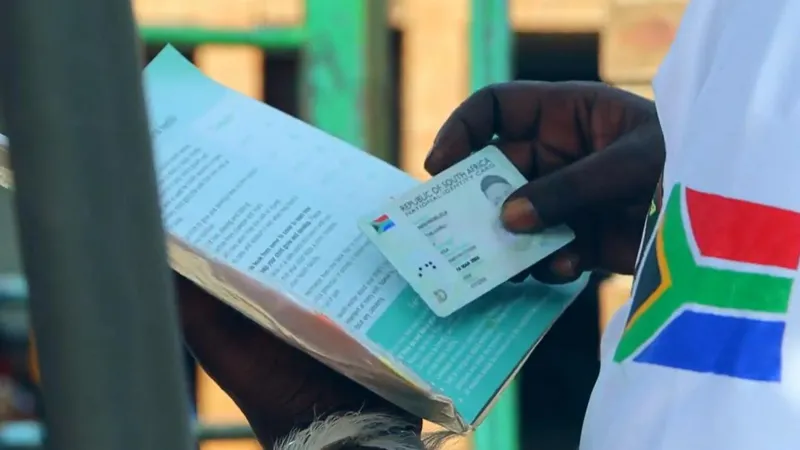
Everyone approaching the gate was ordered to produce South African identity documents.
“I said that I had a passport. They said they don’t take passports. They want IDs only,” Ms Moyo said quietly, trying to mask her frustration behind a restrained smile.
The atmosphere at the clinic was tense but subdued. Residents appeared to understand that arguing with activists could lead to confrontation.
Operation Dudula members have previously been accused by critics of using intimidation and violence during protests and raids targeting undocumented migrants and foreign owned businesses.
Anyone unable to produce a South African ID book was turned away.
Slowly walking away from the entrance, Ms Moyo joined a small group of women standing beside the road with babies tied to their backs, waiting anxiously to see whether the situation would change.
Among them was Tendai Musvava, a Mozambican woman in her 40s.
“I was standing in the queue and then they said they only need some people with IDs. Me, I don’t have an ID. I have a passport, I am from Mozambique. So I can’t get my medication because I don’t have an ID,” she said.
Wearing a bright orange winter jumper and a white hat, Ms Musvava appeared exhausted and defeated.
“I just feel like they do what they want because it’s their country. I don’t have a say. For now I have to follow whatever they say. I don’t have a choice.”
Rising Anger Over Immigration
South Africa officially hosts around 2.4 million migrants, fewer than 4% of the total population according to government estimates, although some politicians and activists claim the real number is far higher.
Many migrants come from neighbouring Zimbabwe, Mozambique and Lesotho, countries historically tied to South Africa through labour migration dating back to the mining industry of the apartheid era.
But economic hardship has increasingly fuelled resentment toward foreigners.
South Africa has one of the world’s highest unemployment rates, particularly among young people. Millions live below the poverty line while public hospitals, schools and housing systems struggle under years of underfunding, corruption scandals and poor management.
In townships such as Diepsloot, frustrations over daily hardship have often merged with hostility toward migrants, who are accused by some residents of taking jobs, overwhelming clinics and contributing to crime.
Anti migrant rhetoric has steadily moved from the fringes into mainstream political debate.
Operation Dudula emerged during the Covid 19 pandemic, initially presenting itself as a grassroots campaign against undocumented immigration and crime.
The movement gained attention through highly publicised operations targeting migrant owned shops, informal settlements and workplaces.
Critics accused it of harassment, xenophobia and inciting violence, while supporters praised it for addressing frustrations they believed the government had ignored.
The group has since transformed itself into a political party ahead of next year’s local government elections, reflecting how immigration has become an increasingly powerful issue in South African politics.
Party leader Zandile Dabula defended the clinic protests, arguing that South Africans should come first when state resources are limited.
“We want prioritisation of South Africans. Emergency care, we understand that you must be treated, but if you are illegal you must be handed over to law enforcers,” she said.
When challenged that many migrants in South Africa are legally documented, Ms Dabula shifted to broader arguments about pressure on the healthcare system.
“Life comes first, we don’t deny that, but it cannot be a freebie for everyone. We cannot cater for the whole globe. We don’t have enough.”
Her comments echo growing sentiment among some South Africans who believe public services are collapsing under the weight of demand.
South Africa’s healthcare system remains deeply unequal. Wealthier citizens often rely on private healthcare, while nearly 85% of the population depends on overstretched public hospitals and clinics.
Long queues, medicine shortages and staff shortages are common complaints across many communities.
Ms Dabula said some people wake before dawn to queue for treatment because medication can run out before everyone is seen.
For some Diepsloot residents, Operation Dudula’s intervention appears to have brought immediate improvements.
Sipho Mohale, a South African resident, described the campaign as “a positive change”.
“The previous time when I was here, the queue was very long. But this time around, it only took me a couple of minutes to get my stuff and get out,” he said.
Another resident, Jennifer Shingange, agreed.
“As South Africans, we would come to the clinic only to find that the medication we need is not available. But since foreign nationals stopped using the clinic, there has been a difference,” she said.
Yet the campaign has also affected South Africans themselves.
Because activists demand physical ID books at clinic entrances, some citizens lacking documents have also been denied entry. Experts estimate that more than 10% of South Africans may not possess proper identity documentation, especially among poorer communities.
Rights groups warn that such actions undermine constitutional protections and create dangerous precedents where private groups effectively control access to state institutions.
Constitutional Rights and State Paralysis
South Africa’s constitution guarantees access to healthcare for everyone living in the country regardless of nationality or immigration status. Legal experts say clinics cannot lawfully deny treatment based on citizenship alone.
That is why human rights organisations have reacted with alarm to Operation Dudula’s growing presence outside public health facilities.
Fatima Hassan, founder of the Health Justice Initiative, said allowing activists to decide who can enter clinics amounts to a breakdown in the rule of law.
“To have a group that is not sanctioned by the state to make decisions about who gets in and who gets out is deeply problematic,” she said.
“Unless government gets a handle on this situation quite soon, it’s going to lose the ability to do law and order itself.”
Ms Hassan and other activists argue that the protests violate not only constitutional rights but also public health principles. Denying access to medication for chronic illnesses, HIV treatment or maternal healthcare could have serious consequences extending beyond migrants themselves.
South Africa runs the world’s largest HIV treatment programme, and public health specialists have repeatedly warned that interruptions to treatment can endanger entire communities. International rights organisations have also expressed concern that anti migrant hostility could discourage vulnerable people from seeking medical care altogether.
Deputy Health Minister Joe Phaahla acknowledged frustrations over overcrowded facilities but condemned the tactics being used by Operation Dudula.
“We don’t agree with that approach because health is a human right,” he said.
“As much as we understand the fact that the provision of services must be properly organised, you don’t organise it through bullying kind of methods.”
Major political parties including the Economic Freedom Fighters and the Democratic Alliance have also criticised the movement’s actions.
However, the government response has appeared hesitant and inconsistent.
An attempt by the South African Human Rights Commission to challenge Operation Dudula in court recently failed on procedural grounds, allowing the group to continue its demonstrations.
Police have arrested some activists for blocking entrances to clinics, but many were later released with warnings. Authorities admit that limited resources have hampered their ability to maintain a constant presence at affected facilities.
Dr Phaahla said deploying stronger security measures was being considered, though police officials have publicly acknowledged that forces are already stretched.
For critics, that hesitation risks emboldening the movement further.
Ms Hassan argued that security forces should have intervened immediately when activists first began controlling access to clinics.
“The police and the military should have been there on day one to prevent it because that is simply lawlessness,” she said.
Meanwhile, Operation Dudula is broadening its campaign beyond healthcare. The group has recently turned its attention toward public schools, saying undocumented migrants should also be excluded from educational services.
Analysts say the movement’s growing visibility reflects deeper failures by the South African state to address unemployment, inequality and public frustration.
Xenophobic violence has periodically erupted in South Africa for more than two decades, sometimes leaving dozens dead and forcing migrants to flee their homes and businesses.
Previous outbreaks in 2008, 2015 and 2019 triggered international condemnation and diplomatic tensions with neighbouring African countries whose citizens were targeted.
 Many experts warn that today’s clinic protests risk normalising discrimination even further.
Back in Diepsloot, those broader political battles feel distant compared with the immediate struggle to obtain medicine.
After being turned away, Ms Musvava said she was now considering visiting a private doctor despite having almost no money.
“I think I’ll have to go to the doctor. I will pay the money. I will have to sacrifice to get it,” she said.
When asked how she would afford it, she paused.
“I don’t have money,” she admitted softly. “But I will have to make a plan.”