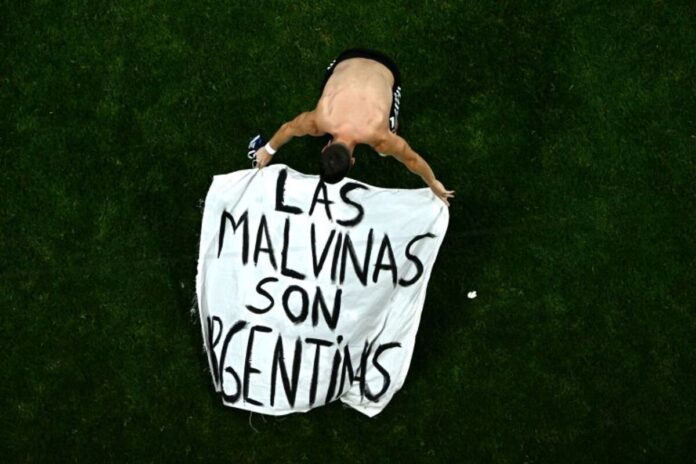
FIFA has opened a disciplinary investigation into Argentina’s national team after several players unfurled a banner declaring the Falkland Islands as Argentine territory during celebrations following their dramatic 2-1 World Cup semifinal win over England on Wednesday night.
Defender Lisandro Martinez and substitute Giovani Lo Celso held up the banner, which read “Las Malvinas son Argentinas” — “The Falklands are Argentinian” — as they celebrated Argentina’s stunning comeback victory at Atlanta Stadium. The gesture, aimed at fans in the stands, quickly reignited a decades-old territorial dispute and drew swift condemnation from British officials, who called on FIFA to take action.
FIFA confirmed on Thursday that its independent Disciplinary Committee is reviewing the incident as part of what a spokesperson described as “standard procedure.” According to a FIFA statement, the committee is “currently assessing the match reports and considering the relevant circumstances before deciding on potential further steps based on the FIFA Disciplinary Code.” FIFA’s rules explicitly prohibit displays at stadiums that carry “a political, ideological, religious or offensive” message, and FIFA has the authority to sanction both individual players and national federations found in breach.
British Business Secretary Peter Kyle led the criticism, branding the celebration an “egregious violation” of FIFA’s own regulations and insisting the matter now rests squarely with football’s governing body. “Politics needs to be separate from football,” Kyle told reporters . “That is now a matter for FIFA. We expect FIFA to undertake an investigation into this.” A spokesperson for outgoing Prime Minister Keir Starmer added that while “the World Cup might not be ours, the Falkland Islands definitely are,” and confirmed Starmer’s support for a FIFA probe.
The Falklands, known in Argentina as Las Malvinas, have been a source of tension between the two nations since Argentina invaded the British-administered South Atlantic archipelago in 1982. Britain retook the islands after a brief but bloody war that killed 649 Argentine and 255 British service members. The islands remain under British control, though Argentina has never dropped its claim of sovereignty.
Argentine President Javier Milei defended the players, calling their celebration “perfectly valid” and saying it reflected sentiment “shared by all Argentinians.” Still, Milei acknowledged that FIFA would likely respond with a financial penalty. “What the players do is understandable; they get carried away by their emotions,” he told a Buenos Aires radio station, adding he expected discussions of a fine. Martinez, who has spent four years playing club football in England with Manchester United, said simply: “We couldn’t let the Argentine people down.”
This is not the first time FIFA has confronted Argentina over the same banner. Ahead of the 2014 World Cup, players displayed identical signage during a warm-up match in Buenos Aires, prompting a FIFA investigation that resulted in a fine of 30,000 Swiss francs, or roughly $37,000, against the Argentine federation. FIFA has taken similar action against other nations, fining Serbia in 2022 over a political banner referencing Kosovo, and banning a South Korean player in 2012 over a banner asserting a territorial claim against Japan. FIFA’s fines for political messaging typically range from about $5,000 to $20,000, though penalties can vary depending on the severity and history of the offense.
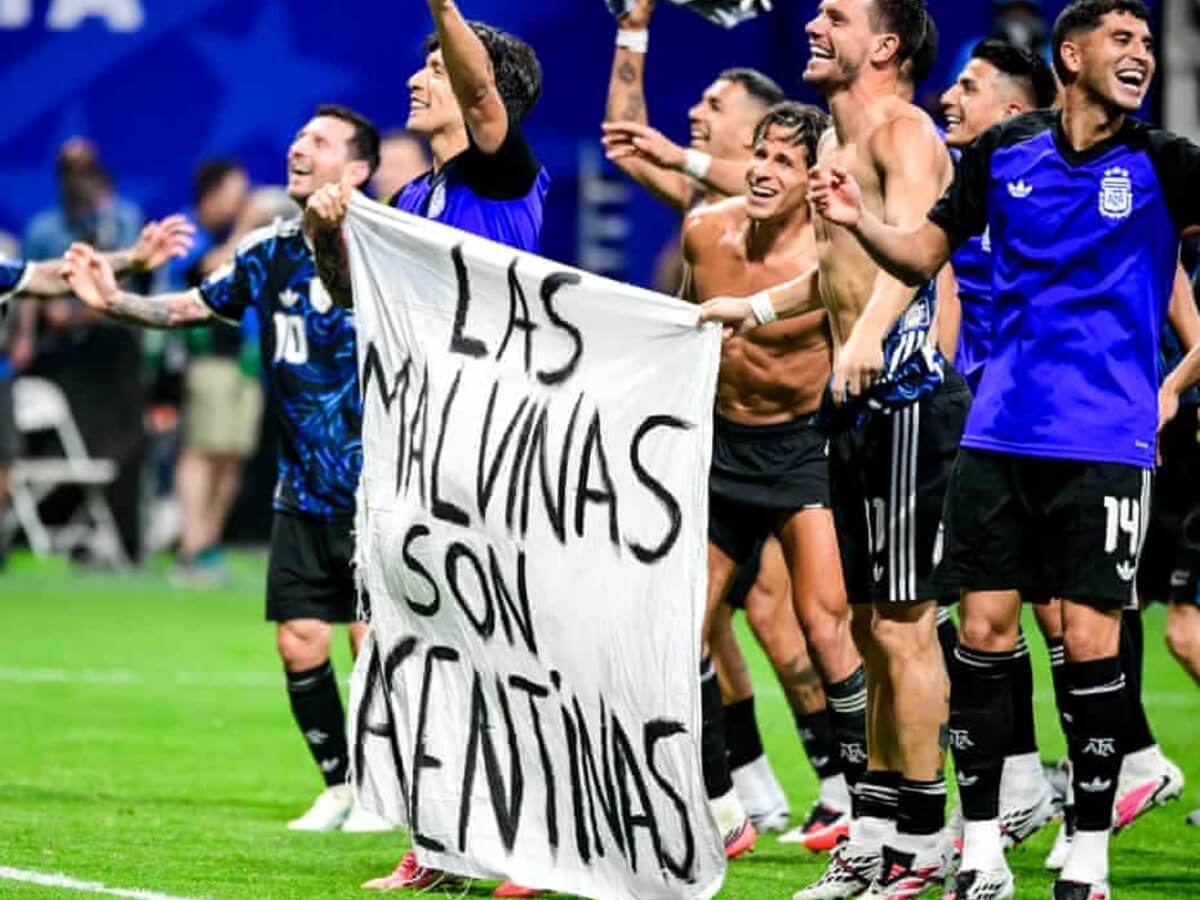

Argentina, chasing a second consecutive World Cup title, will face Spain in Sunday’s final at New York New Jersey Stadium. Any FIFA sanction is unlikely to be resolved before then, based on the timeline of previous cases, meaning the controversy may continue to shadow Argentina’s celebrations even as the team prepares for football’s biggest match.