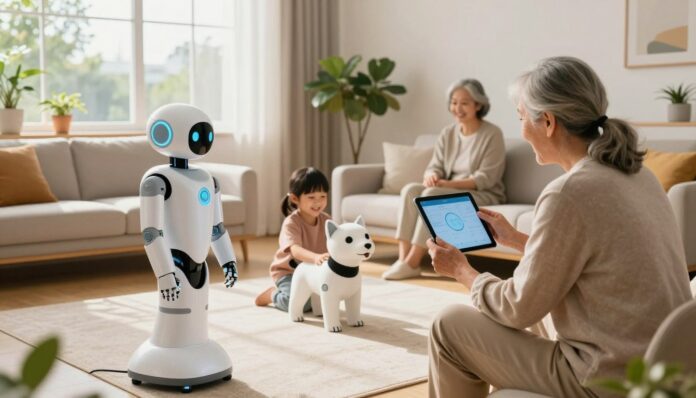
Social robots are rapidly becoming a fixture in American households, promising to help with everything from home security and education to elder care and daily assistance. Powered by advances in artificial intelligence, these machines are designed to interact with people in increasingly natural ways, offering companionship, monitoring homes, and supporting independent living.
Yet as social robots become more capable, they are also raising difficult questions about privacy, data security, and surveillance. Unlike traditional household appliances, many of these devices rely on cameras, microphones, sensors, and cloud-based processing to function effectively. In doing so, they collect large amounts of information about the people and environments around them.
For many consumers, the convenience is undeniable. A robot can patrol a home while its owners are away, remind an elderly resident to take medication, or help a child learn new skills through interactive lessons. But these benefits come with trade-offs. Every interaction, movement, and voice command can generate data, creating new vulnerabilities in spaces traditionally considered private.
As social robots move from novelty devices to everyday household companions, the debate over how to balance innovation with privacy is becoming increasingly urgent.
The Rise of Social Robots in the Home
Once confined to science fiction and research laboratories, social robots are now entering the mainstream consumer market. Advances in artificial intelligence, machine learning, and sensor technology have enabled robots to perform tasks that go far beyond simple automation.
Unlike robotic vacuum cleaners or voice assistants, social robots are designed to engage directly with people. They can recognize faces, respond to spoken commands, interpret emotions, and navigate physical environments. Their ability to communicate and adapt makes them more than tools; they are becoming active participants in household life.
Consumer demand continues to grow as families seek technology that can improve convenience, safety, and quality of life. Industry analysts expect the market for domestic robotics to expand significantly over the coming decade as costs fall and capabilities improve.
Several technology companies are competing to define the future of home robotics.
Amazon Astro and Home Monitoring
Amazon’s Astro robot represents one of the most ambitious attempts to bring mobile robotics into everyday homes. Designed as a roaming assistant, Astro can move throughout a house, monitor rooms, and provide remote access to homeowners while they are away.
Supporters see Astro as a new layer of home security. Critics, however, question whether constant monitoring inside private living spaces creates risks that consumers may not fully understand.
ElliQ and Independent Living
ElliQ focuses on supporting older adults who wish to remain independent. The robot offers medication reminders, social engagement, wellness prompts, and assistance with communication.
As populations age, technologies like ElliQ are increasingly viewed as potential tools for addressing loneliness and helping seniors remain in their homes longer. At the same time, they raise questions about how much personal information should be collected in the name of care and safety.
Miko and Educational Robotics
Educational robots such as Miko target children through interactive learning experiences. These devices use conversational AI, games, and educational content to promote language development and problem-solving skills.
While parents often welcome new learning tools, child-focused robotics introduce additional concerns about data collection, online safety, and the protection of minors’ personal information.
Behind the Convenience
The capabilities that make social robots useful are the same capabilities that create privacy concerns.
To navigate a home, many robots build detailed maps of interior spaces. They may record room layouts, furniture placement, and movement patterns. This spatial information helps robots operate effectively, but it can also reveal sensitive details about household routines and living arrangements.
Microphones and cameras present another challenge. Many social robots rely on continuous listening and visual recognition to respond to users. As a result, conversations, behaviors, and daily activities may be recorded, processed, or stored.
In most cases, this information is transmitted to cloud servers where artificial intelligence systems analyze and process the data. Once information leaves the home, consumers often have limited visibility into how it is stored, shared, or protected.
Privacy advocates warn that the accumulation of such data creates an attractive target for cybercriminals and increases the potential consequences of future data breaches.
Cybersecurity and Beyond
As social robots become connected devices, they inherit many of the cybersecurity risks associated with the broader smart-home ecosystem.
Hackers who gain access to a poorly secured robot may be able to view camera feeds, intercept communications, or collect sensitive information about household members. In extreme cases, compromised devices could provide a pathway into other connected systems within the home.
Manufacturers therefore face growing pressure to strengthen security protections. Industry experts increasingly advocate for end-to-end encryption, regular software updates, multi-factor authentication, and transparent security policies.
Trust will ultimately depend on whether companies can demonstrate that privacy and cybersecurity are being treated as core design priorities rather than afterthoughts.
Beyond technical security concerns, social robots raise broader ethical questions about surveillance, consent, and human behavior.
Not everyone who enters a home has agreed to be monitored. Guests, caregivers, and family members may be unaware that a robot is collecting information through cameras and microphones. Ensuring meaningful consent remains one of the most challenging issues facing the industry.
Researchers also warn about the psychological effects of constant monitoring. Homes have traditionally been places of privacy and personal freedom. The presence of always-on devices could alter how people behave, communicate, and interact with one another.
Algorithmic bias presents another concern. If robotic systems are trained on incomplete or unrepresentative datasets, they may struggle to recognize certain accents, languages, facial features, or cultural behaviors, resulting in unequal user experiences.
Balancing Innovation and Privacy
The future of social robotics will likely depend on whether companies can convince consumers that convenience does not have to come at the expense of privacy.
Emerging technologies such as edge computing may help reduce risks by processing more information directly on devices rather than transmitting it to remote servers. Greater transparency, stronger consumer protections, and clearer privacy standards could also help build trust.

Social robots have the potential to transform how people live, learn, and care for one another. But their long-term success will depend on addressing the concerns that accompany their growing presence in the most personal spaces of everyday life.
As artificial intelligence becomes more deeply embedded in domestic environments, the challenge for policymakers, technology companies, and consumers alike will be ensuring that innovation enhances human life without compromising fundamental privacy rights.