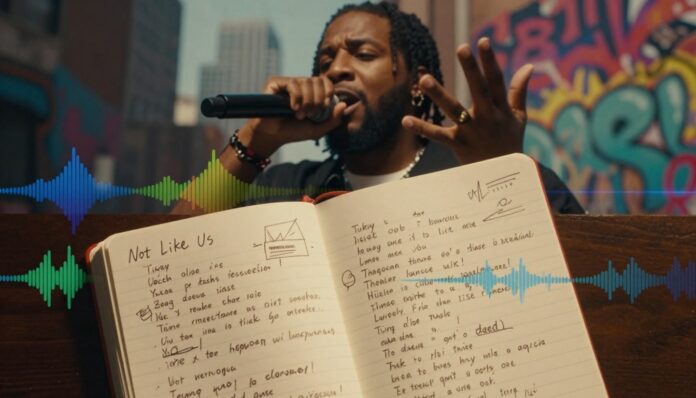
Kendrick Lamar’s “Not Like Us,” the song that decisively ended his year-long feud with Drake, continued its remarkable run on Sunday night when Lamar performed it during the Super Bowl halftime show, the most-watched event in American television.
The performance came despite an ongoing lawsuit Drake has filed against UMG Recordings, the parent company of both rappers’ record labels. Lamar included some of the song’s most controversial lines in his set, at one point teasing the track’s opening beats before launching into it, calling it the crowd’s “favorite song.”
The song’s victory lap began last May, when it topped the Billboard Hot 100 and became Lamar’s first solo number-one single since 2017’s “Humble.” He went on to perform it five times at a surprise Juneteenth concert to a crowd that knew every word, and last week took home five Grammy Awards for the track, including Song of the Year.
The rivalry between Lamar and Drake had simmered for years before erupting into open conflict. Tensions reignited in October 2023 after J. Cole described himself, Drake, and Lamar as rap’s “big three.” Lamar rejected the framing on the Future and Metro Boomin track “Like That,” released last March, declaring there was only a “big me.”
Drake responded in April with “Push Ups,” mocking Lamar’s guest features on songs by Maroon 5 and Taylor Swift. Lamar fired back with “Euphoria,” a track that targeted Drake’s perceived insecurities, including repeated references to his race. The exchanges escalated rapidly, with both rappers turning around new tracks within hours of each other’s releases.
The conflict effectively ended when Lamar released “Not Like Us,” in which he accuses Drake of being attracted to underage girls, an allegation Drake has strongly denied. Drake’s defamation lawsuit against UMG accuses the label of working to create “a viral hit out of a rap track that falsely accuses Drake of being a pedophile and calls for violent retribution against him.” Lamar is not named as a defendant in the suit.
Frederick Paige, an assistant professor at Virginia Tech and co-founder of the university’s hip-hop studies program, described the intensity of the exchange. “You know the Michelle Obama quote, ‘When they go low, we go high’?” he said. “They went in the basement. The degree of dirt and allegations made… it’s tough.”
A Diss Track that Became a Phenomenon
“Not Like Us” spread quickly after its release, amassing nearly 200 million YouTube views and gaining traction on TikTok and traditional radio. It reached number one on the Billboard Hot 100 less than two weeks after its release and has since surpassed one billion streams.
Paige and fellow Virginia Tech professor Craig Arthur, an associate professor of practice and DJ, both pointed to the song’s deceptively upbeat sound as central to its crossover appeal. “It’s a super catchy tune that you wouldn’t expect to be a diss track,” Paige said. “It doesn’t sound that aggressive.” The track’s chorus, built around producer Mustard’s beat, reportedly created in just 30 minutes became an instant earworm, famously prompting a star-studded crowd at the Grammys to sing along when the song played as Lamar accepted one of his awards.
Arthur noted that subject matter as inflammatory as the song’s allegations would typically make an organization like the Recording Academy hesitant to honor it. But the song’s commercial impact proved too significant to ignore. Lamar’s standing in the industry likely played a role as well. He has won 22 Grammys, making him one of the most-decorated rappers in the award show’s history, and became the first rapper to win the Pulitzer Prize for Music in 2018 for his album “DAMN.”
“‘Not Like Us’ came from a highly decorated emcee that even folks far outside of hip-hop look up to,” Arthur said.
Beyond the feud, Paige and Arthur both described “Not Like Us” as a tribute to West Coast hip-hop and a rejection of what Paige called “culture vultures”, artists who borrow from hip-hop culture without genuine ties to it. The song’s music video leaned heavily into Lamar’s Compton roots, with behind-the-scenes footage showing him welcomed home as a local hero.
Both professors said Lamar’s attacks succeeded in part because they targeted Drake’s perceived lack of authentic connection to a specific regional rap scene, unlike Lamar’s deep ties to Compton. Paige suggested the conflict was also strategic. “I think (Lamar) took on Drake for a very particular reason, in terms of that fan base and that outreach to grow (Lamar’s) fan base and show that real artistry, in his opinion, and authenticity win over all the circus tricks,” he said.
The Super Bowl Moment
Both professors described Lamar as a fitting choice for the Super Bowl stage given the broader themes in his catalog, which spans growing up in public housing, institutionalized racism, and police brutality. Paige noted the complexity of performing protest material like “Alright” in such a mainstream setting. “It’s really interesting to think about a song like ‘Alright,’ which is seen as a protest song, and then go to the Super Bowl,” he said. “What is the chess move there?”
There had been uncertainty over whether Lamar would perform “Not Like Us” at all given Drake’s pending litigation against UMG. He ultimately did, rapping one of the song’s most quoted lines, “Tryna strike a chord, but it’s probably A minor,” during the set.
Paige said the moment carried weight beyond the song itself, pointing to broader themes of resilience that run through Lamar’s work. “There are a lot of people right now that are struggling with our political shifts trying to figure out where we’re going to go, how we’re going to take care of ourselves and each other,” he said. “I’m interested in seeing how Kendrick takes on that challenge to motivate and excite people for not only the second half of football, but for many years to come.”