A powerful 7.4 magnitude earthquake struck off northern Japan on Monday, setting off urgent tsunami warnings and sending residents along the Pacific coast scrambling for higher ground as authorities warned that waves could arrive sooner and hit harder than expected.
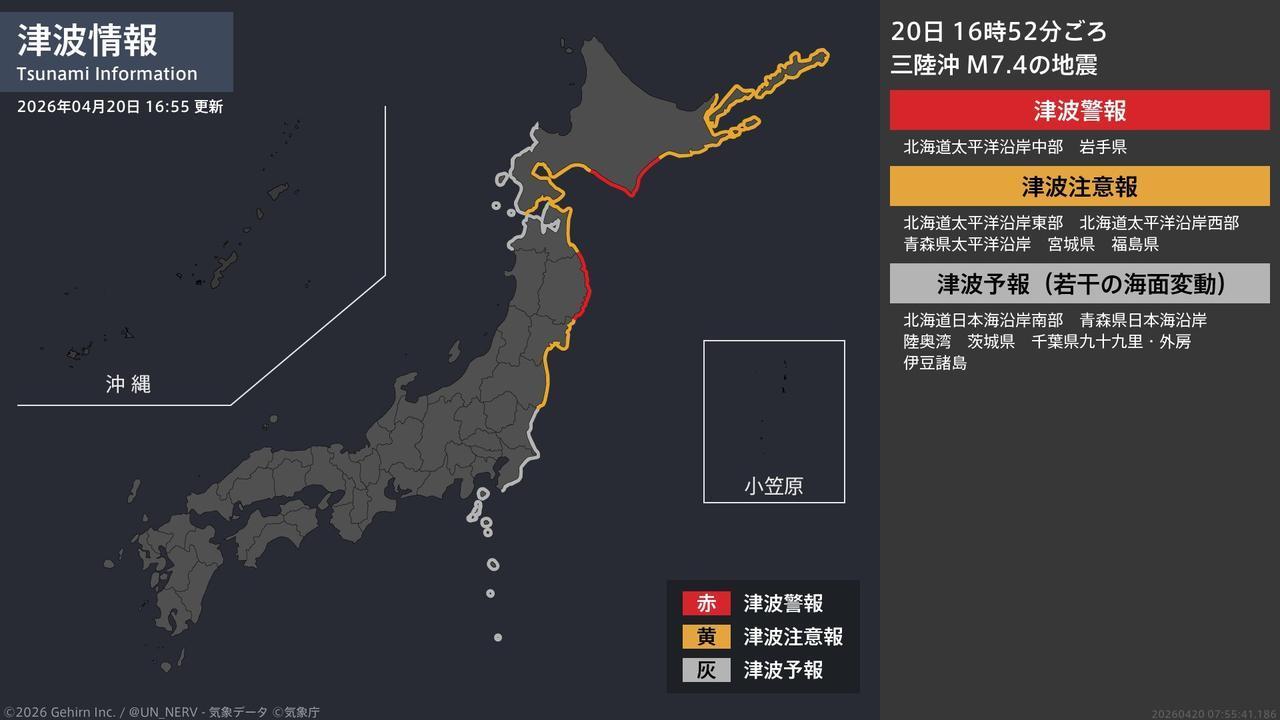
The quake hit off the Pacific coast of northern Iwate Prefecture at 4:53 p.m. local time, according to the Japan Meteorological Agency, which quickly issued a full tsunami warning for several coastal regions. The agency said waves of up to 3 meters could strike parts of Hokkaido, Aomori and Iwate, triggering one of the most serious levels of alert in a country that is no stranger to seismic disasters.
Within minutes of the quake, sirens and emergency alerts echoed across coastal communities. Authorities warned that tsunami waves were already approaching and urged people to evacuate immediately to higher ground or designated shelters. The warning carried a stark message that waves can strike repeatedly and may exceed initial projections, a reminder shaped by painful lessons from past disasters.
Tsunami warnings trigger urgent evacuations
The highest level warning was issued for three coastal zones where waves of up to 3 meters were expected. In Hokkaido’s central Pacific coast, the first waves were forecast to arrive around 11:30 a.m. local time at Urakawa Town, with high tide expected at 12:17. Tokachi Port was projected to see waves at 11:40, while Shono in Erimo Town was also expected to be hit around 11:30.
Along Aomori Prefecture’s Pacific coast, the agency predicted waves would reach Mutsuogawara Port at 11:20 a.m., followed by Hachinohe Port at 11:30 and Sekinehama in Mutsu City at 11:40. In Iwate Prefecture, projections showed waves arriving even earlier, with Miyako and Kamaishi expected to be hit at 11:10 a.m., and Ofunato and Kuji Port around 11:20.
One projection extended unusually far, suggesting that wave activity in at least one location in Iwate could continue as late as midnight on May 1, highlighting the potential for prolonged coastal impact.
In addition to the full warnings, tsunami advisories were issued for a wider swath of the coastline. These included Hokkaido’s eastern and western Pacific coasts, Aomori’s Sea of Japan coast, as well as Miyagi and Fukushima prefectures. In these areas, waves of around 1 meter were expected, still dangerous enough to pose a threat to people near shorelines and river mouths.
The Japan Meteorological Agency emphasized the seriousness of the situation in its public alert. It warned that tsunami waves were already approaching and urged immediate evacuation. It stressed that estimated arrival times were not precise and that waves could come earlier or later than predicted. It also warned that waves might grow larger than expected and that repeated surges could occur over an extended period.
For areas under advisory rather than full warning, officials still urged caution. Residents were told to stay away from the coast and river mouths, where surging water could spill inland. Even relatively small tsunami waves can sweep away vehicles and people, especially when combined with strong currents.
Strong shaking felt far beyond epicenter
The earthquake itself was powerful enough to be felt far from its source. Buildings in Tokyo, located hundreds of kilometers to the south, swayed noticeably, according to reports from Agence France-Presse. While Japan’s infrastructure is designed to withstand frequent earthquakes, the widespread shaking underscored the scale of the event.
Early reports from broadcasters such as NHK and international outlets indicated that train services were temporarily halted in some regions as a precaution, and inspections were launched to check for damage to roads, bridges and critical infrastructure. Airports in northern Japan also began assessing runway conditions, while coastal ports suspended operations amid the tsunami threat.
There were no immediate confirmed reports of major structural damage or casualties in the first hours after the quake, though officials cautioned that information was still being gathered from affected areas. Emergency response teams were placed on standby, and local governments activated disaster response protocols.
Japan’s location along the Pacific Ring of Fire makes it one of the most seismically active countries in the world. Earthquakes of this magnitude are not uncommon, but the combination of strong ground shaking and tsunami risk always raises concerns, particularly in regions that were devastated by previous events.
Memories of past disasters shape response
For many residents, Monday’s warnings revived memories of the catastrophic earthquake and tsunami that struck northeastern Japan in March 2011. That disaster, which measured magnitude 9.0, triggered massive waves that overwhelmed coastal defenses, leading to widespread destruction and the Fukushima nuclear crisis.
In the years since, Japan has invested heavily in early warning systems, evacuation planning and coastal defenses. The rapid issuance of Monday’s tsunami warnings and the detailed projections for wave arrival times reflect those improvements. Officials have repeatedly emphasized that even with advanced technology, the key to saving lives is swift public response.
Television broadcasts showed people moving quickly away from coastal areas, some on foot and others by car, as emergency announcements played continuously. Local authorities opened evacuation centers on higher ground, and schools in affected regions began procedures to move students to safety.
Experts speaking on Japanese media noted that while a 3 meter tsunami is smaller than the waves seen in 2011, it remains highly dangerous. Such waves can flood low lying areas, damage buildings and infrastructure, and create powerful currents that can carry debris inland.
International monitoring agencies, including the Pacific Tsunami Warning Center, also began assessing the quake’s broader impact. Initial indications suggested that the tsunami threat was largely confined to Japan’s northern Pacific coast, though neighboring countries continued to monitor sea level data for any unusual activity.
As the situation developed, authorities stressed that the danger would not pass quickly. Tsunami waves often arrive in multiple surges, with the first wave not necessarily being the largest. In some cases, significant waves can continue for hours or even longer after the initial arrival.
The Japan Meteorological Agency reiterated that people should not return to coastal areas until all warnings and advisories are officially lifted. This caution reflects past incidents where individuals returned too early, only to be caught by subsequent waves.
Seismologists also began analyzing the quake’s characteristics, including its depth and fault movement, to better understand the risk of aftershocks. Japan frequently experiences strong aftershocks following major earthquakes, and these can sometimes trigger additional hazards.
Local governments coordinated closely with national authorities to ensure consistent messaging. Public announcements were broadcast through television, radio and mobile alerts, reinforcing evacuation instructions and providing updates on wave forecasts.
While Japan’s preparedness has improved significantly over the past decade, events like this serve as a reminder of the country’s vulnerability to natural forces. Coastal communities, in particular, remain on the front line, balancing daily life with the ever present possibility of earthquakes and tsunamis.
For now, the focus remains on safety. Residents in affected areas have been urged to remain vigilant, stay in secure locations and follow official guidance until the threat has fully passed. The coming hours will be critical in determining the extent of the tsunami’s impact and whether the worst case scenarios can be avoided.
As the waves approach and monitoring continues, Japan once again finds itself relying on a combination of technology, preparedness and public cooperation to navigate a familiar but always dangerous challenge.