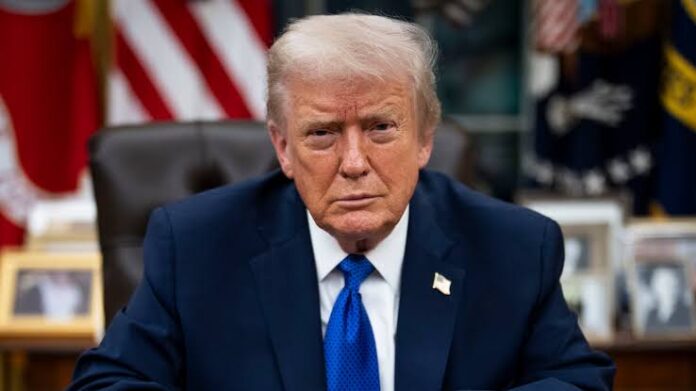
The Trump presidency entered another turbulent phase Monday as President Donald Trump took a series of major actions touching the Justice Department, public health, monetary policy and foreign affairs.
Taken individually, each development would have generated significant attention. Together, they offered a striking picture of an administration determined to expand presidential influence while challenging long established political and institutional norms.
The day began with the formal swearing in of Todd Blanche as attorney general. Blanche, who previously represented Trump during his legal battles, was sworn in by Emil Bove, another former Trump lawyer who now serves as a federal appeals court judge.
The appointment has drawn particular scrutiny because Blanche spent some of the most consequential years of Trump’s political career defending him against criminal charges. His move from Trump’s personal legal team to the country’s top law enforcement position has raised questions about how independently the Justice Department will operate.
Blanche’s arrival at the Justice Department represents one of the clearest examples of Trump’s effort to reshape federal institutions around his administration’s priorities.
He remained closely involved with Trump during the president’s legal troubles and helped develop his defense strategy in several high profile cases. Supporters see his appointment as part of Trump’s effort to restore what they consider accountability to a Justice Department that had become politically biased.
Critics, however, fear the department could become increasingly responsive to the president personally rather than operating independently from the White House.
The concern is particularly significant because the Justice Department has traditionally been expected to maintain a degree of independence from presidential politics, even though the attorney general ultimately serves under the president.
Blanche’s confirmation therefore carries significance beyond the appointment itself. It could help determine how aggressively the administration pursues Trump’s political priorities through federal law enforcement.
The president also signed an executive order focused on childhood vaccination policy, reigniting a debate that has followed his administration for years.
Trump repeated claims linking vaccines to autism, despite the established scientific consensus that routine childhood vaccines are not shown to cause autism. His comments came as the United States continues to deal with outbreaks of vaccine preventable illnesses, including measles.
Health and Human Services Secretary Robert F. Kennedy Jr., who has himself faced scrutiny over his views on vaccines, defended the administration’s approach and described it as an effort based on rigorous scientific standards.
The policy has nevertheless generated concern among public health experts who argue that changes to established vaccination guidance could weaken confidence in childhood immunization.
Vaccines remain widely regarded by medical authorities as an important tool for preventing serious infectious diseases. The debate surrounding Trump’s policy therefore extends beyond politics and into questions about public health and public confidence in medical guidance.
Trump also addressed the Federal Reserve and its newly appointed chairman, Kevin Warsh.
The president has repeatedly expressed support for lower interest rates, arguing that borrowing costs should come down. While presidents can publicly state their preferences on monetary policy, the Federal Reserve is designed to operate independently of direct political control.
Trump’s comments about Warsh therefore renewed concerns about the extent to which the White House may attempt to influence the central bank.
The Federal Reserve’s decisions affect borrowing costs, inflation, employment and financial markets. Any perception that monetary policy is being shaped primarily by presidential demands could have consequences well beyond Washington.
Trump also turned his attention toward Democratic candidates, using inflammatory language to describe progressive and Democratic socialist politicians who have recently won primary contests.
His comments suggested that the coming midterm campaign could feature increasingly aggressive attacks against progressive candidates, particularly those from Muslim and immigrant backgrounds.
The rhetoric reflects a broader political strategy that has frequently relied on portraying Democratic opponents as extreme or dangerous.
With the midterm elections approaching, Republicans face the challenge of maintaining Trump’s core support while responding to concerns among voters who may be uncomfortable with the administration’s increasingly confrontational approach. Foreign policy also featured prominently in Trump’s remarks.
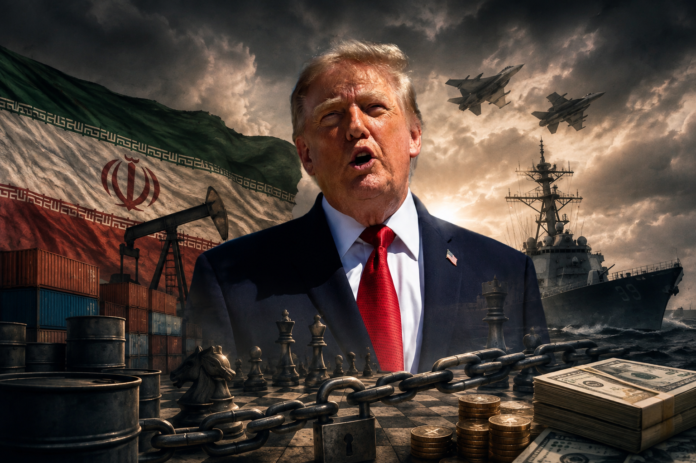
The president spoke confidently about the situation surrounding Iran and the Strait of Hormuz, a strategically important waterway through which a substantial amount of global energy supplies normally passes.
Trump suggested that the strait was effectively open. However, maritime activity remained significantly below normal levels, highlighting the difference between the president’s characterization of the situation and conditions on the ground. The development comes after months of military tension involving Iran and the United States.
Trump has portrayed the conflict as a success, while critics argue that the continuing instability demonstrates how difficult it has been to achieve a lasting resolution. Taken together, Monday’s developments have intensified a larger debate about the nature of Trump’s presidency.
Supporters argue that the president was elected to challenge Washington’s established political system and reduce the influence of what they consider an entrenched bureaucracy. From this perspective, replacing officials, asserting greater presidential authority and challenging traditional institutional boundaries are part of the mandate voters gave Trump.
Critics see something more troubling. They argue that concentrating too much authority around the president risks weakening institutions that are intended to provide checks and balances within the US government.
That debate has become particularly intense around the Justice Department, Federal Reserve and public health agencies, where independence from direct political pressure has traditionally been considered important.
The administration’s aggressive approach has also coincided with political difficulties.
Polling cited in the original report indicated that many Americans remain skeptical about the administration’s handling of major national issues, including the conflict involving Iran.
Public concern over the president’s priorities could become increasingly important as the country moves toward the midterm elections.
For Trump, maintaining the loyalty of his core supporters may not be enough if dissatisfaction spreads among independent voters and other groups that could determine control of Congress.
The administration therefore faces a delicate political calculation: continue pursuing the sweeping changes that energized Trump’s supporters while avoiding policies and rhetoric that could alienate voters outside his traditional base.
The Trump presidency is increasingly defined by its willingness to challenge established norms and concentrate decision making around the White House. Whether that approach ultimately produces the transformation Trump and his supporters seek, or creates deeper institutional and political instability, will depend on how the administration’s actions unfold and how voters respond.
Monday’s events showed just how quickly the boundaries of presidential power can be tested when a president is determined to reshape government according to his own vision.
Related: Trump’s Power Play Signals a Bitter Season Ahead in U.S. Politics
This article was produced by the Maple Epoch Editorial Team. See our editorial standards and AI-use disclosure and editorial policy.