Ted Turner, the brash and visionary media mogul who launched CNN and transformed the television news business forever, has died at age 87. The network he founded reported his death Wednesday, citing a news release from Turner Enterprises.
Turner was a man of enormous contradictions, a billionaire who slept above his Atlanta office in CNN’s early days, a restless entrepreneur who once said his life was “more an adventure than a quest to make money,” and a garrulous personality whose shoot-from-the-lip style earned him the nicknames “Captain Outrageous” and “The Mouth of the South.” He had been slowed in later years by Lewy Body Dementia.
“If only I had a little humility, I’d be perfect,” he once bragged.
The Creation of CNN
Turner’s signature and most lasting achievement was the launch of CNN on June 1, 1980 — the world’s first 24-hour all-news television network. The idea that viewers could access news on their own schedule, rather than tuning in for the nightly broadcast at a fixed hour, was genuinely revolutionary at the time. Turner’s own frustration with the constraints of traditional television news was part of the motivation. He often worked past 8 p.m., long after the ABC, CBS, and NBC nightly newscasts had ended, and was asleep before local stations aired their 11 p.m. broadcasts.
Critics in the early days dismissed the upstart operation as the “chicken noodle network.” Turner was undeterred. “I was going to have to hit hard and move incredibly fast and that’s what we did, move so fast that the networks wouldn’t have the time to respond, because they should have done this, not me,” he said in a 2016 interview. “But they didn’t have the imagination.”
CNN’s breakthrough moment came during the Gulf War in 1991. While most television journalists had evacuated Baghdad ahead of the American attack, CNN stayed, capturing live images of the war’s opening moments, anti-aircraft tracers lighting up the sky, correspondents flinching from the concussions of bombs. It was a defining moment not just for the network but for the history of broadcast journalism.
Turner was promised a continued role at CNN after selling Turner Broadcasting System to Time Warner for $7.3 billion in stock in 1996, but was gradually pushed out, a loss he never fully accepted. “I made a mistake,” he said later. “The mistake I made was losing control of the company.”
Building a Media Empire
Robert Edward Turner III was born on November 19, 1938, in Cincinnati. His family moved to Savannah, Georgia, when he was nine. After being expelled from Brown University for sneaking a woman into his room, he returned to Atlanta to work at his domineering father’s billboard company, Turner Advertising. When his father died by suicide in 1963, Turner took over the business at 24 years old.
In 1970 he bought an independent UHF station with a weak signal that barely covered Atlanta. On December 17, 1976, he began transmitting the station to cable systems around the country via satellite, creating the TBS SuperStation. “It was the start of something bigger than we ever imagined,” he said in 1996.
TBS built its early audience on old movies, reruns of “The Andy Griffith Show,” and Turner’s acquisition of the Atlanta Braves baseball team. In the 1980s he went deeply into debt to purchase MGM, a move greeted with widespread skepticism but the deal gave his company a vast library of classic films that eventually became the foundation for the TNT and Turner Classic Movies networks. The acquisition of the Hanna-Barbera animation library led to the launch of the Cartoon Network.
“He sees the obvious before most people do,” said Bob Wright, former president and CEO of NBC. “We all look at the same picture, but Ted sees what you don’t see. And after he sees it, it becomes obvious to everybody.”
By the time the 1996 Time Warner deal closed, Turner had transformed his father’s billboard company into a global media conglomerate encompassing seven major cable networks, three professional sports teams, and two movie studios.
Sports, Land, and Philanthropy
Turner built a sports empire in Atlanta, at various points owning the Braves, the NBA’s Hawks, and the NHL’s Thrashers. He is best remembered at the helm of the Braves, who he transformed from perennial doormats into postseason regulars through the 1990s. He managed the team himself for one game early in his ownership, and helped ignite baseball’s free-agent market by signing pitcher Andy Messersmith.
But perhaps his deepest passion was for land. Turner accumulated more than two million acres across the American West, becoming Nebraska’s largest private landholder. He maintained the nation’s largest bison herd, spoke frequently about reviving the West’s buffalo population, and in 2002 launched a restaurant chain, Ted’s Montana Grill, serving bison burgers. Researchers at Texas A&M University credited his donation of several bulls in 2005 with meaningfully increasing the genetic diversity of the last herd of southern Plains bison.
Turner’s philanthropic ambitions were equally sweeping. On September 18, 1997, he pledged $1 billion — $100 million a year for ten years to United Nations charities, one of the largest single philanthropic commitments in American history at the time. He continued fulfilling the pledge even as his fortune shrank dramatically following the AOL Time Warner merger, during which his net worth fell from nearly $10 billion to roughly $2 billion in just two and a half years. “That means that, on average, my net worth dropped by about $67 million per week,” he wrote in his 2008 autobiography, “Call Me Ted.”
Together with former U.S. Senator Sam Nunn, he founded the Nuclear Threat Initiative, a nonprofit dedicated to reducing the threat of nuclear, biological, and chemical weapons. He also gave in smaller, personal ways including a $500 donation to a volunteer fire department that helped put out a blaze on one of his ranches.
‘Captain Outrageous’
Turner married three times, most famously to actor Jane Fonda, whom he wed in 1991. Fonda quit acting during their decade together but divorced him in 2001, citing his philandering, though the two remained friends. “He was sexy. He was brilliant. He had 2 million acres by the time I left,” she said. “It would have been easy to stay.”
He won the America’s Cup in 1977 skippering his yacht “Courageous” and was captured by television cameras sprawled on the floor at the victory celebration, very much the worse for drink. He described his youthful ambitions with characteristic swagger: “I used to tell people I wanted to become the world’s greatest sailor, businessman and lover all at the same time.”
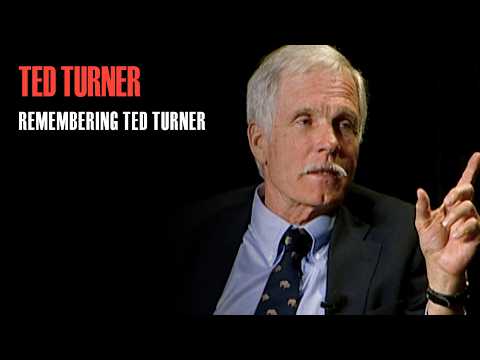
His mouth frequently got him into trouble. He called Christians “losers” and “Jesus-freaks,” later apologizing. He once compared his bitter rival Rupert Murdoch to Adolf Hitler before the two eventually reconciled over shared environmental concerns. He also had an unexpected friendship with Cuban leader Fidel Castro, the two bonding over hunting, rum, cigars, and arguments about politics.
Turner is survived by five children. His net worth stood at approximately $2.5 billion in 2023, though he had dropped off the Forbes 400 list of richest Americans two years earlier.
He was devoted to his star on the Hollywood Walk of Fame, earned in 2004 for his love of classic cinema, though that same devotion led to one of his most controversial decisions: colorizing classic black-and-white films, including “Casablanca,” to appeal to younger audiences, a move that drew fierce criticism from filmmakers and film historians alike.
Asked once to share the secret to his success, Turner kept it simple. “Early to bed, early to rise, work like hell and advertise.”