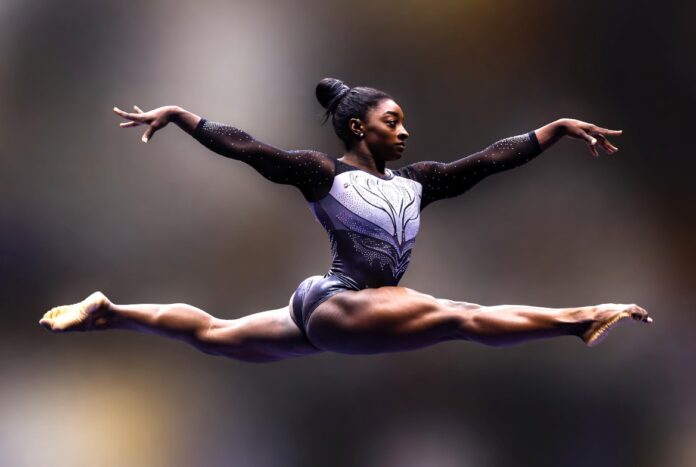
There is a question echoing through every gymnastics press conference, every red carpet interview, every “TODAY” show segment in 2026. The question is always the same, and the most decorated gymnast in the history of the sport keeps giving the same honest, carefully measured, somewhat maddening answer. Will Simone Biles compete at the 2028 Los Angeles Olympics?
“I feel like we’re still at a 50-50,” Biles told CNN Sports at the Laureus World Sports Awards in Madrid in late April 2026. “We’re still on a time crunch here. Now it’s almost half of 2026, so we’re gonna have to make these decisions pretty quickly.”
That answer, candid and unresolved, tells you everything and nothing simultaneously. It is the answer of a 29-year-old woman who has won 11 Olympic medals, redefined the difficulty ceiling of her sport, survived institutional abuse, conquered her own neurological crisis on the world’s biggest stage, and earned the right to take all the time she needs. But it is also the answer of an athlete who still has something left to give, and who knows it. The tension between those two realities is the defining story of Simone Biles in 2026.
Where She Stands Right Now
In early 2026, Biles was in Italy supporting Team USA at the Milan-Cortina Winter Olympics, attending multiple events alongside her husband, Chicago Bears safety Jonathan Owens. She made a guest appearance on the “TODAY” show, broadcast remotely from Milan.
“I’m still on the health and wellness journey,” she told the show. “Laurent asks me all the time, and if I have to say anything, I’m just like, ‘Give me a little bit more time to recover, mentally, physically.’ But he’s always like, ‘Okay, well, you just give me two years.’ So I feel like we’re coming up on that mark. We got a little bit more of things to do, and then we’ll see.”
Laurent Landi, the USA Gymnastics Hall of Fame coach who guided Biles to her triumphant Paris 2024 campaign, remains in regular contact. The conversation between coach and athlete is clearly ongoing. What Biles has made undeniably clear is that physique is not the limiting factor here. “Physically, my coaches will get me in shape,” she told CNN. “Mental health plays a big role in it.”
That statement is not an excuse. It is, at this point, empirical. When Biles’ mental and physical states aligned in Paris 2024, she produced the greatest comeback in gymnastics history. When they diverged in Tokyo 2021, the consequences nearly cost her her life in the air.
She is currently taking a break from the sport to allow her body to recover, with plans to begin some Pilates and yoga, as she put it herself: “That’s as far as I got right now.”
Simone Biles Career Medal Summary (Through Paris 2024)
| Competition | Gold | Silver | Bronze | Total |
|---|---|---|---|---|
| Olympic Games | 7 | 3 | 1 | 11 |
| World Championships | 23 | 4 | 3 | 30 |
| Combined Total | 30 | 7 | 4 | 41 |
Sources: USA Gymnastics, FIG, Team USA official records
The Paris 2024 Foundation: Why This Break Makes Sense
To understand 2026, you must first properly account for what Paris 2024 demanded. Biles led the U.S. gymnastics team to gold, won the individual all-around, and took gold on vault and silver on floor exercise, bringing her Olympic medal total to 11 and making her the most decorated American gymnast in Olympic history.
She did this at 27 years old, nine years after her Rio debut, three years after the Tokyo breakdown that forced a reckoning not just for her but for global sports culture. Biles was already deemed the oldest American gymnast to compete at the Olympics in 72 years when she competed at 27 in Paris. And after the Games ended, the toll was real. She admitted she was sick for 10 days after the Paris Olympics because of the demands the competition placed on her body.
The subsequent decision to step away from active training was, by any reasonable assessment, not retreat. It was recovery. The difference matters enormously in elite sport, and Biles has spent three years since Tokyo teaching the world to understand that distinction.

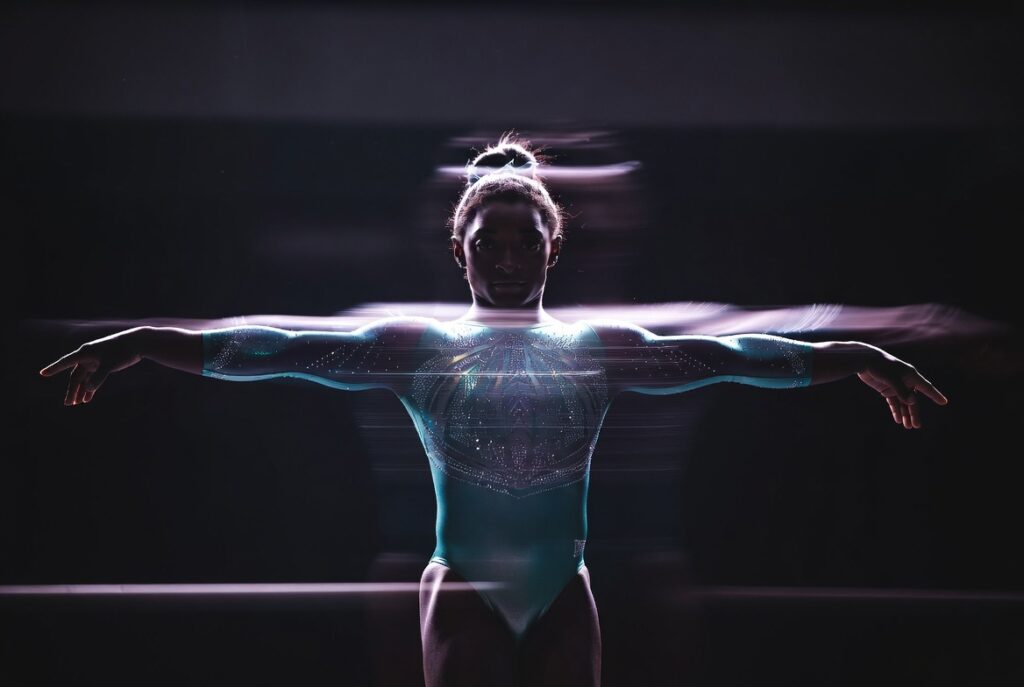
“I feel like it showed the realness to me because everyone thought I was a robot, she’s not real, but it’s like, down to the core, I’m just like you guys. I’m real.” — Simone Biles, CNN interview, April 2026
The 2026 American Cup: Competition Returns
The 2026 American Cup took place on March 6 at the Ford Center in Evansville, Indiana, with Simone Biles headlining the field. The event was broadcast live on Fox Sports 2 and streamed on the Fox Sports App, beginning at 5:30 p.m. ET.
The 2026 American Cup carries added significance because it falls within the competition cycle leading up to the next World Championships and, ultimately, the 2028 Olympic Games in Los Angeles. For gymnasts like Biles, tonight’s performance was more than just a quest for a title; it was an opportunity to gauge current form, refine routines, and build momentum.
The American Cup has been a recurring landmark in Biles’ competitive calendar. She won it in 2015 by a then-record margin. Her appearances at the event function as visible checkpoints against which the gymnastics world measures where she is physically and technically. The 2026 edition was no different — coaches and national federations closely scrutinized performances, identifying areas for improvement and solidifying team strategies ahead of the 2028 Olympic road.
Simone Biles — Olympic Performance by Games
| Olympics | Year | Events | Gold | Silver | Bronze | Age |
|---|---|---|---|---|---|---|
| Rio de Janeiro | 2016 | Team, AA, Vault, Floor, Beam | 4 | 0 | 1 | 19 |
| Tokyo | 2020 | Team, Beam | 0 | 1 | 1 | 24 |
| Paris | 2024 | Team, AA, Vault, Floor | 3 | 1 | 0 | 27 |
| Total | 7 | 2 | 2 | |||
| LA 2028 (potential) | 2028 | TBD | TBD | TBD | TBD | 31 |
Sources: Team USA, FIG, NBC Olympics
The Five Skills That Bear Her Name: A Technical Breakdown
While the 2028 decision remains open, Biles’ technical legacy in gymnastics is permanent and codified. Five elements currently bear her name in the Code of Points after she successfully completed them in international competition: two on vault, two on floor exercise, and one on balance beam.
These are not ceremonial honours. Each skill represents a genuine technical advance in the sport, moves that FIG rated at the highest difficulty levels because no other active gymnast had been capable of performing them cleanly in competition.
Biles I (Floor): The first skill to be named after the gymnast, it involves a double layout with a half-twist in the second flip. Biles first performed the move at the 2013 World Championships at just 16 years old.
Biles II (Floor): She began working on a triple-twisting double flip and unveiled it while winning the 2019 U.S. Championships, then executed it at the World Championships, where she won her fifth record world all-around title. The Biles II on floor is valued at J (1.0) in the 2025-2028 FIG Code of Points, the maximum difficulty rating available in the scoring system.
Biles (Vault I): Her vault skills include the Biles, which she debuted in 2018, requiring a roundoff with a half-twist onto the vaulting table followed by a front double full somersault off the table.
Biles II (Vault): This vault was named after Biles at the 2023 World Championships. It is a Yurchenko-style vault with two flips in a pike position, the Yurchenko double pike. In the 2025-2028 FIG Code of Points, the Biles II vault holds the highest difficulty of 6.4 among all vaults, reflecting its unprecedented combination of entry, height, and piked double salto. Execution scores for the Biles II have reached 9.7 when landed stuck.
Biles (Beam Dismount): A dismount consisting of a double-twisting double-tucked salto backward with 720 degrees of twist, valued at H (0.8) in the 2025-2028 FIG Code of Points. Biles first competed the skill at the 2019 U.S. Championships and had it officially named at the 2019 World Championships in Stuttgart.
The Five Biles Elements — Technical Reference
| Element Name | Apparatus | Debut Year | FIG Difficulty Value | Description |
|---|---|---|---|---|
| Biles I | Floor | 2013 Worlds | H (0.8) | Double layout half-twist (2nd flip) |
| Biles II | Floor | 2019 Worlds | J (1.0) | Triple-twisting double tuck |
| Biles I | Vault | 2018 Worlds | 6.0 | Yurchenko half-on, front double full |
| Biles II | Vault | 2023 Worlds | 6.4 (highest of any vault) | Yurchenko double pike |
| Biles | Beam | 2019 Worlds | H (0.8) | Double-twisting double-tucked dismount |
Sources: FIG Code of Points 2025-2028, NBC Olympics, CBS News
The Sixth Element: Paris 2024’s Unfinished Business
Going into Paris 2024, Biles had an opportunity to claim a historic sixth eponymous element. On July 25, 2024, Biles submitted an original skill on the uneven bars to the FIG Women’s Technical Committee for evaluation. The new skill is a clear hip circle forward with 1.5 turns, a more difficult variation of the Weiler half she has performed for most of her career. The FIG awarded the skill a difficulty value of E on a scale of A to J.
Should Biles have successfully completed the skill, she would have become the only active gymnast with skills named after her on all four events. Biles did not perform the skill during either the team competition or the individual all-around. Uneven bars, typically her weakest event, was the only individual event final she did not qualify for.
The submitted element remains unearned in the Code of Points. If she returns to elite competition, it represents another piece of technical legacy within reach.
World Championship All-Around Titles — Historical Comparison
| Gymnast | Nation | World AA Titles | Years |
|---|---|---|---|
| Simone Biles | USA | 6 | 2013, 2014, 2015, 2018, 2019, 2023 |
| Larisa Latynina | USSR | 4 | 1958, 1960, 1962 |
| Věra Čáslavská | Czech | 4 | 1962, 1965, 1966, 1968 |
| Lilia Podkopayeva | Ukraine | 1 | 1995 |
| Vanessa Ferrari | Italy | 1 | 2006 |
| Gabrielle Douglas | USA | 1 | 2011 |
Sources: FIG World Championships historical records
Mental Health, the Twisties, and Why 2026 Is Different
After Tokyo, Biles detailed how the twisties were a “trauma response” to the abuse she suffered at the hands of former USA Gymnastics and Michigan State University doctor Larry Nassar, sentenced to 40 to 175 years in prison in 2018. “Everything that has happened, I’ve just pushed it down, shoved it down, wait until my career’s done, go fix it. And something like this happens and unfortunately, to me, it happened at the Olympics,” Biles explained in her documentary, Simone Biles Rising.
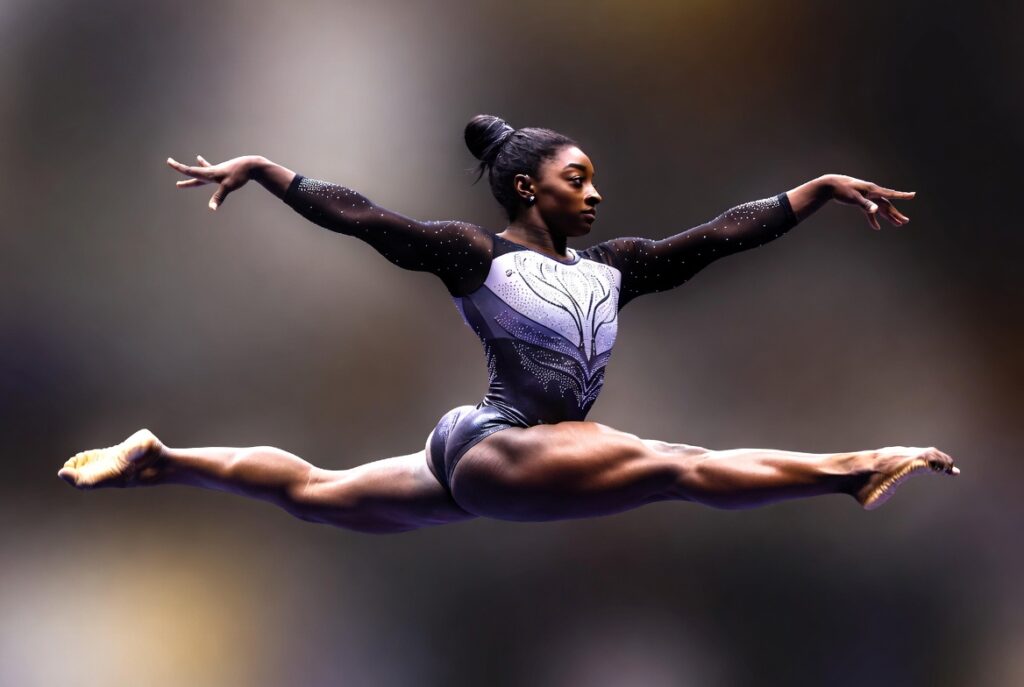
The decision to withdraw in Tokyo was, in retrospect, a life-safety decision made by someone performing at 40,000 feet with faulty instruments. What is different in 2026 is not the physical capabilities, which remain extraordinary, but the infrastructure around those capabilities. She remains in therapy, continues advocating loudly for athlete mental health, and recently met with figure skater Ilia Malinin after his catastrophic collapse at the Milan-Cortina Games to offer support — a mentor now for the generation she inspired.
Biles operates at a level of difficulty that creates a mathematical advantage over her competitors. The Biles II vault exemplifies the sheer power and rotational velocity she generates, allowing her to maintain a scoring cushion that makes her nearly unbeatable even when accounting for minor execution errors.
That mathematical advantage does not expire at 29. It expires when she decides it does.
“I’m at a point in my career where I’m humble enough to know when to be done.” — Simone Biles, Sports Illustrated Sportsperson of the Year interview, 2024
What a LA 2028 Return Would Mean
If Biles competes in Los Angeles, she would be 31 years old, which would make her the oldest U.S. Olympic gymnast in decades. She has said she will be at the 2028 Games in some capacity, but “I just don’t know right now if it’s on the floor or in the stands.”
The logistical window is narrowing rapidly. So far, the lone member of the 2024 U.S. Olympic women’s champion team to return to elite competition is its youngest member, Hezly Rivera, who won the 2025 U.S. all-around title. The landscape Biles would return to is one being actively reshaped by a new generation. The competitive argument for returning to a home Olympics, the first on U.S. soil since 1996, remains one of the most compelling draws imaginable.
Biles herself has acknowledged the pull: “I’ve learned so much about myself in such different Olympic experiences that now having another Olympic year in a cycle, it’s traumatizing in a way to walk into. But I feel like at this point, nothing can break me.”
Simone Biles vs. Career Contemporaries at Age 29+
| Gymnast | Nation | Competed Past 29? | Last Major Title | Final Olympic Age |
|---|---|---|---|---|
| Simone Biles | USA | TBD (currently 29) | World AA 2023, Olympic AA 2024 | 27 (Paris) |
| Oksana Chusovitina | Uzbekistan | Yes (competed to 46) | 2003 World vault silver | 41 (Tokyo 2021) |
| Alicia Sacramone | USA | No (retired 28) | 2011 Worlds team | N/A |
| Shannon Miller | USA | No (retired 22) | 1996 Olympics | 19 |
| Larisa Latynina | USSR | Yes (competed to 28) | 1966 Worlds AA | 27 (1964 Tokyo) |
Sources: FIG, USA Gymnastics, Olympic records
Questions On Everyone’s Mind
Is Simone Biles currently competing in gymnastics in 2026? Biles is currently taking a break from training to allow her body to recover. She has noted she hopes to begin Pilates and yoga soon and is making a 50-50 decision about the 2028 Olympics.
Did Simone Biles compete at the 2026 American Cup? Yes, Biles was headlining the 2026 American Cup held on March 6 at the Ford Center in Evansville, Indiana. The event carried particular significance as an early marker in the road toward the 2028 LA Olympics.
How many skills are named after Simone Biles? Five elements currently bear her name in the Code of Points: two on vault, two on floor exercise, and one on balance beam. A sixth, on uneven bars, was submitted in Paris 2024 but not successfully competed.
What is Simone Biles’ total medal count? As of 2026, Simone Biles holds 41 combined Olympic and World Championship medals, including 11 Olympic medals and 30 World Championship medals, with 23 world championship gold medals, the most for any gymnast in history.
What is Simone Biles’ decision on the 2028 Olympics? She described it as “still at a 50-50” in April 2026, with the acknowledgment that “we’re going to have to make these decisions pretty quickly.” Mental health readiness is the determining factor she has cited most prominently.
Why did Biles take time off after Paris 2024? Following the Paris Olympics, Biles admitted she was sick for 10 days due to the physical toll of competition. She subsequently prioritized rest and mental health recovery before considering any return to training.
The Verdict
There is no current competitive Simone Biles gymnastic programme to evaluate in the way there was in 2023 or 2024. That is the honest account of where things stand in May 2026. What there is, instead, is something equally compelling: a generational athlete navigating the most difficult question in elite sport with more transparency and self-awareness than the system that shaped her ever prepared her for.
Her return in Paris proved that her time away had not diminished her technical superiority. She operates at a level of difficulty that creates a mathematical advantage over her competitors, evidenced by the multiple elements named after her in the gymnastics Code of Points, a distinction reserved for athletes who successfully perform a new skill at a World Championship or Olympic Games.
The sport is different because she existed. The scoring rubric had to be adjusted to accommodate her. Future gymnasts will spend careers trying to match what she did before her 25th birthday. Whether she steps back onto the competitive floor at 31 in front of a home crowd in Los Angeles, that legacy is alredy sewn permanently into the Code of Points, four events, five elements, and 41 medals that nobody in gymnastics history has come close to matching.
The floor is not going anywhere. Neither, it seems, is she.