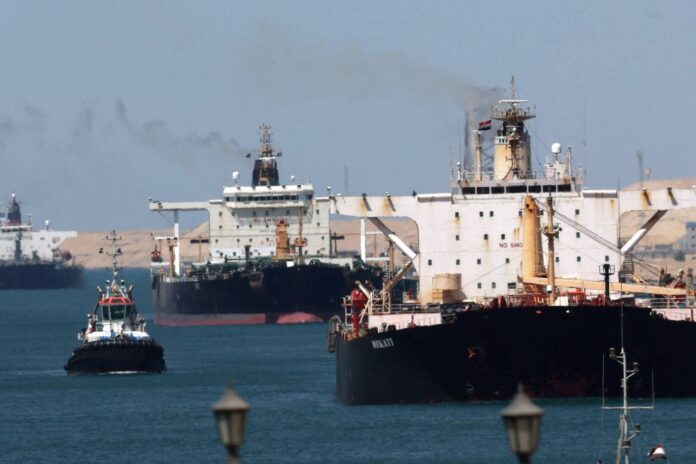
Three supertankers laden with oil have passed through the Strait of Hormuz amid the fragile truce between the United States and Iran, according to shipping data. The development offers a rare moment of movement in a corridor that has, for weeks, been defined more by uncertainty than transit.
Iran’s blockade of the strait, a chokepoint for about 20 percent of global oil and liquefied natural gas shipments, has disrupted global energy supplies and sent oil prices soaring since the start of the US and Israel’s war on Iran at the end of February. Analysts across major financial institutions have described the disruption as one of the most serious threats to energy flows since earlier Gulf crises, with ripple effects already visible in fuel prices from Asia to Europe.
The Liberia flagged Very Large Crude Carrier Serifos, and the China flagged VLCCs Cospearl Lake and He Rong Hai exited the Hormuz Passage trial anchorage, which bypasses Iran’s Larak Island, on Saturday, data from the London Stock Exchange Group showed. The anchorage, a relatively lesser known routing option, has gained sudden prominence as shipping companies look for ways to reduce exposure to Iranian territorial waters while still maintaining flows.
Each vessel is capable of carrying 2 million barrels of oil. In total, their cargo represents a significant injection of supply into a market that has been tightening by the day. Traders say even limited shipments like these can have outsized psychological effects, easing fears of a complete shutdown while not fully resolving underlying risks.
Tankers, diplomacy and quiet negotiations
Serifos, which is chartered by Thai state owned energy firm PTT, according to data from LSEG and analytics firm Kpler, is among seven vessels that Malaysia sought clearance for from Iran to transit the strait, two people familiar with the matter told the Reuters news agency. The need for clearance highlights the extent to which shipping in the region has become entangled with diplomacy, requiring backchannel communication and assurances from multiple governments.
Behind the scenes, regional officials and shipping executives have been engaged in what one industry source described to international media as “constant negotiation mode,” balancing commercial urgency with security concerns. Several reports from global news outlets indicate that Gulf states have also quietly urged restraint on all sides, wary that any prolonged closure could damage their own export revenues and long term customer relationships.
The tanker, carrying crude loaded from Saudi Arabia and the United Arab Emirates in early March, is expected to arrive at Malaysia’s Malacca Port on April 21, according to LSEG and Kpler data. Its journey reflects a supply chain that has already absorbed weeks of disruption, with cargoes delayed, rerouted, or temporarily stranded.
Malaysia’s Ministry of Foreign Affairs, PTT, and Malaysian state energy firm Petronas did not respond to requests for comment sent outside office hours on Sunday. The silence is consistent with a broader pattern among companies and governments involved, many of which have avoided public statements while the situation remains fluid.
Another tanker, Ocean Thunder, loaded with Iraqi crude and chartered by a unit of Petronas, transited the waterway last week. Its earlier passage hinted that limited movement might still be possible under the ceasefire, though industry observers cautioned that each successful transit does not guarantee the next.
Cospearl Lake, laden with Iraqi oil, is expected to arrive at eastern China’s Zhoushan port on May 1, LSEG data showed. China, the world’s largest importer of crude, has been closely watching developments in the Gulf. State media and analysts there have emphasized the need for stability, warning that prolonged disruption could impact not just energy security but broader economic recovery.
It was not clear where He Rong Hai would discharge the Saudi crude on board. Uncertainty over final destinations has become increasingly common, as buyers and traders adjust to shifting risks and insurance constraints.
 Both VLCCs are chartered by Unipec, the trading arm of Chinese energy giant Sinopec, the data showed. Sinopec did not respond to a request for comment outside office hours. Industry insiders note that Chinese firms, with their extensive state backing and diversified supply networks, are among the few actors capable of maintaining operations in such uncertain conditions.
A backlog at sea and a market on edge
Even as these tankers move, hundreds of others remain stuck in the Gulf, waiting to exit during the two week ceasefire period. Satellite tracking and maritime analytics suggest a growing congestion of vessels, many of them fully loaded, idling in what has effectively become a floating bottleneck.
Shipping insurers have raised premiums sharply, citing heightened risks of escalation. Some underwriters have reportedly withdrawn coverage altogether for certain routes, forcing operators to either delay voyages or accept significantly higher costs. These added expenses are already feeding into global oil prices, which have shown sharp volatility since the conflict began.
Three other empty tankers, Mombasa B, Agios Fanourios I, and Shalamar, were sailing in the strait on Sunday to enter the Gulf and load oil, LSEG data showed. Their presence underscores that, despite the risks, the flow of energy cannot simply stop. Demand continues, contracts must be fulfilled, and producers rely on exports for revenue.
Malta flagged VLCC Agios Fanourios I signalled that it is heading to Iraq to load Basrah crude for Vietnam, according to the data. The route highlights the interconnected nature of modern energy markets, where a single shipment can link the Middle East to Southeast Asia through a chain of logistical and financial arrangements.
Eastern Mediterranean Maritime, which manages Agios Fanourios I and Cmb.Tech NV, the manager for Liberia flagged VLCC Mombasa B, did not immediately respond to requests for comment outside office hours. Pakistan National Shipping, which manages the tanker Shalamar, also did not immediately respond.
The situation in the Strait of Hormuz is being closely monitored far beyond the region. Governments in Europe, already dealing with energy vulnerabilities in recent years, have expressed concern about the potential for prolonged disruption. Some have begun reviewing strategic reserves, while others are accelerating efforts to diversify supply sources.
In the United States, analysts have pointed out that while domestic production offers some insulation, global price spikes inevitably affect American consumers. Political pressure is building for measures to stabilize markets, though options remain limited without a broader de escalation.
Meanwhile, energy experts note that even if the ceasefire holds, restoring normal shipping patterns could take weeks. The backlog of vessels, combined with cautious scheduling and ongoing security assessments, means delays are likely to persist.
There is also the question of precedent. Iran’s ability to disrupt traffic through the strait, even temporarily, reinforces its strategic leverage. At the same time, the coordinated efforts by shipping companies and governments to maintain limited flows demonstrate a degree of resilience in the global energy system.
For now, the passage of Serifos, Cospearl Lake, and He Rong Hai offers a glimpse of cautious progress. It is not a resolution, nor even a clear turning point, but rather a reminder that even in moments of high tension, the machinery of global trade continues to move, carefully, slowly, and under constant watch.
Whether this fragile movement evolves into a sustained reopening or collapses under renewed conflict remains uncertain. What is clear is that the Strait of Hormuz, narrow in geography but vast in importance, remains at the center of a story that is still unfolding.
This article was first published on Aljazeera