The Metropolitan Museum of Art’s upcoming Costume Institute exhibition, “Costume Art,” is breaking with a long tradition of standardized mannequin display by introducing 25 new mannequins modeled on real people with disabilities, larger bodies, and other forms long excluded from museum fashion displays.
Among those who took part in the project is artist and couture designer Michaela Stark, who underwent a photogrammetry scan last summer at a Brooklyn studio surrounded by 175 cameras.
Wearing only her signature corsetry, Stark stood at the center of a circular camera rig that captured her body from every angle simultaneously, ultimately producing three mannequins based on her likeness. She described the experience as intimate and a little nerve-wracking, though she found an unexpected ease in it.
“Something about being naked on a 40-degree Celsius day in a corset that isn’t hiding anything kind of takes the awkwardness away from the situation,” she said.
Costume Institute curator Andrew Bolton said the project was designed to challenge the conventions of museum mannequin display, which has traditionally relied on a standardized women’s size 2 figure.
The exhibit, which opens to the public May 10 following its launch at the Met Gala on May 4, examines how the dressed body has been represented in art across centuries. Bolton said the goal of the new mannequins was to acknowledge body types historically excluded from that visual history, including corpulent, disabled, and aging bodies.
Rather than modifying existing mannequin forms, curators chose to build entirely new ones based on real individuals with lived experience.
Nine models were scanned to create the 18 new mannequins based on real people, including Stark, Irish disability activist Sinéad Burke, who was born with dwarfism, athlete and actor Aimee Mullins, who wears prosthetic legs, and musician and model Aariana Rose Philip, who uses a wheelchair.
Seven additional mannequins were created to represent other body types, including the pregnant body and the thin male body, without being modeled on specific individuals.
Unlike many exhibition props that are retired once a show closes, all 25 new mannequins will become part of the museum’s permanent collection when “Costume Art” concludes in January 2027.
Stark, who has designed for Beyoncé and runs her own body-positive lingerie line, Panty, said the permanence of the project carries particular meaning for her. Her three mannequins, dressed in her own designs, will appear in the exhibit’s Reclaimed Body and Corpulent Body sections.
Stark has built much of her design philosophy around reworking corsetry, a technique traditionally used to mold bodies toward conventional beauty standards, into something that instead highlights the parts of the body people are often taught to conceal. “It’s using the corsets to bring back power to the female form,” she said.
She also framed her involvement in the exhibit against what she sees as a troubling shift in the broader fashion industry. “It’s a really interesting moment in time for the Met to be doing this show because obviously we’ve seen the complete rapid decline of the body positivity industry,” she said, noting that designers are increasingly declining to work with plus-size models.
Her observation aligns with a recent Vogue Business Size Inclusivity Report, which found a decline in plus-size representation on the runways of four major Fashion Week cities for the Fall/Winter 2026 season.
Burke echoed that concern, describing the decline as “shameful and embarrassing.” Her organization, Tilting the Lens, works to place disabled people in leadership positions throughout the fashion industry, from creative directors to chief executives.
Burke, who will attend the Met Gala as a member of the host committee, modeled for two mannequins that will appear in the exhibit’s Disabled Body section, one dressed in a Burberry trench coat made specifically for her and the other in a piece by Vivienne Westwood and Malcolm McLaren.
She described the scanning process as deeply vulnerable. “You stood in this cage of cameras,” she said. “It’s deeply uncomfortable and really vulnerable in the sense that you are in your skin and in very little else… your body is photographed, observed, recorded from every angle, angles which you yourself may not even be familiar with.”
Despite the discomfort, she welcomed the opportunity to consult with the museum on how disabled people are represented, including decisions around language, noting that euphemisms are often used to create distance from disability rather than confront it directly.
She has also helped train museum guides and volunteers on how to engage visitors thoughtfully around the exhibit’s themes.

The technical process behind the mannequins involved several stages. Scans captured at a Brooklyn company called New York Capture were used by artist Frank Benson to sculpt a digital model tailored to display each garment. That digital data was then sent to Bonaveri, an Italian manufacturer, to produce the finished mannequins.
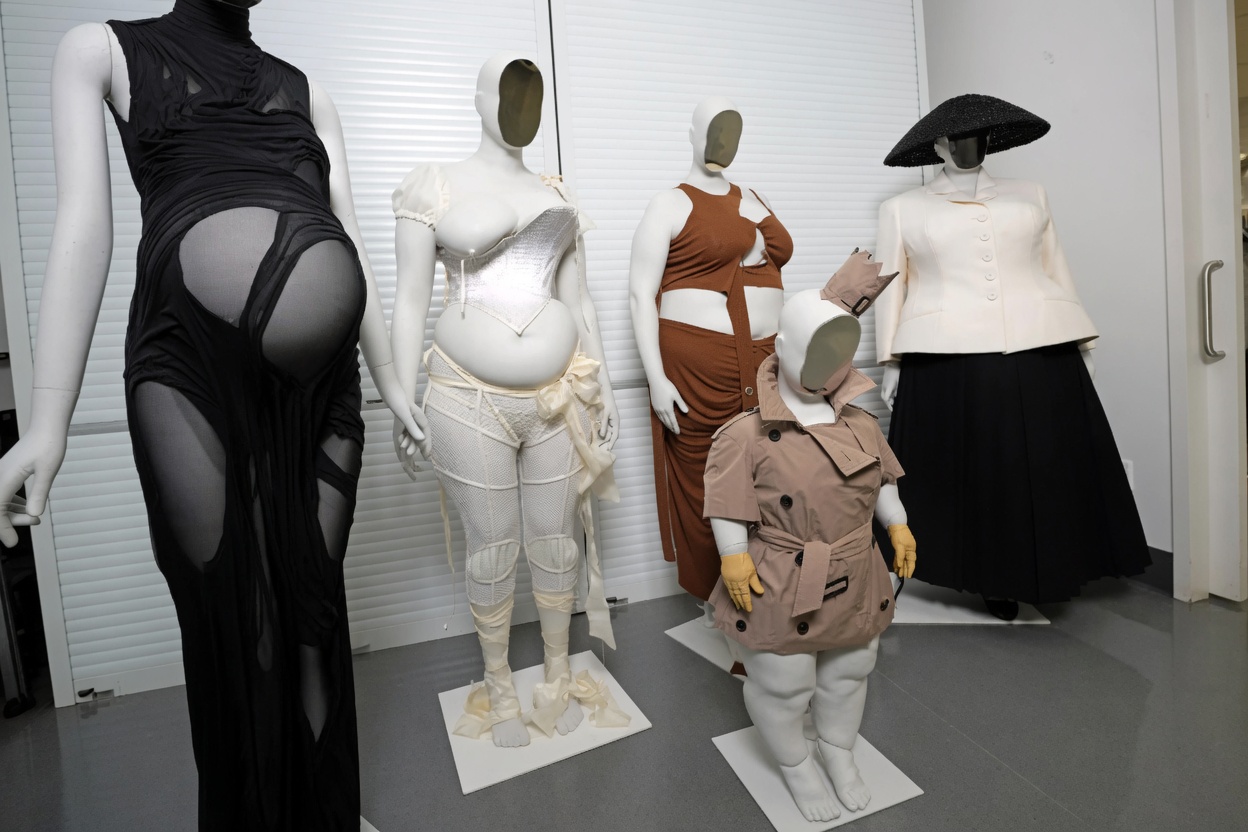

About a third of the mannequins are displayed on pedestals, a placement Bolton said was deliberate in certain cases. He recalled Burke telling him she had spent her entire life being looked down on, both literally and metaphorically, and that the idea of being placed where visitors would look up at her moved her deeply.


Bolton was careful to note that the inclusion of more diverse mannequins is not intended as a rejection of traditional body types or historical representation, many of which remain featured throughout the exhibit. “We’re using it as an opportunity to add new voices and new silhouettes and new presences,” he said. “The figures don’t deny the past, but in a way, I suppose they complete the picture.”