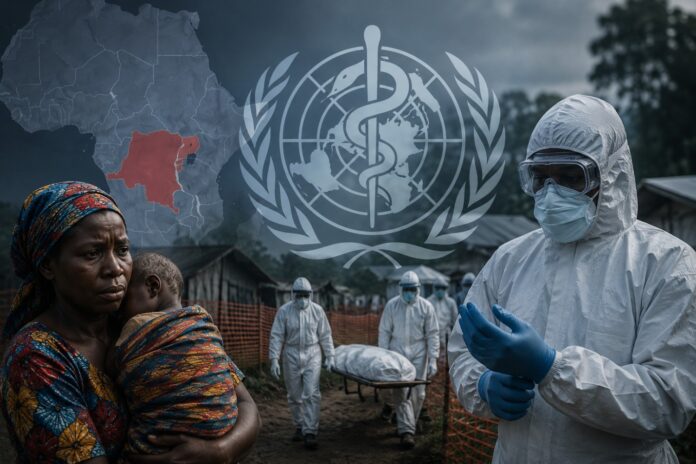
The Ebola outbreak tearing through eastern Congo has spread to a sixth province, health officials said Thursday, as the country’s fastest-growing epidemic of the virus in years continues to outpace efforts to contain it.
A man died of Ebola in Buta, the capital of the previously unaffected Bas-Uele province, after traveling there from Isiro in neighboring Haut-Uele province, according to Jean Kaseya, director general of the Africa Centres for Disease Control and Prevention. The death confirmed that the virus has now reached six of Congo’s 26 provinces, extending an outbreak that began quietly months before it was formally declared.
Health authorities first announced the Ebola outbreak on May 15, but genetic sequencing conducted since then indicates the virus was already circulating as far back as February. That delay has allowed the disease to spread further and faster than initial estimates suggested, complicating the response from the outset.
According to the latest figures from Congolese authorities, the outbreak has infected more than 4,500 people and killed over 2,100 of them. The World Health Organization said this week that the pace of the outbreak puts it on track to surpass the 2014-16 West Africa Ebola epidemic, the deadliest on record, which killed more than 11,000 people over roughly two years. Congo has reached its current death toll in a fraction of that time, nearly three times faster than the West African crisis unfolded.
Unlike the more familiar Zaire strain of Ebola, this outbreak is being driven by the rarer Bundibugyo virus, for which no vaccine or treatment has yet been approved. That gap has left responders with limited tools even as case numbers climb. Clinical trials of two potential treatments began last month in Ituri province, the hardest-hit area of the outbreak, and two vaccines developed specifically to target the Bundibugyo strain are now being tested in humans for the first time. The WHO also said it plans to examine whether an existing Ebola vaccine, developed for the Zaire strain, might offer partial protection, after animal studies produced encouraging results.
Kaseya said Africa CDC supports deploying that existing vaccine, known as Ervebo, in provinces affected by the Bundibugyo virus, citing early evidence of possible cross-protection. “We are in a gray area,” he told reporters Thursday, “and when you are in a gray area, you have to make strong decisions to stop seeing people dying.”
The response has also been hampered by conditions on the ground. Health workers at the Nizi Treatment Center in Ituri province went on strike Thursday and temporarily shut the facility, saying they had not been paid in three months. Kaseya called on Congo’s government to settle the outstanding wages, saying funding for salaries was available and that paying health workers was the state’s responsibility, not that of international partners.
Bas-Uele, the newly affected province, is a remote region in northeastern Congo bordering the Central African Republic, where ongoing armed conflict has pushed thousands of refugees across the border. Poor roads, patchy communication networks, and population movement tied to gold mining and displacement have made it especially difficult for teams to track the virus there.
Officials say between 60% and 70% of new Ebola cases are now being detected outside the network of monitored contacts, a sign that traditional containment methods are struggling to keep up. “We are chasing the virus; the virus is ahead of us,” said Dr. Mohamed Yakub Janabi, the WHO’s regional director for Africa. Kaseya went further, telling reporters Thursday that “the concept of contact tracing in DRC has become useless” given how widely the virus is now moving through communities.


Ebola spreads through contact with bodily fluids, including blood, vomit and semen, as well as contaminated surfaces such as bedding and clothing. It is rare but highly contagious, and the disease it causes is frequently fatal. The outbreak has been further complicated by community mistrust, misinformation claiming Ebola is not real, and threats from armed groups operating in the region. These have slowed the work of health teams trying to isolate cases and vaccinate contacts before the virus can spread even further.