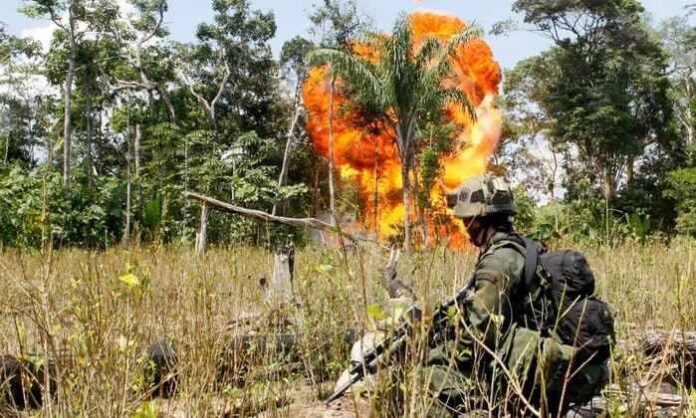
At least 19 people have been killed in a Colombian military air strike on a suspected rebel encampment in the southeastern province of Guaviare, marking a significant escalation in the government’s campaign against dissident armed groups involved in narcotics trafficking and extortion.
According to Colombia’s armed forces, the strike targeted a faction of former Revolutionary Armed Forces of Colombia rebels that rejected the country’s peace process and continued operating as an illegal armed organization.
The operation is especially notable because President Gustavo Petro had previously shown reluctance to authorize aerial bombardments against insurgent camps. But with peace negotiations collapsing and violence rising, his administration has now signaled a tougher military posture.
Military says camp posed imminent threat
Defence Minister Pedro Sánchez said Petro approved the strike after being informed of an imminent threat posed by the group to civilians and security forces.
Officials said the camp belonged to fighters loyal to a dissident commander known as Iván Mordisco, one of the most powerful rebel leaders still active in Colombia.
Sánchez described Mordisco as one of the country’s most dangerous criminals and drug traffickers.
During the same operation, security forces also detained three people and rescued three children who authorities said had been recruited by the armed group.
The strike in Guaviare is likely to be viewed as one of the strongest military actions taken under Petro’s presidency against rebel dissidents.
Who is Iván Mordisco
Iván Mordisco was once a member of the Farc, the guerrilla organization that fought the Colombian state for decades before signing a historic peace accord in 2016.
However, Mordisco rejected the settlement and broke away during negotiations, helping lead factions that refused to demobilize.
His network has since been accused of financing itself through cocaine trafficking, illegal mining, extortion, and territorial control in remote regions of Colombia.
Authorities say his forces remain particularly influential in jungle areas where state presence is weak and trafficking routes are lucrative.
Petro previously referred to Mordisco as “a drug trafficker disguised as a revolutionary,” reflecting the government’s argument that many dissident groups now function more as criminal enterprises than ideological insurgencies.
End of talks and return to force
When Petro became Colombia’s first left wing president, he launched an ambitious “total peace” agenda aimed at negotiating with multiple armed groups simultaneously.
The strategy sought to reduce violence through dialogue, ceasefires, and reintegration agreements. Mordisco’s faction initially entered talks under that framework.
But negotiations collapsed after roughly six months when the dissident group walked out, dealing a major setback to Petro’s peace initiative.
Since then, security tensions have grown. The government has blamed Mordisco’s faction for a deadly explosive attack on a military facility in Cali in August.
The Guaviare air strike suggests Bogotá is increasingly prepared to use force where negotiations fail.
Children caught in Colombia’s conflict
The rescue of three minors has renewed attention to the continued recruitment of children by armed groups in Colombia.
Human rights organizations have warned that child recruitment has risen in recent years, particularly in rural zones affected by poverty, displacement, and weak state institutions.
Reports indicate some children are kidnapped, while others are lured away with false promises of money, protection, or opportunity.
Advocates say the use of children by armed actors remains one of the most disturbing legacies of Colombia’s long internal conflict.
Pressure from Washington
The military operation also comes amid rising diplomatic tensions with the United States over narcotics policy.
Colombia remains the world’s largest producer of cocaine, and Washington has increased pressure on Bogotá to curb trafficking networks.
US Treasury Secretary Scott Bessent recently accused Petro of allowing drug cartels to flourish and failing to stop the expansion of the narcotics trade.
Last month, the United States imposed financial sanctions on the Colombian president, further straining relations.
Petro has strongly rejected the accusations and instead criticized US anti narcotics operations in Caribbean and Pacific waters.
He accused the United States of murder over strikes on vessels allegedly carrying drugs, saying at least 76 people had been killed.
On Tuesday, Petro again condemned those actions and ordered Colombia to suspend intelligence sharing with US security agencies.
In a post on X, he said the fight against drugs must be subordinated to the human rights of Caribbean people.
A turning point for Petro
The Guaviare strike may represent a political turning point for Petro.
Critics had accused him of being too lenient toward armed factions, while supporters argued negotiations needed time to succeed.


Whether the return to harder military tactics weakens dissident groups or deepens Colombia’s cycle of violence remains uncertain.
For now, the deaths of at least 19 people in Guaviare underline the reality that despite peace accords and reform promises, Colombia’s armed conflict is far from over.