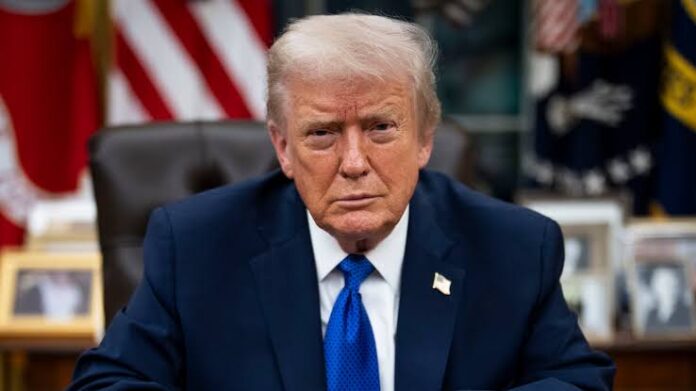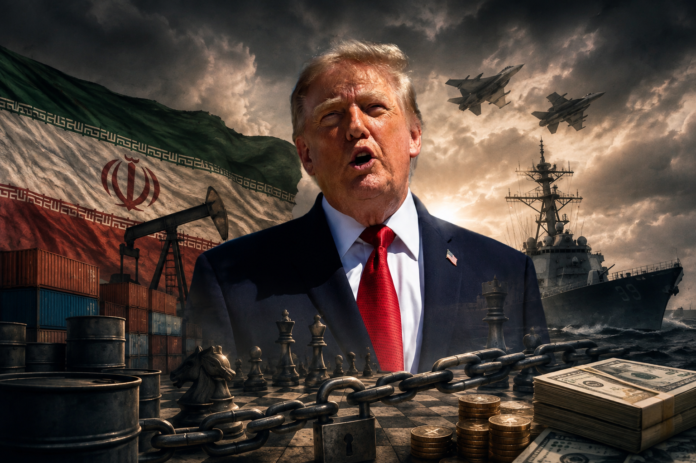
United States President Donald Trump has announced what he calls the “most crushing economic operation ever taken against any country,” marking a major shift in Washington’s strategy against Iran. After months of military operations and failed diplomatic efforts, the United States is now focusing on economic warfare to weaken Iran’s economy, cut off its revenue sources, and pressure Tehran into negotiations or political concessions.
Trump said the campaign would impose unprecedented economic isolation on Iran and warned that any country, business, financial institution, airport, government agency, shipping company, exchange house, or individual helping Iran conduct business could face severe US sanctions. He described the campaign as “economic D-Day” and urged America’s allies to cooperate in isolating Tehran from the global financial system.
The announcement comes as the Iran conflict enters its sixth month with no clear end in sight. Washington believes economic pressure may succeed where military action and diplomatic incentives have failed. Trump reportedly halted negotiations with Iran after talks produced little progress and is now preparing for what analysts describe as a prolonged economic battle rather than a conventional military campaign.
The United States has already imposed extensive sanctions targeting Iran’s oil exports, shipping companies, tankers, oil brokers, financial institutions, and companies accused of helping Tehran evade restrictions. Washington has also increased naval pressure around Iranian ports to limit the country’s ability to export oil, which remains its largest source of foreign income. The new strategy expands that campaign by threatening penalties against foreign countries and companies that continue supporting Iran economically.
Trump specifically identified networks involved in oil smuggling, financial transactions, cash transfers, swap arrangements, ship registries, exchange houses, front companies, airports, and government entities as targets. The goal is to close loopholes that Iran has used for years to continue trading despite international sanctions.
Iran rejected Trump’s announcement almost immediately. Foreign Minister Abbas Araghchi described the new measures as “economic terrorism,” accusing Washington of trying to distract attention from America’s own economic problems, including rising debt and interest costs. Iranian officials argued that the United States has spent decades trying to isolate Iran economically without achieving its objectives.
Iranian state media also dismissed Trump’s announcement as largely nothing new. State broadcaster IRIB claimed the move followed the failure of US military aggression, while Tasnim News Agency argued that America has long attempted to cut Iran off from international financial networks. Fars News Agency said Washington has repeatedly predicted Iran’s economic collapse over the years without succeeding, insisting Tehran has become increasingly skilled at bypassing sanctions and maintaining economic relationships through alternative channels.
At the center of Trump’s strategy is Iran’s oil industry. Oil exports generate billions of dollars that fund government operations and regional influence. By targeting buyers, banks, insurers, shipping companies, and financial intermediaries, Washington hopes to reduce Iran’s ability to earn revenue from global oil sales.
However, analysts believe China could become the biggest challenge to America’s strategy. Although many countries reduced Iranian oil imports after previous sanctions, several independent Chinese refineries continue purchasing discounted Iranian crude. One of the strongest economic tools available to Washington would be sanctions against Chinese banks facilitating payments for Iranian oil transactions.
Targeting Chinese financial institutions could significantly disrupt Iran’s oil revenue, but it also carries major diplomatic and economic risks. Beijing has consistently opposed unilateral US sanctions and warned Chinese companies against complying with American restrictions. Sanctioning Chinese banks could increase tensions between the world’s two largest economies and complicate broader US-China relations.
Other important Iranian trading partners that may face pressure include Iraq, Turkey, the United Arab Emirates, and several Central Asian countries. These countries maintain trade, financial, or transport links that Iran has used to soften the impact of sanctions. Enforcing restrictions on overland trade through neighboring countries is expected to be particularly difficult because of long-established commercial networks.
A major development came when the United Arab Emirates announced it had suspended financial ties with Iran shortly before Trump’s statement. The UAE accused Iran of launching ballistic missiles toward UAE waters, while Tehran denied the allegation and described it as a false flag operation. Analysts believe Washington may have encouraged the UAE’s decision through recent diplomatic contacts between senior US and Emirati officials.
The UAE’s move is significant because it has historically served as an important financial and commercial gateway for Iranian businesses. If financial ties remain suspended and enforcement becomes stricter, Iran could lose access to one of its most valuable regional economic hubs.
Despite these measures, experts warn that Iran has spent years building systems to bypass sanctions. These include alternative banking channels, informal money transfer networks, regional trade routes, front companies, and discounted oil sales to willing buyers. This means announcing new sanctions alone may not be enough unless enforcement becomes much stronger.
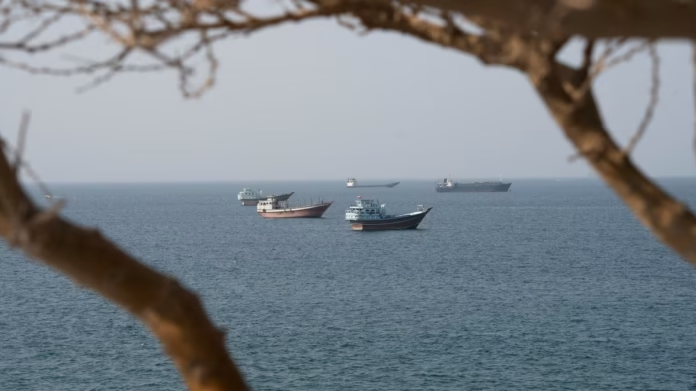
Another critical part of the conflict is the Strait of Hormuz, one of the world’s most important oil shipping routes. Roughly one-fifth of global oil supplies pass through this narrow waterway connecting the Persian Gulf to international markets. Any disruption in the strait could quickly increase global oil prices and shipping costs.
Analysts warn that Iran could respond to economic pressure by escalating tensions around the Strait of Hormuz instead of engaging in direct military confrontation. Disrupting commercial shipping or threatening vessels could raise oil prices, increase transportation costs, and create supply chain disruptions around the world.
Higher oil prices would not only affect global markets but could also increase fuel prices, grocery costs, and inflation in the United States. This creates a political dilemma for Trump. Responding militarily to Iranian actions could escalate the conflict further, while failing to respond could expose him to criticism from political opponents.
The economic war also has important domestic political implications in America. The approaching US midterm elections increase pressure on the administration to show results quickly. Rising energy prices and continued conflict could become major campaign issues if American consumers begin paying more for fuel and everyday goods.
Some analysts believe Iran may deliberately prolong the confrontation, betting that American voters will lose patience before Tehran’s government feels enough economic pain to change course. The article compares this possibility to Iran’s role during the 1979–1981 US hostage crisis, when prolonged tensions damaged President Jimmy Carter politically before the 1980 election.
Experts remain divided over whether Trump’s strategy can succeed. Supporters argue that cutting Iran’s access to oil revenue and global finance could significantly weaken its economy over time. Critics counter that Iran has survived decades of severe sanctions, developed sophisticated sanctions-evasion networks, and continues to maintain relationships with countries willing to trade despite US restrictions.
Former Israeli intelligence official Daniel Citrinowicz argued that stronger economic pressure may impose serious costs on Iran but is unlikely to fundamentally change Tehran’s long-term strategic calculations. Other analysts say sanctions typically require months or years to produce meaningful political results, making time one of the biggest obstacles facing Trump’s strategy.
Washington also faces difficult risk-reward calculations. Targeting Chinese banks could hurt Iran but damage relations with Beijing. Increasing pressure on regional trade routes could affect allies and neighboring economies. A successful blockade would require cooperation from countries across the Gulf, Europe, and Asia, making diplomacy just as important as sanctions.
Analysts suggest the United States could further increase pressure by targeting the financial networks of Iran’s Islamic Revolutionary Guard Corps (IRGC), strengthening relationships with governments in Iraq and Lebanon to reduce Tehran’s regional influence, and enforcing sanctions more aggressively against companies involved in illicit oil trade and sanctions evasion.
However, the success of any economic campaign depends heavily on international cooperation. Some experts argue Washington has made that cooperation more difficult by alienating allies during the conflict and criticizing countries unwilling to support its military strategy. Reports of US pressure on countries such as Oman have also complicated regional diplomacy, particularly as Oman has played an important role in mediation efforts with Iran.
Ultimately, Trump’s new approach represents a shift from battlefield confrontation to financial warfare. Instead of relying primarily on military strikes, the United States is attempting to isolate Iran through sanctions, banking restrictions, shipping controls, and diplomatic pressure on countries that continue doing business with Tehran.
The biggest unanswered question is whether economic warfare can force Iran into negotiations before political and economic costs begin affecting the United States and its allies. Iran’s ability to bypass sanctions, maintain oil exports through alternative channels, and build regional partnerships means the campaign may become a long-term contest of endurance rather than a quick victory.
As the conflict enters a new phase, the battle is increasingly being fought through oil markets, international banking, shipping routes, diplomacy, and global trade. Whether Trump’s “most crushing economic operation” delivers the rapid results Washington wants or simply prolongs an already costly conflict remains uncertain.
Related: Pope Leo Holds Firm Against Trump’s Iran War
This article was produced by the Maple Epoch Editorial Team. See our editorial standards and AI-use disclosure and editorial policy.